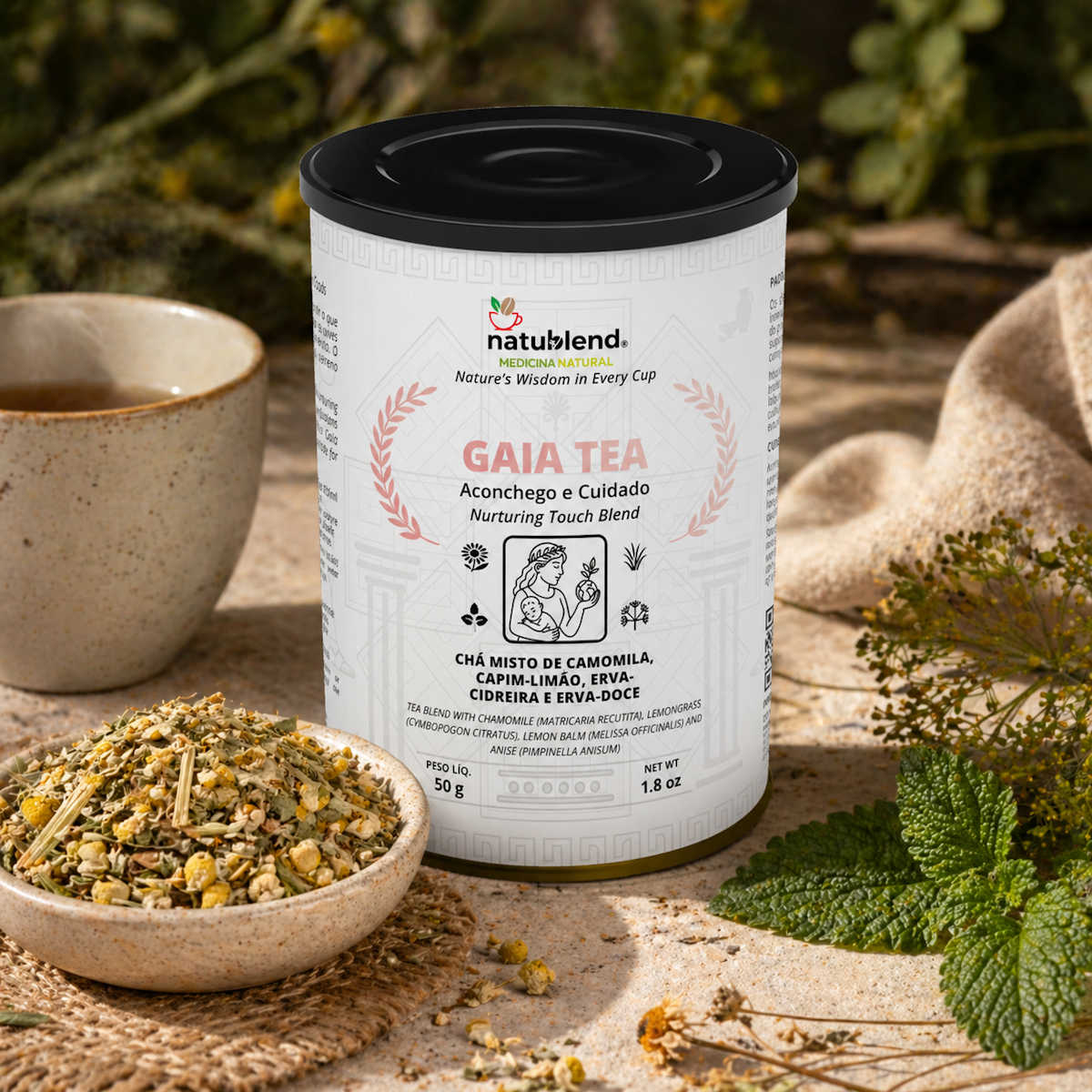
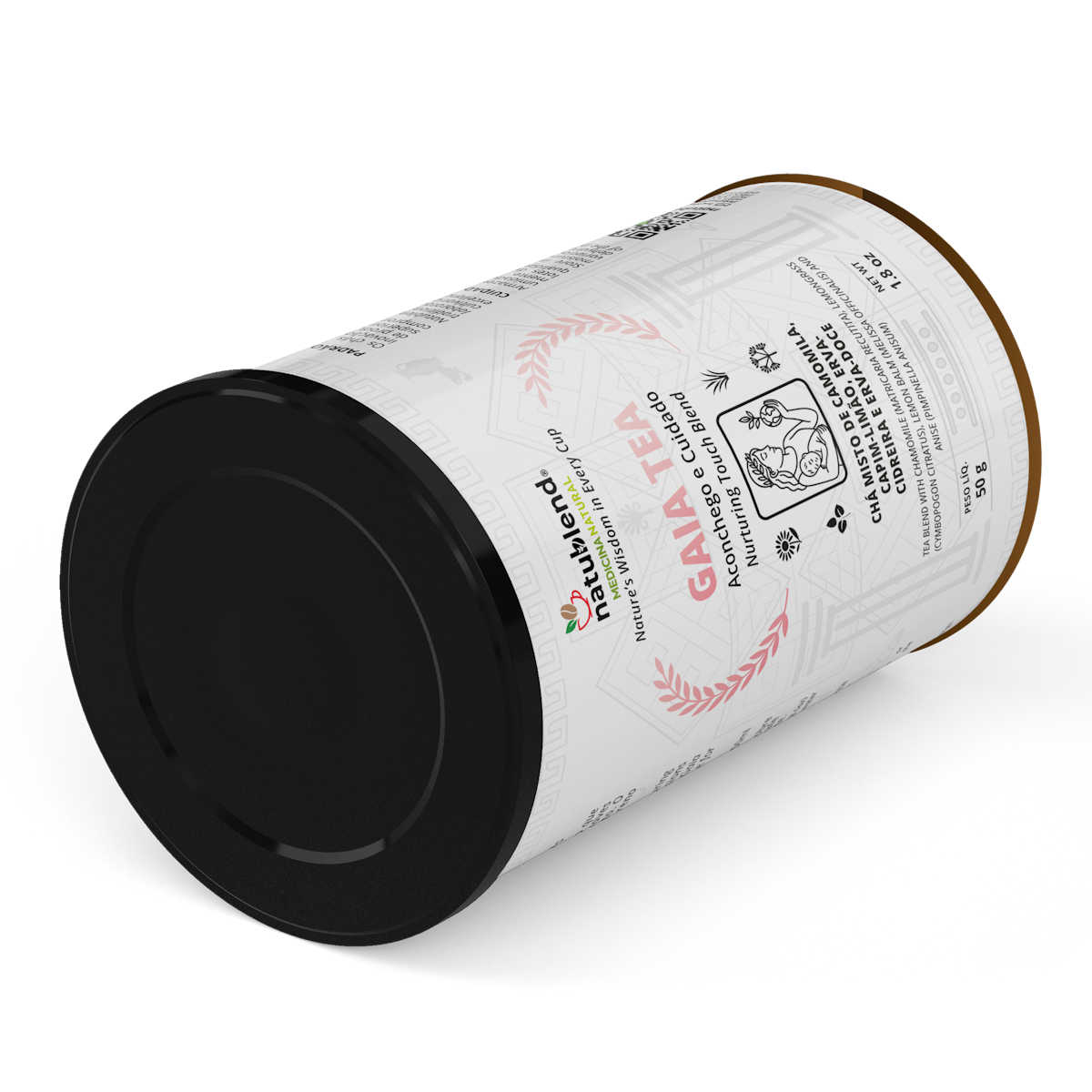
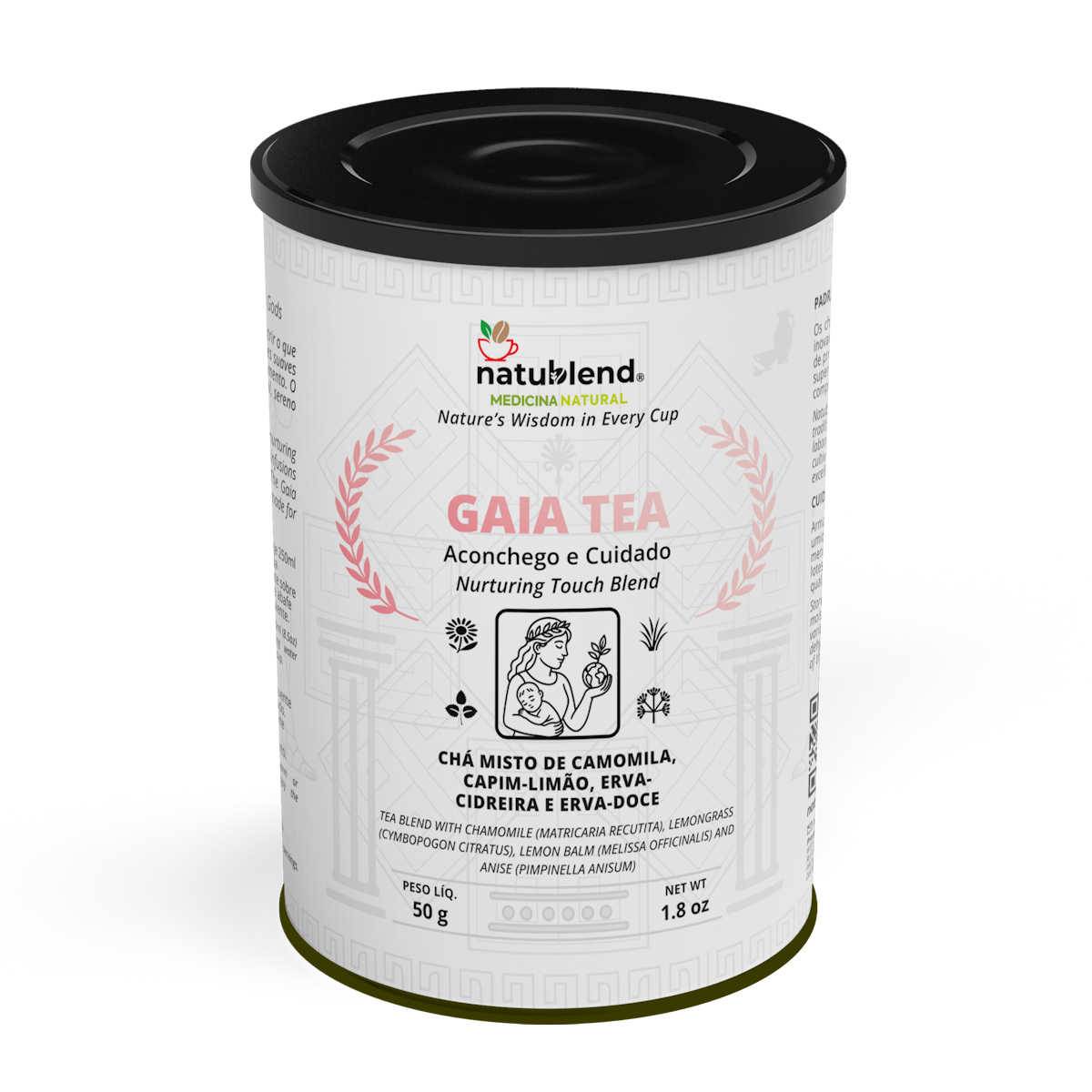
Gaia Tea brings together anise, chamomile, lemon balm, and lemongrass in a 50 g tin from Natublend’s Sabedoria dos Deuses (Wisdom of the Gods) collection. None of the four ingredients is a leaf of Camellia sinensis, the plant behind black, green, and white teas, so the blend is an herbal infusion that is naturally caffeine-free, as the brand itself states; the story of that leaf, which stayed out of the tin, is told in the article on the history of tea, from China to the Ribeira Valley.
The name pays tribute to Gaia, who in Greek mythology was the Earth itself. Natublend suggests the blend for several moments of the day, from the first cup of the morning to afternoon breaks and the pause after meals, and a curious detail runs through the sections below: in Brazil, two of the four plants in the tin share the nickname cidreira.
Why Gaia
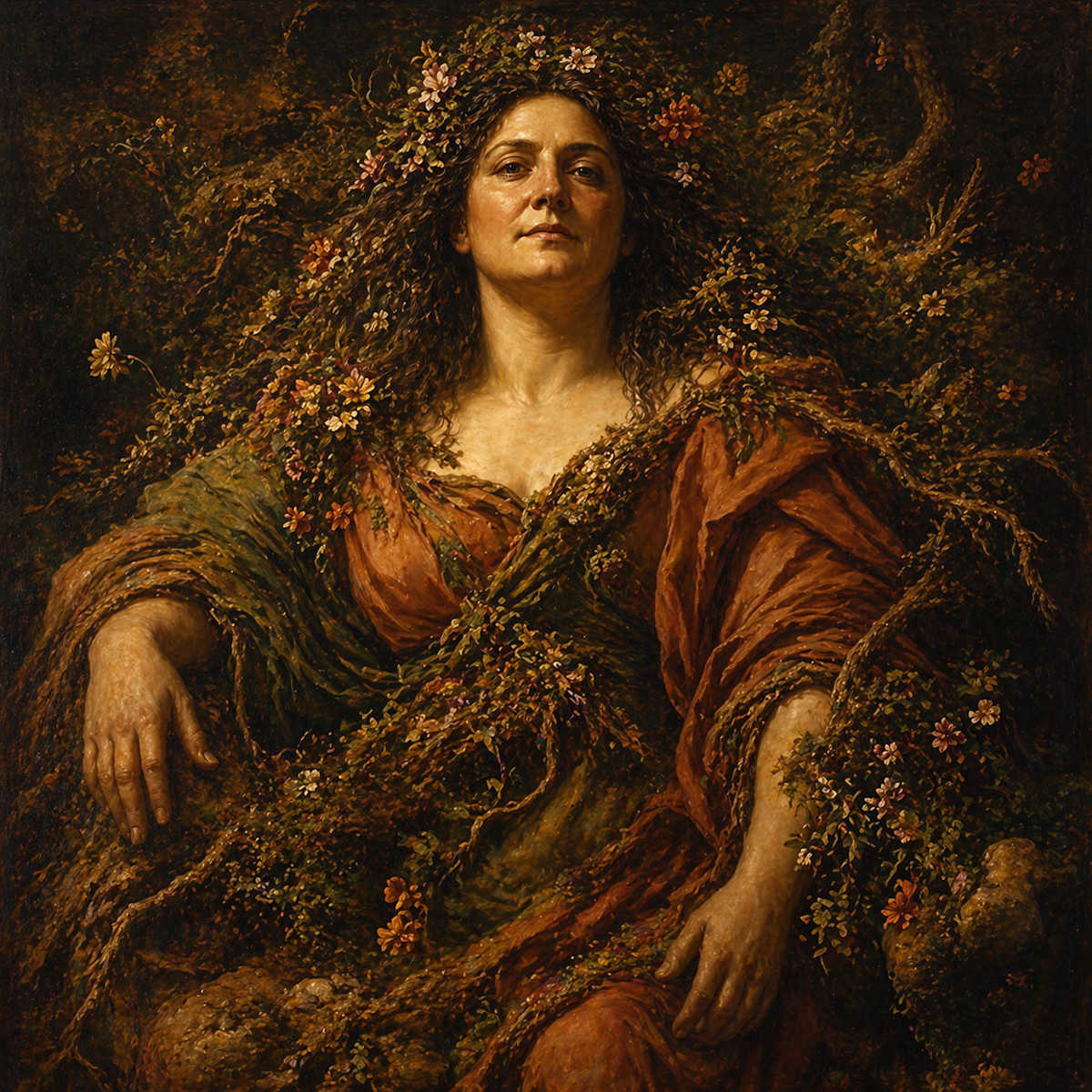
In Greek mythology, Gaia is the Earth personified, one of the protogenoi, the primordial deities who emerged at the very beginning of creation, long before the gods of Olympus (Theoi Project, n.d.). The ancient Greeks pictured the Earth as a flat disk encircled by the river Oceanus, and Gaia was that Earth itself. Entire lineages of the pantheon descend from her: her union with Uranus, the Sky, produced the heavenly gods, her union with Pontus gave rise to the sea deities, and from her union with Tartarus came the Giants (Theoi Project, n.d.). Natublend named the blend in her honor and, on the product page, adds a touch of poetic license not found in the ancient sources, imagining the goddess beginning her mornings with an aromatic infusion. Beyond that image, the reference lies in the name and in the illustration the brand uses for the blend, which shows Gaia covered in flowers, roots, and vines.
The Four Ingredients of Gaia Tea
Each of the four plants has its reference article under another blend in the collection, noted at the end of each entry. Here, what matters is the role each one plays in this cup, along with a naming coincidence: lemongrass and lemon balm, which belong to different botanical families, can both answer to the same Brazilian common name, cidreira.
Chamomile
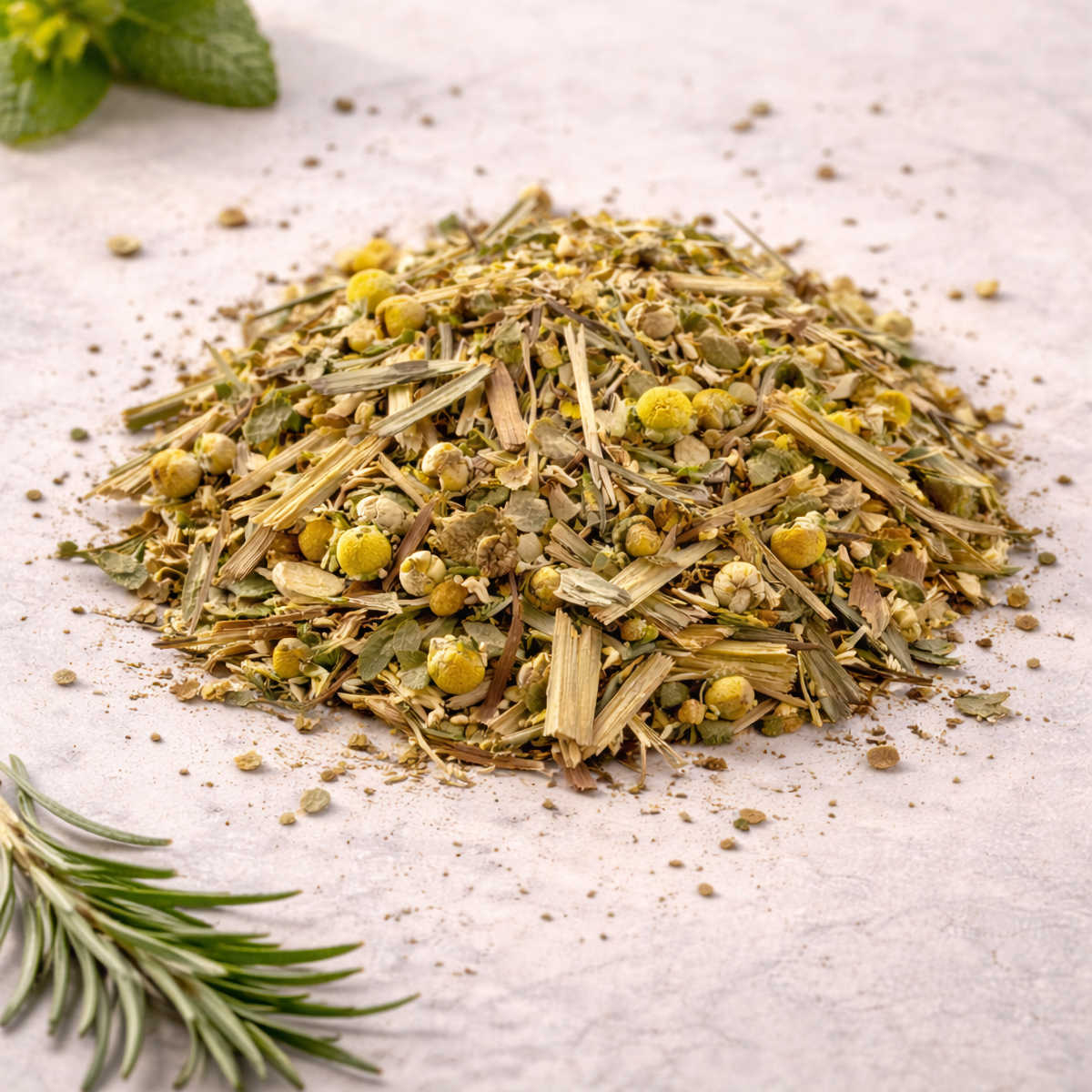
The most frequent ingredient in the collection, present in nine of the 15 tins, chamomile goes by the accepted name Matricaria chamomilla L., according to Plants of the World Online, the botanical catalog of the Royal Botanic Gardens, Kew; Matricaria recutita, still common on labels, is considered a synonym of the same species, in the family Asteraceae (POWO, n.d.). The dried flower heads are what go into the infusion. In Gaia Tea, chamomile forms the floral base on which the citrus of the two cidreira plants rests. The plant’s story is told in the Bacchus Tea article.
Lemongrass
Also known in Brazil as capim-cidreira, lemongrass is Cymbopogon citratus (DC.) Stapf, a grass in the family Poaceae whose leaves go into the blend (POWO, n.d.). The sensory lexicon for blended teas published by Kim and colleagues describes its aroma as a light lemon scent combined with a note of dry hay (Kim et al., 2018), and in Gaia Tea it is this lemon with an herbaceous background that brightens the middle of the sip. The plant has its own article under Zeus Tea.
Lemon Balm
Lemon balm contributes its leaves to the blend, and its name calls for a brief explanation. In Portuguese the ingredient is called erva-cidreira, a Brazilian common name that refers both to Lippia alba, a shrub native to the Americas in the family Verbenaceae, and to Melissa officinalis L., in the family Lamiaceae (POWO, n.d.); the tin’s label settles the matter in its English description, which identifies the ingredient as lemon balm, the latter species. In Gaia Tea, lemon balm shares the citrus side with lemongrass, in a more herbal and less sharp register. Its reference article is the one for Harmonia Tea.
Anise
In Brazil, erva-doce is an ambiguous common name, used both for anise, Pimpinella anisum L., and for fennel, Foeniculum vulgare Mill., both in the family Apiaceae (Revista Cultivar, n.d.). In Gaia Tea, the label resolves the question: its English description identifies the ingredient as anise, Pimpinella anisum, whose dried fruits, commonly called seeds, are the part used (POWO, n.d.); fennel, incidentally, appears in the collection as a separate ingredient. In the cup, anise contributes the aniseed touch that rounds off the sip. The plant’s full story is in the Athena Tea article.
Sensory Profile
Aroma of the dry blend. When the tin is opened, the first thing to rise is the sweet scent of anise, which Natublend itself places at the front of the dry aroma. Lemongrass follows close behind, with its light lemon note over a background of dry hay. Chamomile is more discreet, with the slightly muted floral fragrance that the lexicon by Kim and colleagues associates with dried flowers (Kim et al., 2018), while lemon balm stays in the background in a green, herbaceous tone.
Aroma of the infusion. In the cup, the order is reversed: the citrus of the two cidreira plants moves to the front, as the brand’s description indicates, while chamomile holds the middle as a floral base and the anise, dominant in the tin, recedes into a sweet background.
Liquor color. Natublend describes the infusion as golden, pale, and translucent, with very faint greenish glints that it attributes to lemongrass. Among the terms Su and colleagues use to describe the liquor of Taiwanese specialty teas, ranging from the pale greenish yellow of green tea to the red of black tea, the golden tone, which the authors associate with Dongding oolong, falls in the lighter half of that range (Su et al., 2021). When well strained, the infusion shows what a tasting glossary calls a bright liquor, clear and lively, the opposite of a cloudy, dull liquid, which the same glossary treats as an undesirable quality (SV Tea, n.d.).
Flavor. In the brand’s description, chamomile opens the sip with a soft floral base, and lemon balm comes in right behind it with a gentler citrus. On the mid-palate, lemongrass brightens the citrus side and keeps the whole from becoming too sweet. The finish belongs to the anise, with a sweet, discreet aniseed aftertaste, and this is where the trait the brand highlights is confirmed: the infusion has a gentle sweetness with no added sugar.
Body. Light and smooth, without the astringency that black or green tea leaves usually bring. The natural sweetness of chamomile and anise lends the cup a rounded feel that its pale color gives no hint of.
How to Brew Gaia Tea
Natublend’s recipe comes in two versions, one hot and one cold, and both start from the same ratio: 2 g of the blend for every 200 ml of water.
- Heat the water to between 90 and 95 °C (194 and 203 °F), without letting it reach a full boil.
- Place 2 g of the blend in the cup or teapot for every 200 ml of water.
- Pour in the water, cover, and let it steep for 5 to 7 minutes.
- Strain without pressing the herbs.
- If you like, reuse the same portion for one or two more infusions.
For the cold version, the brand recommends 2 g in 200 ml of cold water, left in the refrigerator for 6 to 8 hours. For the hot version, Natublend explains why it takes the water off the heat before it boils: at 100 °C (212 °F), according to the brand, the essential oils of lemongrass and lemon balm, which give the blend its herbal freshness, can be lost. The steeping time of 5 to 7 minutes, in turn, matches the range that the brewing guide from the American tea company The Republic of Tea recommends for chamomile (The Republic of Tea, n.d.).
When Natublend Suggests Enjoying It
Natublend does not tie Gaia Tea to a single time of day: the product page suggests it in the morning, during midday breaks, after meals, and also in the evening, in two or three cups over the course of the day, and the same portion of herbs can make more than one of them.
For hot days, the brand itself suggests the cold version, which it describes as lighter and more citrusy. Alongside these suggestions, Natublend lists precautions worth repeating: it advises breastfeeding or pregnant women and people with specific health conditions or on continuous medication to consult a health professional before consumption, does not recommend the blend for children under 12 without professional guidance, and asks that the tin be kept tightly closed, away from light, in a cool, dry place. The product page also states that the blend is exempt from registration under Brazilian regulation RDC 240/2018 and contains no artificial colorings, flavorings, or preservatives.
Other Blends in the Collection
Gaia Tea is one of the 15 blends in the Sabedoria dos Deuses collection, and two of them share ingredients with it in very different ways. Harmonia Tea keeps the cidreira pair, lemon balm and lemongrass, but replaces anise and chamomile with jasmine and peppermint, which is why it finishes on mint rather than anise. Athena Tea uses the same anise, but over a black tea base with cloves and rosemary, which adds caffeine and a spiced register that Gaia Tea does not have.
Frequently Asked Questions
Does Gaia Tea Contain Caffeine?
No. None of the four ingredients is a leaf of Camellia sinensis, the plant of true tea in the industry’s vocabulary, which uses the term tisane for drinks made from other plants, and none of them is among the few infusion herbs that contain caffeine of their own, such as yerba mate (Upton Tea Imports, n.d.). Natublend presents the blend as naturally caffeine-free.
How Does Gaia Tea Taste When Cold Brewed?
Lighter and more citrusy than the hot version, according to the brand itself. The recipe uses the same ratio, 2 g in 200 ml of cold water, and calls for 6 to 8 hours in the refrigerator, because without heat the aromas are extracted slowly; in this version, the two cidreira plants dominate the glass.
What Recipes Pair with Gaia Tea?
The anise suggests a distinctly Brazilian pairing. Cakes and breads that already contain the seed echo the aniseed finish of the cup, such as bolo de fubá com erva-doce, a cornmeal cake flavored with aniseed, and pão doce, the soft sweet bread of Brazilian bakeries. Tart fresh fruits, such as oranges and pineapple, complement the citrus side of the two cidreira plants without masking the chamomile.
Why Does the Blend Bear Gaia’s Name?
Natublend named the blend in honor of Gaia, the personified Earth of Greek mythology, one of the primordial deities and the ancestor of much of the pantheon. On the product page, the brand completes the tribute with an image of its own, the goddess beginning her mornings with an aromatic infusion, a poetic license that does not appear in the ancient sources.
This content is informational and describes teas and infusions as foods. It does not replace professional health guidance. Pregnant women, breastfeeding women, children, and people undergoing medical treatment should consult a health professional before adding any infusion to their routine.
References
View All 11 Cited References
Peer-Reviewed Scientific Studies (2)
- PMC2018 KIM, J. H. et al. A Lexicon for Descriptive Sensory Evaluation of Blended Tea. Preventive Nutrition and Food Science, vol. 23, no. 4, pp. 364-373, 2018. Available at: pmc.ncbi.nlm.nih.gov.
- PMC2021 SU, T.-C. et al. Using Sensory Wheels to Characterize Consumers’ Perception for Authentication of Taiwan Specialty Teas. Foods, vol. 10, no. 4, 836, 2021. Available at: pmc.ncbi.nlm.nih.gov.
Supplementary Readings (9)
- THEOI PROJECT. Gaia. Theoi Greek Mythology, n.d. Available at: theoi.com.
- ROYAL BOTANIC GARDENS, KEW. Matricaria chamomilla L. Plants of the World Online (POWO), n.d. Available at: powo.science.kew.org.
- ROYAL BOTANIC GARDENS, KEW. Cymbopogon citratus (DC.) Stapf. Plants of the World Online (POWO), n.d. Available at: powo.science.kew.org.
- ROYAL BOTANIC GARDENS, KEW. Melissa officinalis L. Plants of the World Online (POWO), n.d. Available at: powo.science.kew.org.
- REVISTA CULTIVAR. Erva-doce: Foeniculum vulgare Mill. ou Pimpinella anisum L.? n.d. In Portuguese. Available at: revistacultivar.com.br.
- ROYAL BOTANIC GARDENS, KEW. Pimpinella anisum L. Plants of the World Online (POWO), n.d. Available at: powo.science.kew.org.
- SV TEA. A Tea Taster’s Glossary. n.d. Available at: svtea.com.
- THE REPUBLIC OF TEA. Guide on How Long to Steep Chamomile Tea. n.d. Available at: republicoftea.com.
- UPTON TEA IMPORTS. A Closer Look at the Difference Between Teas, Tisanes and Herbal Infusions. n.d. Available at: uptontea.com.