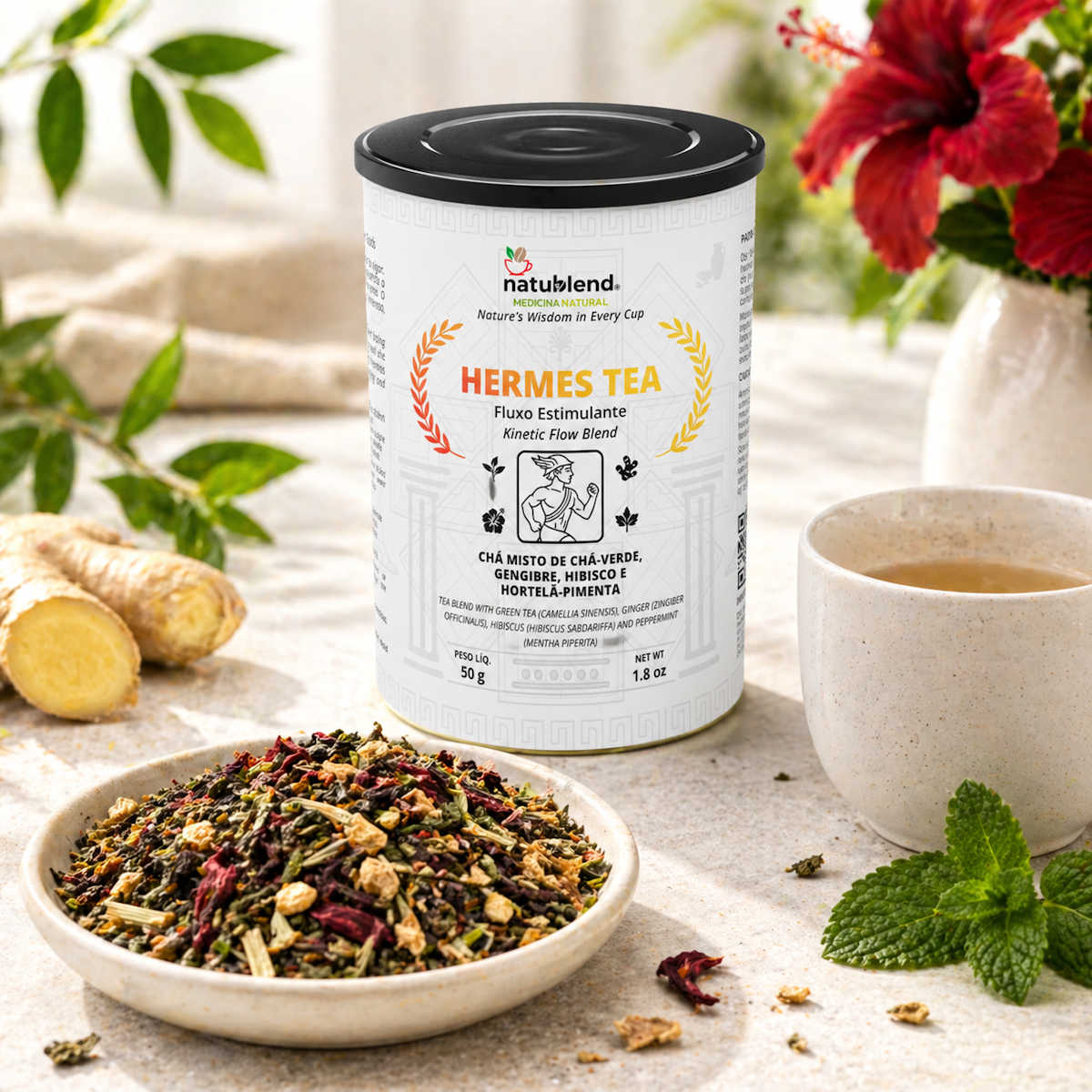
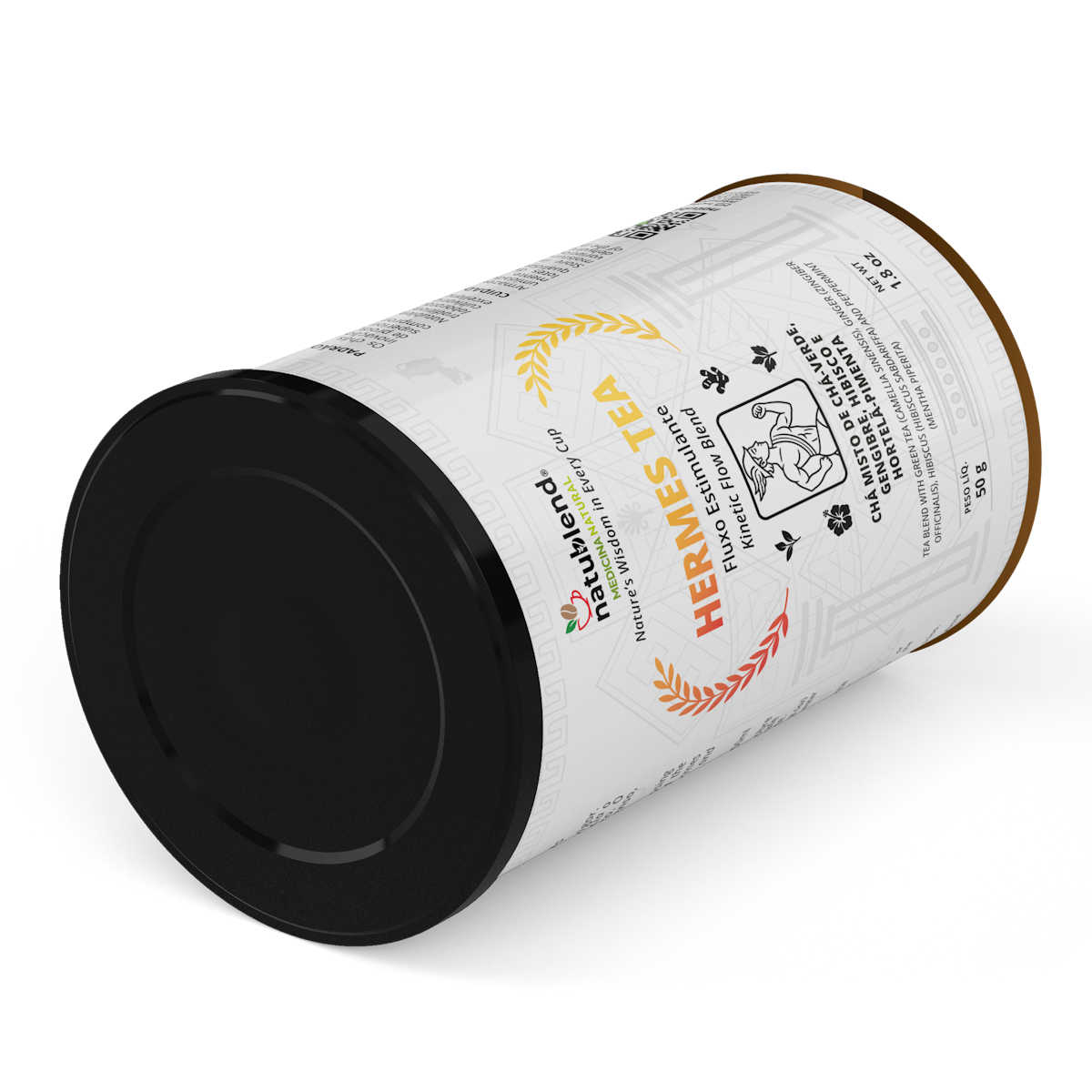
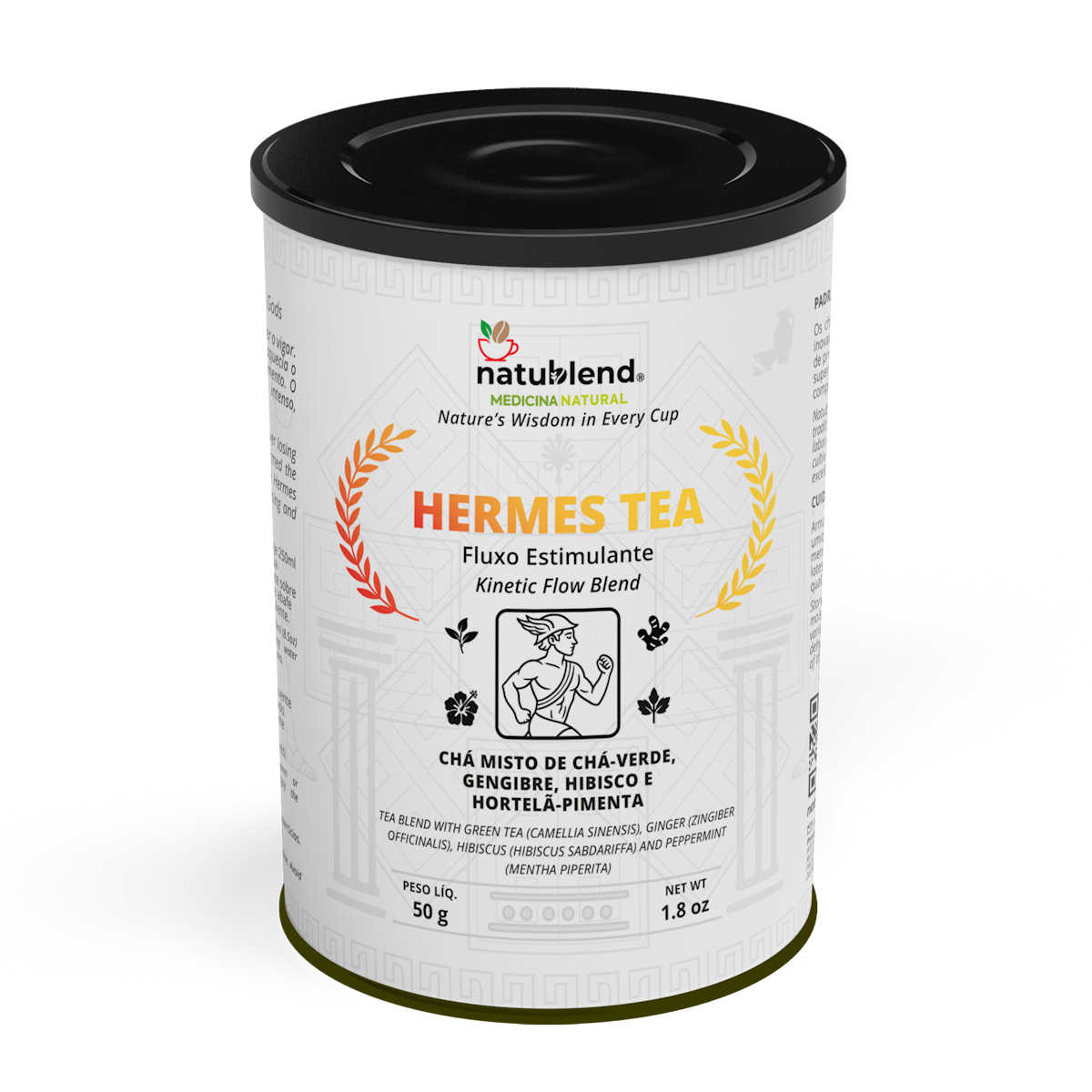
Hermes Tea combines ginger, green tea, hibiscus, and peppermint in a 50 g tin from Natublend’s Wisdom of the Gods collection. Because its base is green tea, the leaf of Camellia sinensis, the blend contains caffeine; the article on the history of tea, from China to the Ribeira Valley traces where this leaf comes from and how it reached Brazil. Hibiscus, which gives the cup its reddish glint, is not tea in the strict sense: it is a flower calyx, and infusions of plants other than Camellia sinensis are called tisanes (Upton Tea Imports, n.d.).
The name honors Hermes, the messenger of the gods in Greek mythology. Natublend suggests Hermes Tea, unsweetened, for the morning and for days spent on the move, from one appointment to the next. The sections that follow present the myth behind the name, tell the story of hibiscus, describe the cup, and walk through the brewing method the brand recommends.
Why Hermes

In Greek mythology, Hermes is the Olympian god of commerce, herds, hospitality, roads, and travelers, as well as the herald and personal messenger of Zeus (Theoi Project, n.d.). Hesiod’s Theogony presents him as the son of Zeus and the nymph Maia, daughter of the Titan Atlas (Hesiod, n.d.). Two episodes stand out in his myth: as a newborn, he stole the cattle of Apollo, and later he killed Argus Panoptes, the hundred-eyed giant (Theoi Project, n.d.). Natublend named the blend in honor of Hermes, and on the tin the god appears in full stride, wearing his winged helmet; in the painting that opens this article, he crosses the sky among golden clouds, his sandals winged as well.
The Four Ingredients of Hermes
Hibiscus is the ingredient this article covers in full, since Hermes is the blend whose article serves as its reference page in the collection. Ginger, green tea, and peppermint make up the same base found in Apollo and Bacchus; here they are discussed for how they play against the acidity of the calyces, with links to the articles that tell each one’s story.
Hibiscus
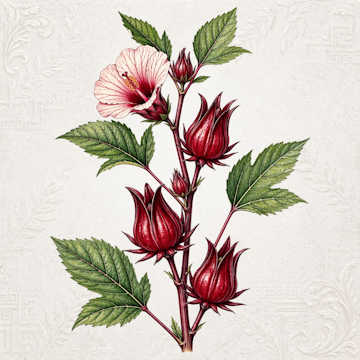
The hibiscus in Hermes is Hibiscus sabdariffa L., of the family Malvaceae, known in English as roselle; that scientific name is the one printed on the label and is well established in the agronomic literature. What goes into the tin is not the petals but the calyces: the sepals that, after flowering, grow, turn fleshy, and enclose the fruit, and that are harvested about 15 to 20 days after the flower opens (Boonkerd et al., 1993). Since the revision published by Barrett and colleagues in 2025, which reinstated the genus Sabdariffa, Plants of the World Online, the catalog of the Royal Botanic Gardens, Kew, has accepted the species as Sabdariffa gossypiifolia (Mill.) M.M.Hanes & R.L.Barrett; the database places its native range in tropical Africa, from the west of the continent to Sudan (POWO, n.d.). PROSEA, the reference work on the plant resources of Southeast Asia, considers this African origin likely, records the arrival of horticultural types in the Americas and India in the 17th century, and mentions sour hibiscus tea, which is very popular in Egypt (Boonkerd et al., 1993).
In Brazil, the plant is known as vinagreira, and also as cuxá, groselha, quiabo-azedo, and rosela. Embrapa Hortaliças, the vegetable research center of Brazil’s agricultural research corporation, highlights its place in the cooking of the state of Maranhão, where the slightly sour leaves are the base of arroz de cuxá, a rice dish, and the calyces are turned into cold drinks, jams, and teas (Embrapa Hortaliças, 2017). The hibiscus tea sensory lexicon by Monteiro and colleagues describes the aroma of the dried calyces with sour and sweet notes of candy and red fruit (Monteiro et al., 2017), a profile that sets Hermes apart from Apollo and Bacchus.
Green Tea
Green tea is the young leaf of Camellia sinensis (L.) Kuntze, of the family Theaceae, with its oxidation stopped early by heating soon after harvest, which preserves the color of the leaf (WSU Extension, n.d.). As the base of Hermes and the source of its caffeine, it joins the hibiscus in what Natublend calls a meeting of leaf and flower: the clean astringency of the tea comes first, and the acidity of the calyces builds on it. The Salus Tea article presents the plant in detail.
Ginger
Ginger, Zingiber officinale Roscoe, of the family Zingiberaceae (POWO, n.d.), goes into the blend as dried rhizome. In Hermes, it works beneath the acidity of the hibiscus, with a pungency that builds on the mid-palate; the lexicon by Kim and colleagues records that ginger also has sweet, citrusy, lemony notes (Kim et al., 2018), and that side of its character is what links it to the red fruit of the hibiscus. The story of the plant is told in the Epione Tea article.
Peppermint
Peppermint, Mentha × piperita L., is a natural hybrid of the family Lamiaceae (POWO, n.d.) and goes into the tin as dried leaf. In Hermes, it closes the tasting with a clean minty note, the refreshing sensation that the lexicon by Kim and colleagues calls cooling (Kim et al., 2018), and after the acidity of the hibiscus that freshness leaves the palate clear for the next sip. The Venus Tea article traces the history of the plant.
Tasting Notes
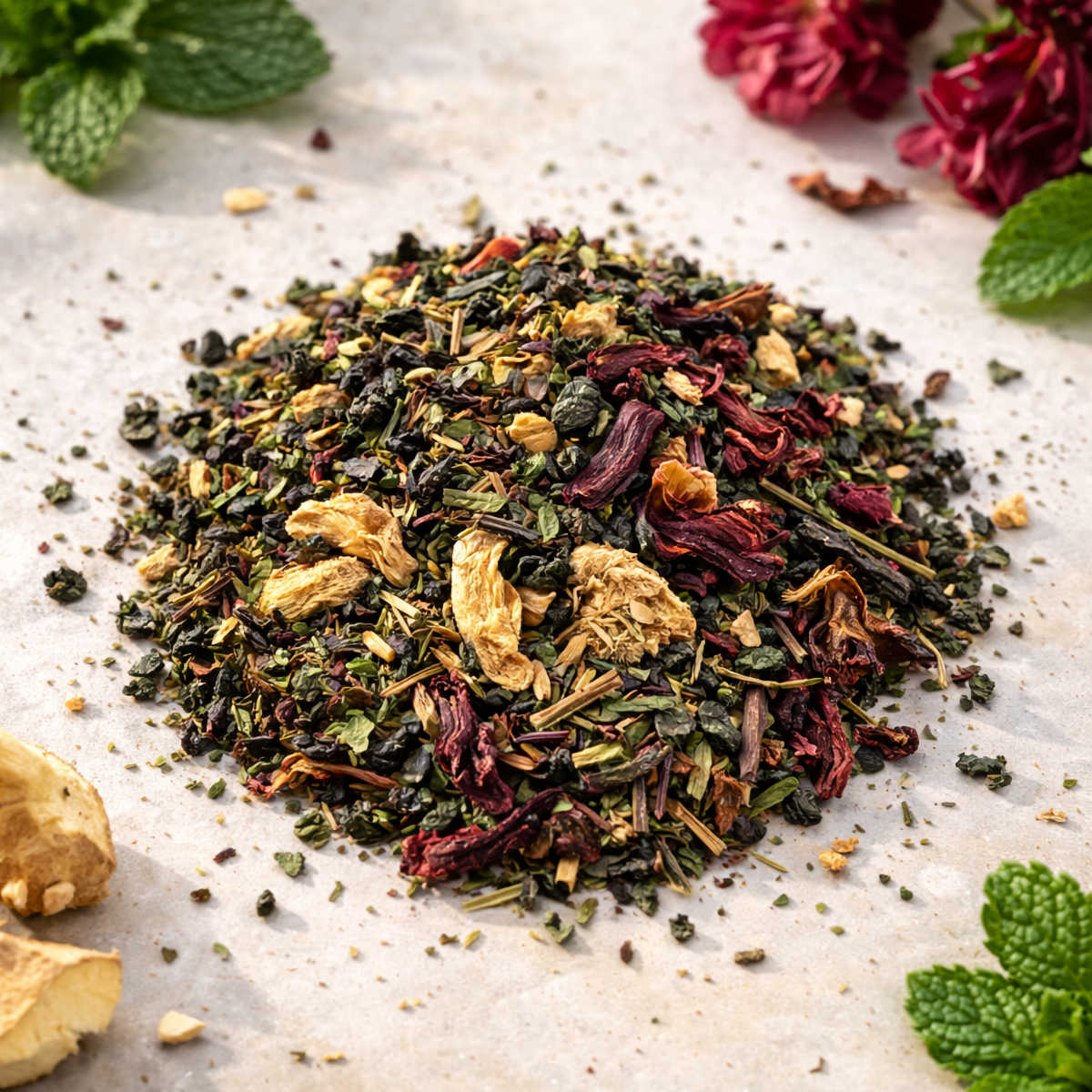
Aroma of the dry blend. Even before its scent, Hermes announces itself through color: in the dry blend, wine-colored flakes of calyx show up among the rolled green leaves and pale pieces of ginger. On the nose, however, the ginger leads, together with the peppermint, in a minty, pungent, and resinous opening; the hibiscus stays in the background with a slightly floral, fruity note, and the green tea serves as a discreet base, as Natublend describes it.
Aroma of the infusion. In hot water, the profile moves closer to what the brand calls citrusy, and the descriptors in the hibiscus lexicon by Monteiro and colleagues help name the fruity part that rises from the cup, with candy, raisin, and raspberry among them (Monteiro et al., 2017). The ginger adds a hint of lemon, and the green tea settles into a vegetal background.
Color of the infusion. Natublend describes an amber infusion leaning toward green, with ruby glints, a tone born of the meeting between the gold of the green tea and the pigment of the calyces. In the lexicon by Monteiro and colleagues, the hue of a hibiscus infusion ranges across blue, purple, and red (Monteiro et al., 2017), and in Hermes that red appears diluted, as a glint rather than as the dominant color.
Flavor. The attack brings the light astringency of the green tea, and the peppermint comes in right after with a gentle freshness. On the mid-palate, the ginger brings a pungent warmth that builds underneath, and the hibiscus shows up as a discreet acidity that tempers that pungency. The finish is minty and lingering, with a trace of ginger in the aftertaste. The only sweetness is the hint of candy carried over from the aroma: the brand does without sugar, and the acidity of the calyces holds the cup together without it.
Body. The brand does not classify the body, noting only that 4 minutes of steeping deepen the ginger and give the cup more body than 3. Taken together, the restrained astringency of the green tea and the acidity of the hibiscus shape a bright, light drink in which freshness counts for more than density.
How to Brew Hermes
Natublend’s recipe for Hermes is straightforward, and the point that calls for the most attention is timing.
- Heat the water to between 80 and 85 °C, without boiling.
- Place 2 g of Hermes in the infuser or teapot for every 200 ml of water.
- Pour in the water, cover right away so the peppermint aroma is not lost, and steep for 3 to 4 minutes, no longer.
- Strain without pressing the ingredients and serve it plain, since, according to the brand, Hermes does not need sugar.
- The same measure yields one or two more infusions; for the second one, the brand recommends water at 85 °C and 4 to 5 minutes.
The 4-minute limit on the first infusion has a chemical explanation: tannins, larger polyphenols responsible for the bitterness and harshness of an over-steeped tea, are extracted more slowly than caffeine and aroma compounds, and the longer and hotter the infusion, the more of them end up in the cup (Red Blossom Tea, n.d.). The below-boiling temperature follows the same logic: according to the brand, green tea is the most delicate ingredient in the blend and, above 85 °C, starts releasing too many tannins. For the iced version, the brand calls for the same measure, 2 g per 200 ml of cold water, steeped in the refrigerator for 6 to 8 hours.
When Natublend Suggests Serving It
Natublend positions Hermes for the morning and for routines full of comings and goings, a use that echoes the god of roads and travelers honored in its name. On those days, the cold-brewed version is especially practical: made the night before and left in the refrigerator overnight, it can go along in an insulated bottle, ready to drink. That last idea is this article’s suggestion, built on the brand’s iced recipe.
Because the base is green tea, that bottle also carries caffeine, in an amount Natublend does not specify, and anyone keeping track of their daily caffeine intake should count it along with their coffee. The brand also states that Hermes is not recommended for children under 12 without professional guidance.
Other Blends in the Collection
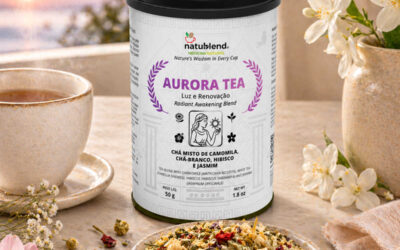
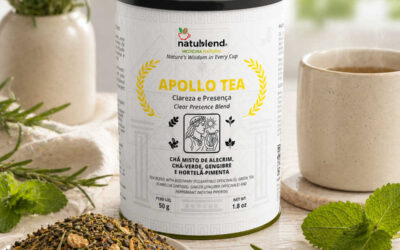
Hermes is one of the 15 blends in the Wisdom of the Gods collection, and two of them show how much the hibiscus contributes to this cup. Apollo Tea uses the same base of ginger, green tea, and peppermint but swaps the hibiscus for rosemary, taking the tasting from fruity and sour to herbal and resinous; by a mythological coincidence, it honors the god whose cattle Hermes stole as a newborn. Aurora Tea keeps the hibiscus but sets it over white tea, alongside chamomile and jasmine, in a far more floral register.
Frequently Asked Questions
Does the Caffeine in Hermes Come from the Hibiscus?
No. The caffeine comes from the green tea, the base of the blend and the leaf of Camellia sinensis. Hibiscus is a flower calyx, and infusions made only from it, like those made from other flowers and herbs, usually contain no caffeine. Natublend does not state the amount per cup.
What Is Hermes Like as an Iced Tea?
Natublend recommends the same ratio as the hot method, 2 g per 200 ml of cold water, steeped in the refrigerator for 6 to 8 hours. According to the brand, cold extraction draws fewer tannins from the green tea and brings the ginger and peppermint further forward. When serving, a clear glass pitcher shows off the ruby glint that hibiscus lends the blend.
Which Fruits Pair Well with Hermes?
The acidity and red-fruit notes of hibiscus call for fruits with a similar profile, such as blackberry, raspberry, and strawberry, or a citrus fruit like orange. In the iced version, sliced strawberries or orange rounds in the pitcher go well with the drink.
Who Was Hermes in Greek Mythology?
He was the Olympian god of commerce, herds, roads, and travelers, the herald and messenger of Zeus, and the son of Zeus himself and the nymph Maia. Natublend named the blend in his honor, and the tin shows the god in full stride, wearing his winged helmet.
This content is informational and describes teas and infusions as foods. It does not replace professional health guidance. Pregnant women, breastfeeding women, children, and people undergoing medical treatment should consult a health professional before adding any infusion to their routine.
References
View All 12 Cited References
Peer-Reviewed Scientific Studies (1)
- PMC2018 KIM, J. H. et al. A Lexicon for Descriptive Sensory Evaluation of Blended Tea. Preventive Nutrition and Food Science, v. 23, n. 4, p. 364-373, 2018. Available at: pmc.ncbi.nlm.nih.gov.
Institutional Sources (2)
- GOV2017 EMBRAPA HORTALIÇAS. Vinagreira. Leaflet in the Hortaliças Não Convencionais series. Brasília, DF: Embrapa Hortaliças, 2017. Available at: infoteca.cnptia.embrapa.br.
- GOV WASHINGTON STATE UNIVERSITY EXTENSION. Tea Types and Home Processing. n.d. Available at: vegetables.wsu.edu.
Supplementary Readings (9)
- UPTON TEA IMPORTS. A Closer Look at the Difference Between Teas, Tisanes and Herbal Infusions. n.d. Available at: uptontea.com.
- THEOI PROJECT. Hermes. Theoi Greek Mythology, n.d. Available at: theoi.com.
- HESIOD. Theogony. English text hosted by Theoi Project, n.d. Available at: theoi.com.
- ROYAL BOTANIC GARDENS, KEW. Hibiscus sabdariffa L., synonym of Sabdariffa gossypiifolia (Mill.) M.M.Hanes & R.L.Barrett. Plants of the World Online (POWO), n.d. Available at: powo.science.kew.org.
- 1993 BOONKERD, T.; NA SONGKHLA, B.; THEPHUTTEE, W. Hibiscus sabdariffa L. In: PROSEA (Plant Resources of South-East Asia), Handbook 8: Vegetables, 1993. Available at: prosea.prota4u.org.
- 2017 MONTEIRO, M. J. P. et al. Cross-cultural development of hibiscus tea sensory lexicons for trained and untrained panelists. Journal of Sensory Studies, v. 32, n. 5, e12297, 2017. Available at: gala.gre.ac.uk.
- ROYAL BOTANIC GARDENS, KEW. Zingiber officinale Roscoe. Plants of the World Online (POWO), n.d. Available at: powo.science.kew.org.
- ROYAL BOTANIC GARDENS, KEW. Mentha × piperita L. Plants of the World Online (POWO), n.d. Available at: powo.science.kew.org.
- RED BLOSSOM TEA CO. What Are Tannins in Tea. n.d. Available at: redblossomtea.com.