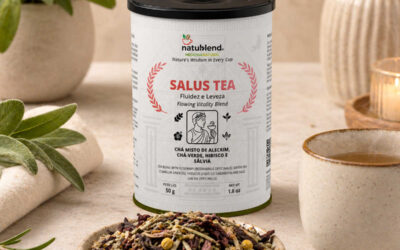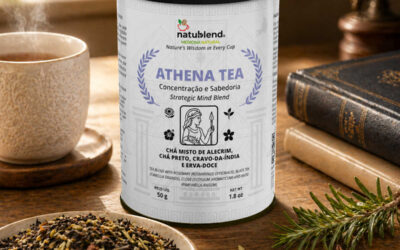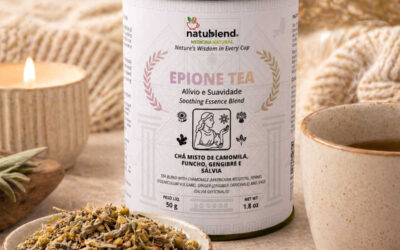
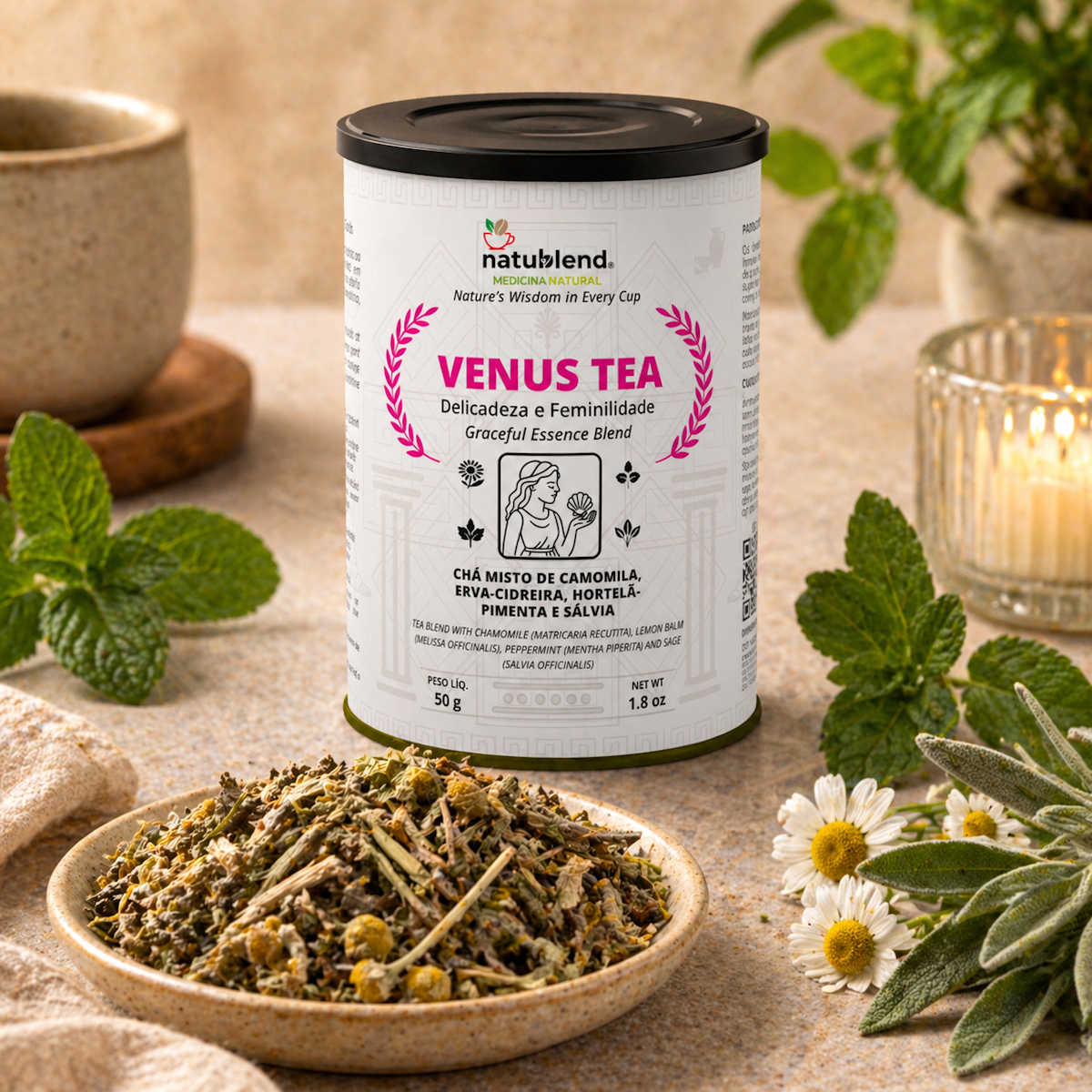
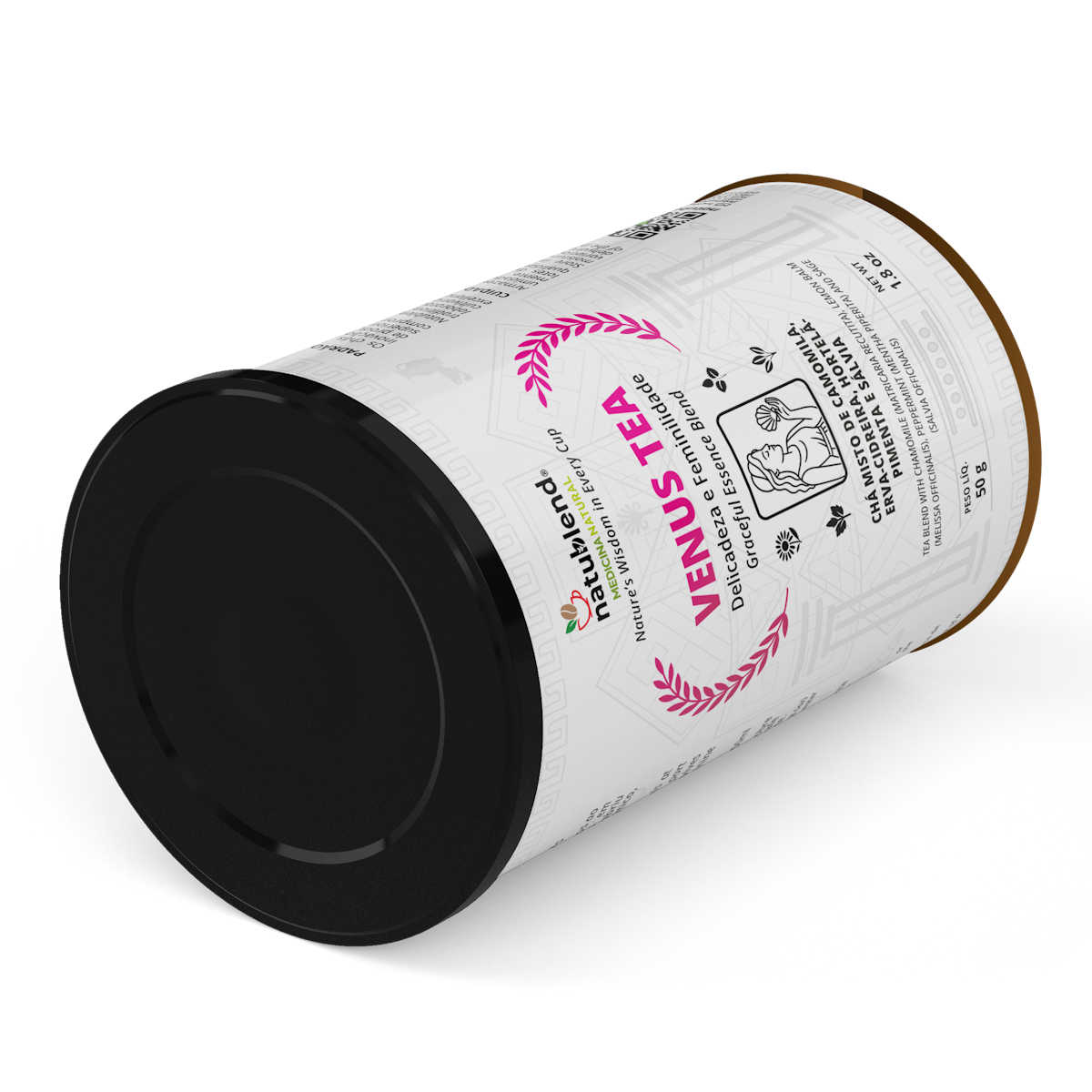
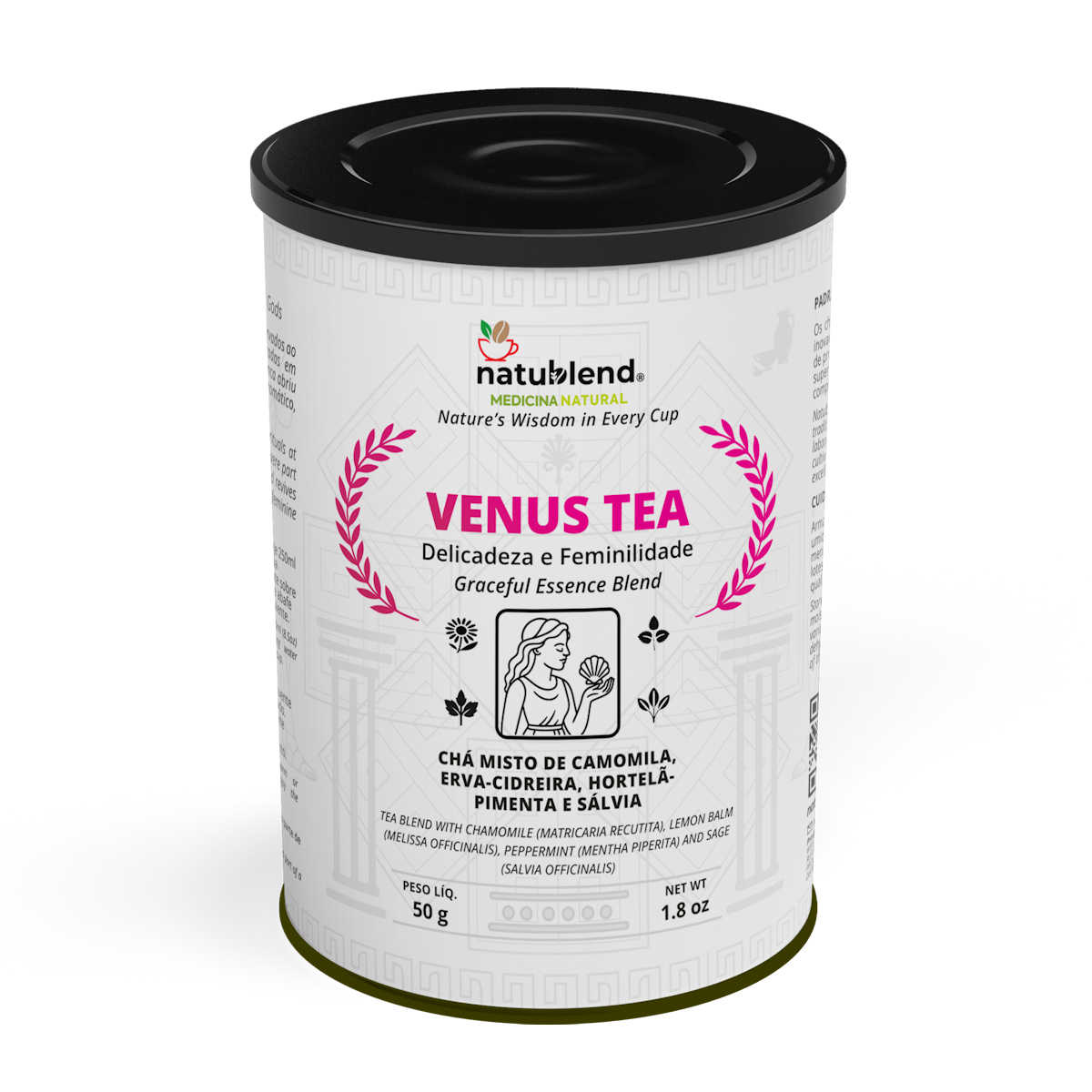
Venus Tea brings together chamomile, lemon balm, peppermint, and sage in a 50 g tin from Natublend’s Wisdom of the Gods collection. The blend is made only from flowers and herbs and contains no Camellia sinensis leaf, the plant behind black, green, and white teas, so the cup contains no caffeine, an absence the brand itself points out on the product page; the story of that leaf is told in the article on the history of tea, from China to the Ribeira Valley.
The name pays tribute to Venus, the Roman goddess of beauty and love, whom the Romans identified with the Greek Aphrodite. On the product page, Natublend presents Venus Tea as a cup for several moments, from the start of the day to late afternoon, and suggests the iced version for hot days.
Why Venus
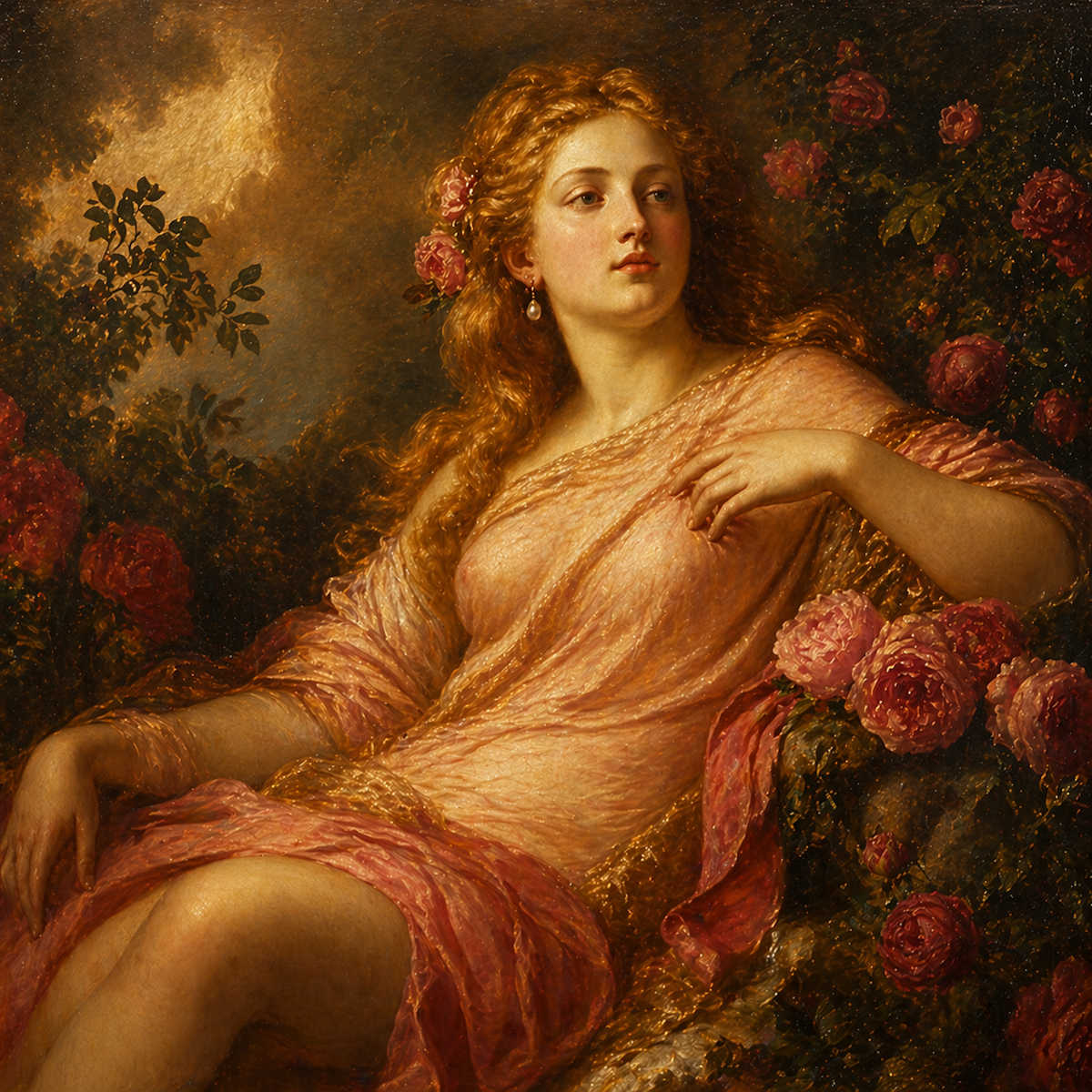
For the Romans, Venus corresponded to Aphrodite, the Olympian goddess of beauty and love, who in the temples of Corinth, Cythera, and Sparta was depicted armed, as a victorious goddess (Theoi Project, n.d.). The Greek sources disagree about Aphrodite’s origin. In the Theogony, Hesiod has her born from the sea foam that formed after Cronus mutilated Uranus, while Homer, in the Iliad, presents her as the daughter of Zeus and Dione (Theoi Project, n.d.). Among the best-known episodes is the Judgment of Paris, in which she won the golden apple by promising the Trojan prince Helen as his wife, a contest that helped set off the Trojan War (Theoi Project, n.d.). Natublend named the blend in honor of the goddess, and the collection’s illustration, at the top of this page, shows her reclining among rosebushes, in shades of pink and gold.
The Four Ingredients in Venus Tea
Peppermint is the ingredient this article covers in depth, which is why it comes first. Chamomile, lemon balm, and sage also appear in other Natublend blends, and each one gets a detailed description in the article indicated under its entry; here they are described mainly by the role each one plays in the sip.
Peppermint
Peppermint, Mentha × piperita L., is a natural hybrid between Mentha aquatica and Mentha spicata, in the family Lamiaceae, and it goes into Venus Tea as dried leaves (POWO, n.d.). The multiplication sign in the scientific name marks precisely this hybrid origin. The name itself dates from the 18th century: Linnaeus named the plant Mentha piperita in 1753, in Species Plantarum (IPNI, n.d.).
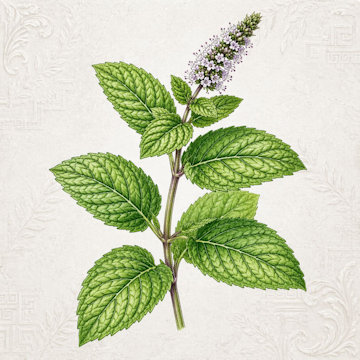
For Venus Tea, what matters is what peppermint does on the palate. The blended tea lexicon by Kim and colleagues defines peppermint by a fresh sensation, known in sensory science as “cooling,” combined with a characteristic herbaceous aroma (Kim et al., 2018). In this blend, as the brand describes it, peppermint takes the middle of the sip: it carries the cup from chamomile’s floral notes into mint, which makes it the point of greatest contrast, and it is also the ingredient that keeps the sweetness of the chamomile and lemon balm from piling up. In the iced version, the peppermint becomes even more present.
Chamomile
The chamomile in Venus Tea is Matricaria chamomilla L., in the family Asteraceae, used as dried flowers; Matricaria recutita, a name still found on labels, is a synonym of the same species (POWO, n.d.). Here it handles the opening: the brand describes a floral aroma with a subtle note of honey in the dried flowers and, on the first sip, a soft, slightly sweet base, before the peppermint takes the cup in another direction. The plant is presented in detail in the article on Bacchus Tea.
Lemon Balm
The Venus Tea page does not name the species, and in Brazil the name the brand uses for this ingredient, erva-cidreira, covers more than one plant, among them Lippia alba, in the family Verbenaceae. The most likely reading is Melissa officinalis L., known in English as lemon balm, in the family Lamiaceae, used for its leaves (POWO, n.d.); if so, it shares a family with peppermint and sage. In Venus Tea, the lemon balm brings the sweet citrus note that follows the chamomile and, together with the sage, accounts for the greenish glint in the infusion, according to the brand. The article on Harmonia Tea explains the different plants sold in Brazil as erva-cidreira.
Sage
The sage is Salvia officinalis L., in the family Lamiaceae, native to a range that runs from southwestern Germany to the Balkans, and the blend uses its leaves (POWO, n.d.). It falls to the sage to close Venus Tea, with the light herbaceous bitterness and earthy background the brand describes, and it is also the ingredient that responds most to time: at 7 minutes of steeping, according to Natublend, the sage gains depth and the cup gains body. The plant is presented in detail in the article on Epione Tea.
Sensory Profile
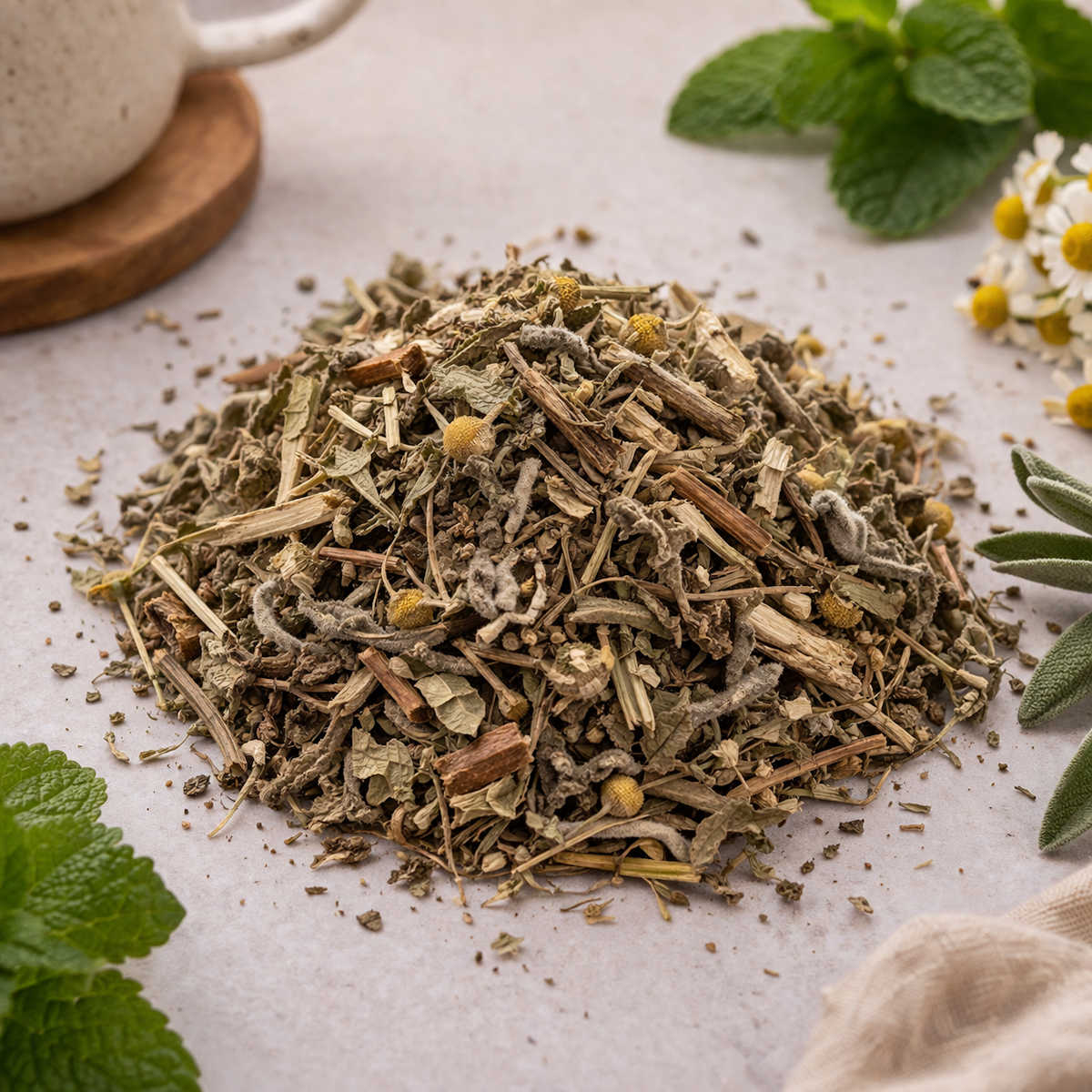
Dry blend aroma. In the tin, the four herbs appear in layers that are easy to tell apart, according to the brand: chamomile, floral with a subtle note of honey; lemon balm, citrusy and sweet; peppermint, minty; and sage, herbaceous and slightly earthy. This is the only blend in the collection in which peppermint and sage share the tin, and both can already be recognized in the dry leaves.
Infusion aroma. The brand asks for the vessel to be covered right after the water is poured, because the menthol compounds in peppermint and the oils in sage dissipate quickly on contact with air, and it sums up the blend’s fragrance as citrus, floral, and minty notes. For the herbaceous side of infusions like this one, sensory studies of herbal teas use terms such as dried herb and freshly cut grass, distinct from cooked vegetable notes (Malongane et al., 2020).
Liquor color. Pale, translucent gold, with a greenish glint the brand attributes to the lemon balm and sage. On the infusion color atlas by Su and colleagues, which runs from pale greenish yellow to red (Su et al., 2021), Venus Tea would sit at the lighter end, close to greenish yellow, the color of a leaf rather than of a flower.
Flavor. As the brand describes it, the attack is floral and soft, from the chamomile, followed by the sweet citrus of the lemon balm. On the mid-palate, the peppermint turns the cup in a new direction, with a minty freshness that cuts through the sweetness of the opening. The finish belongs to the sage, with a light herbaceous bitterness and an earthy background; studies of blended teas assess the bitterness that lingers after the sip as an aftertaste attribute, separate from the bitterness perceived during tasting (Yang; Lee, 2020).
Body. Light, gaining weight when the infusion reaches 7 minutes and the sage deepens, as the brand describes it. The menthol adds a fresh sensation that keeps the cup lively without making it any heavier.
How to Brew Venus Tea
With Venus Tea, the steeping time, between 5 and 7 minutes, is what decides how much of the sage reaches the cup.
- Heat the water to between 90 and 95 °C; if you have no thermometer, wait 30 seconds after it boils.
- Measure out 2 g of the blend for every 200 ml of water.
- Pour the water over the herbs and cover the vessel immediately.
- Steep for 5 to 7 minutes: at 5, the chamomile and lemon balm come through lighter and more citrusy; at 7, the sage deepens and the cup gains body.
- Strain without pressing the leaves and serve without sugar, as the brand recommends.
- If you like, reuse the same portion for one or two more infusions.
Because it is a blend made only from flowers and herbs, Venus Tea takes hotter water than the green or white tea blends, in which the catechins in the leaf call for lower temperatures; the American brand The Republic of Tea, for example, recommends water between 95 and 100 °C in its chamomile brewing guide (The Republic of Tea, n.d.). Natublend stays just below that range, attributing the choice to the loss of the most delicate aromatic oils of peppermint and sage in boiling water.
For the iced version, the brand recommends 2 g in 200 ml of cold water, left in the refrigerator for 6 to 8 hours. The result, according to the brand, is lighter, with the lemon balm and peppermint up front and the sage pulled back into the background.
Natublend’s Suggested Moment
Natublend presents Venus Tea as a cup for several moments of the day. The product page speaks of a start-of-the-day ritual and of a break during the afternoon and, in the section devoted to the ideal moment, points to late afternoon as a good choice. On hot days, the brand suggests the iced version, which spends 6 to 8 hours in the refrigerator and can be prepared the day before.
The absence of caffeine, which the brand highlights, is a matter of composition: none of the four ingredients is a source of it. The brand does not recommend the blend for children under 12 without professional guidance.
Other Blends in the Collection
Venus Tea is one of the 15 blends in the Wisdom of the Gods collection, and several of them share two of its four ingredients. Two of these blends help explain Venus Tea by contrast. Harmonia Tea repeats the lemon balm and peppermint but swaps the chamomile and sage for jasmine and lemongrass, in a more citrusy, floral cup without the bitterness at the close. Epione Tea keeps the chamomile and sage pairing and adds fennel and ginger, which takes the whole into an anise-like, peppery register.
Frequently Asked Questions
Does the Peppermint or the Sage Add Caffeine to Venus Tea?
No. Chamomile, lemon balm, peppermint, and sage contain no caffeine, and the blend contains no Camellia sinensis leaf, the tea plant in the strict sense. Natublend itself points out the natural absence of caffeine on the product page.
Is Venus Tea Worth Making Iced in Summer?
Yes, and it is the brand itself that suggests the iced version for hot days: 2 g in 200 ml of cold water, 6 to 8 hours in the refrigerator. The drink comes out lighter, with the lemon balm and peppermint more present and the sage pulled back, which brings out the cooling side of the menthol.
What Snacks Go Well with Venus Tea in the Afternoon?
The sage finish, herbaceous and slightly bitter, calls for savory or lightly sweet accompaniments: biscoitos de polvilho (Brazilian cassava starch crackers), a plain bolo de fubá (cornmeal cake), pão de queijo (cheese bread), or toast with ricotta and herbs. Lemon desserts also go nicely with the lemon balm.
Venus or Vênus: Why This Spelling?
Because Natublend uses the Latin spelling, Venus, which is also the English form, while in Portuguese the goddess is written Vênus, with an accent. The name honors the Roman goddess of beauty and love, identified with the Greek Aphrodite, and does not describe the drink, which is defined by the four ingredients in the tin.
This content is informational and describes teas and infusions as foods. It does not replace professional health guidance. Pregnant women, breastfeeding women, children, and people undergoing medical treatment should consult a health professional before adding any infusion to their routine.
References
View All 11 Cited References
Peer-Reviewed Scientific Studies (4)
- PMC2018 KIM et al. A Lexicon for Descriptive Sensory Evaluation of Blended Tea. Preventive Nutrition and Food Science, v. 23, n. 4, p. 364-373, 2018. Available at: pmc.ncbi.nlm.nih.gov.
- PMC2020 MALONGANE et al. Sensory Characteristics and Volatile Compounds of Herbal Teas and Mixtures of Bush Tea with Other Selected Herbal Teas of South Africa. Foods, v. 9, n. 4, 496, 2020. Available at: pmc.ncbi.nlm.nih.gov.
- PMC2021 SU et al. Using Sensory Wheels to Characterize Consumers’ Perception for Authentication of Taiwan Specialty Teas. Foods, v. 10, n. 4, 836, 2021. Available at: pmc.ncbi.nlm.nih.gov.
- PMC2020 YANG; LEE. Consumer perception and liking, and sensory characteristics of blended teas. Food Science and Biotechnology, v. 29, n. 1, p. 63-74, 2020. Available at: pmc.ncbi.nlm.nih.gov.
Supplementary Readings (7)
- THEOI PROJECT. Aphrodite. Theoi Greek Mythology, n.d. Available at: theoi.com.
- ROYAL BOTANIC GARDENS, KEW. Mentha × piperita L. Plants of the World Online (POWO), n.d. Available at: powo.science.kew.org.
- 1753 INTERNATIONAL PLANT NAMES INDEX (IPNI). Mentha piperita L. Sp. Pl. 2: 576, 1753. IPNI, n.d. Available at: ipni.org.
- ROYAL BOTANIC GARDENS, KEW. Matricaria chamomilla L. Plants of the World Online (POWO), n.d. Available at: powo.science.kew.org.
- ROYAL BOTANIC GARDENS, KEW. Melissa officinalis L. Plants of the World Online (POWO), n.d. Available at: powo.science.kew.org.
- ROYAL BOTANIC GARDENS, KEW. Salvia officinalis L. Plants of the World Online (POWO), n.d. Available at: powo.science.kew.org.
- THE REPUBLIC OF TEA. Guide on How Long to Steep Chamomile Tea. Tea Library, n.d. Available at: republicoftea.com.