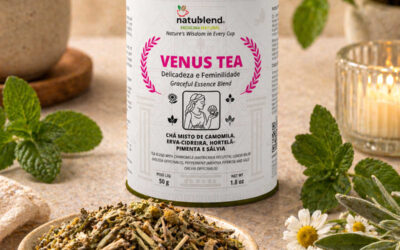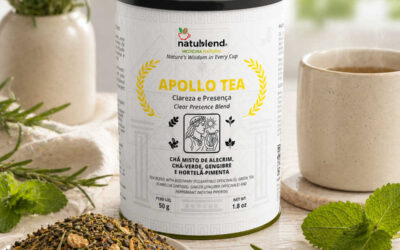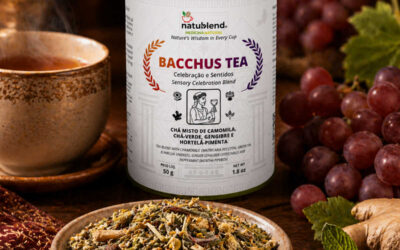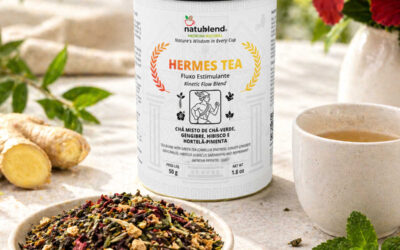
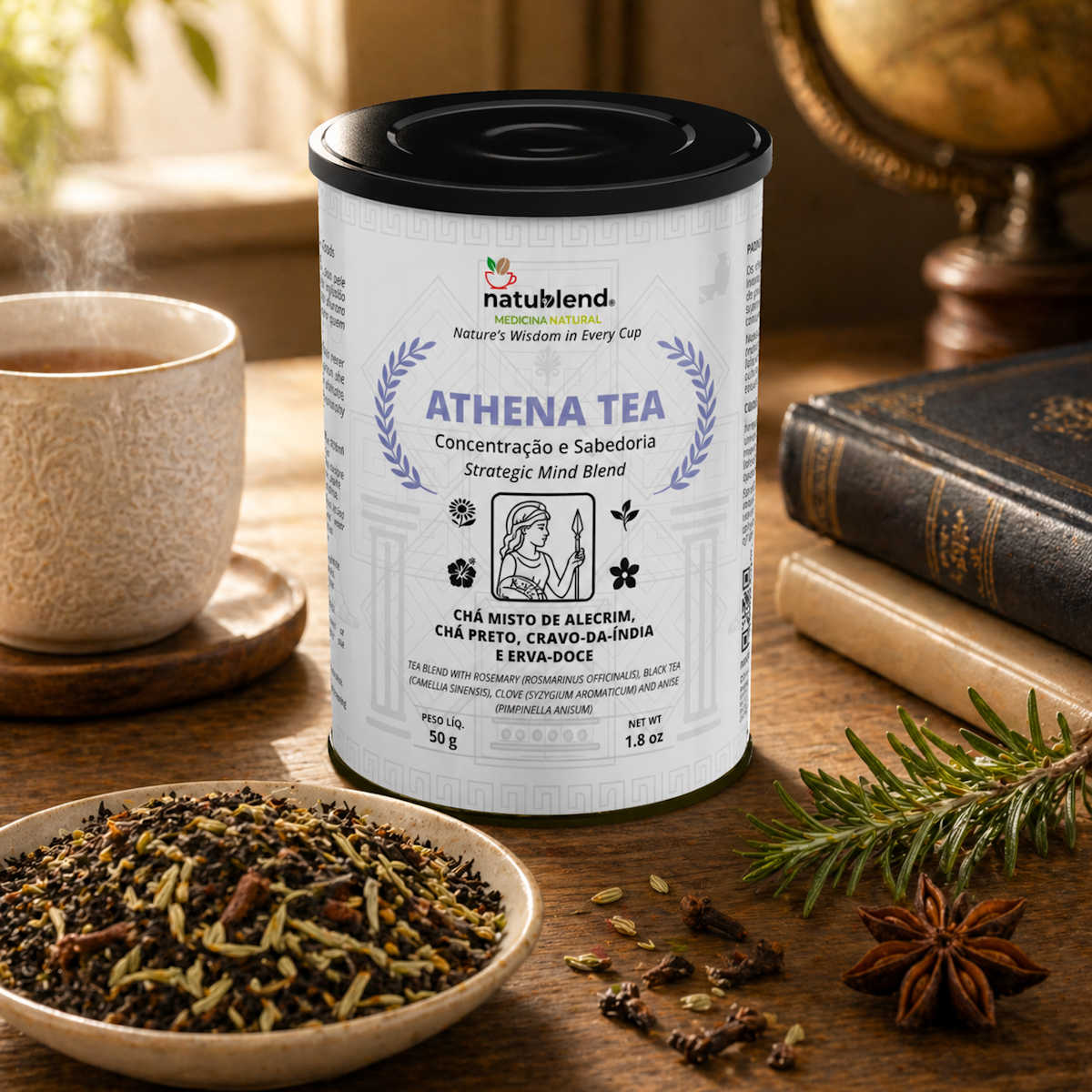
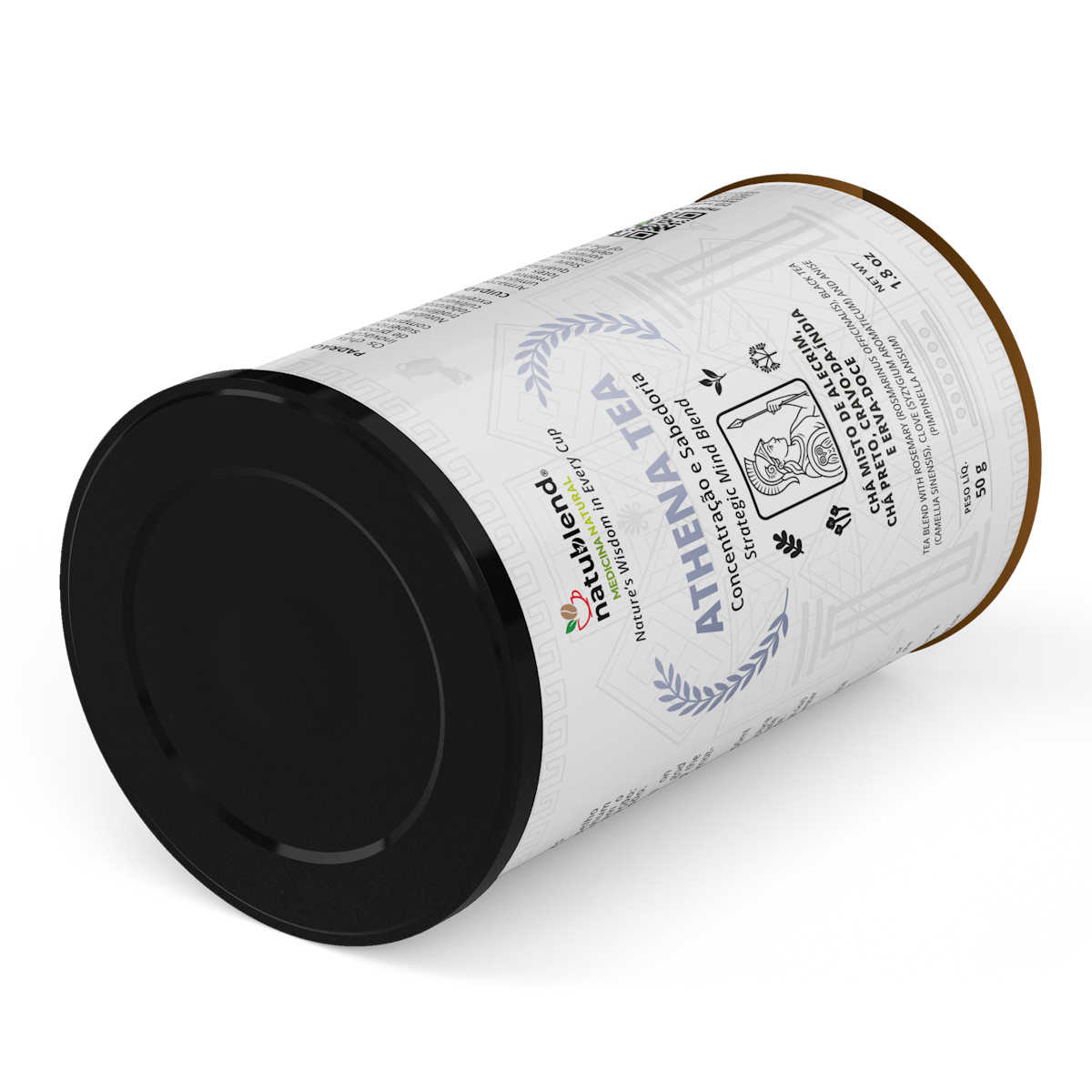
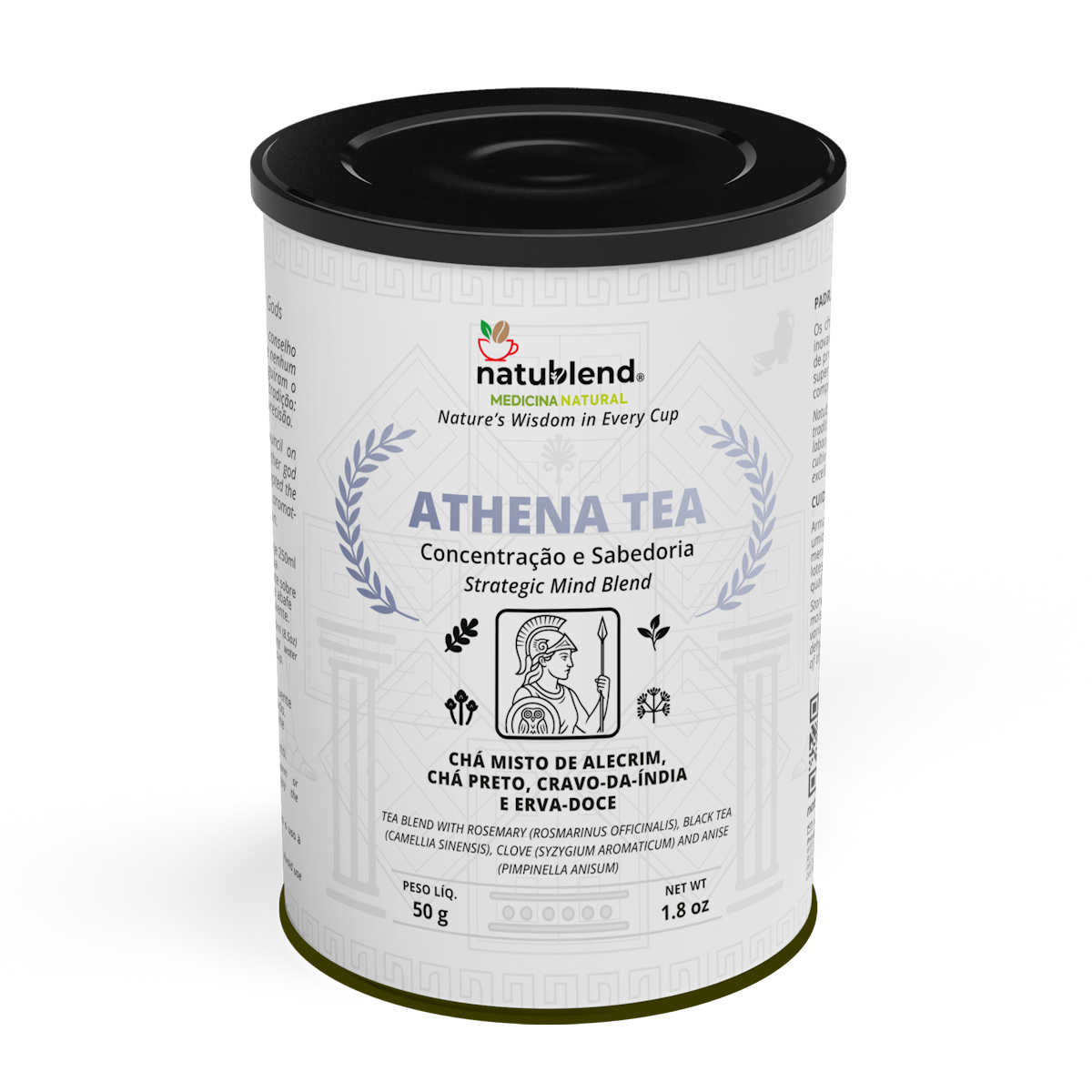
Anise, black tea, clove, and rosemary share the 50 g tin of Athena Tea, a blend from Natublend’s Wisdom of the Gods collection. Black tea, a Camellia sinensis leaf fully oxidized before drying, appears only in this blend within the collection, and it is the source of the caffeine in the cup; the plant’s path to Brazil is traced in the article on the journey of tea, from China to the Ribeira Valley.
The name honors Athena, the Greek goddess of wisdom and crafts, and her myth is where this article begins, before the ingredients, the sensory profile, and the brewing method.
Why Athena

In Greek mythology, Athena is the Olympian goddess of wisdom and good counsel, of war, of the defense of cities, and of crafts, from weaving to pottery; in Rome, her counterpart was Minerva (Theoi Project, n.d.). The best-remembered episode in her myth is her birth. According to Hesiod’s Theogony, Zeus swallowed Metis when she was already pregnant with Athena, because it had been foretold that she would later bear a son destined to rule over gods and men, and the goddess eventually emerged from Zeus’s own head, fully grown and armed (Hesiod, n.d.). Natublend named the blend in honor of the goddess, choosing the spelling Athena rather than the Portuguese Atena, and the collection’s illustrations show her with a crested helmet, an olive branch, an owl perched on her shoulder, and a spear.
The Four Ingredients in Athena
Anise and black tea get their full introduction here (anise also appears in Gaia Tea); clove and rosemary follow, more briefly.
Black Tea
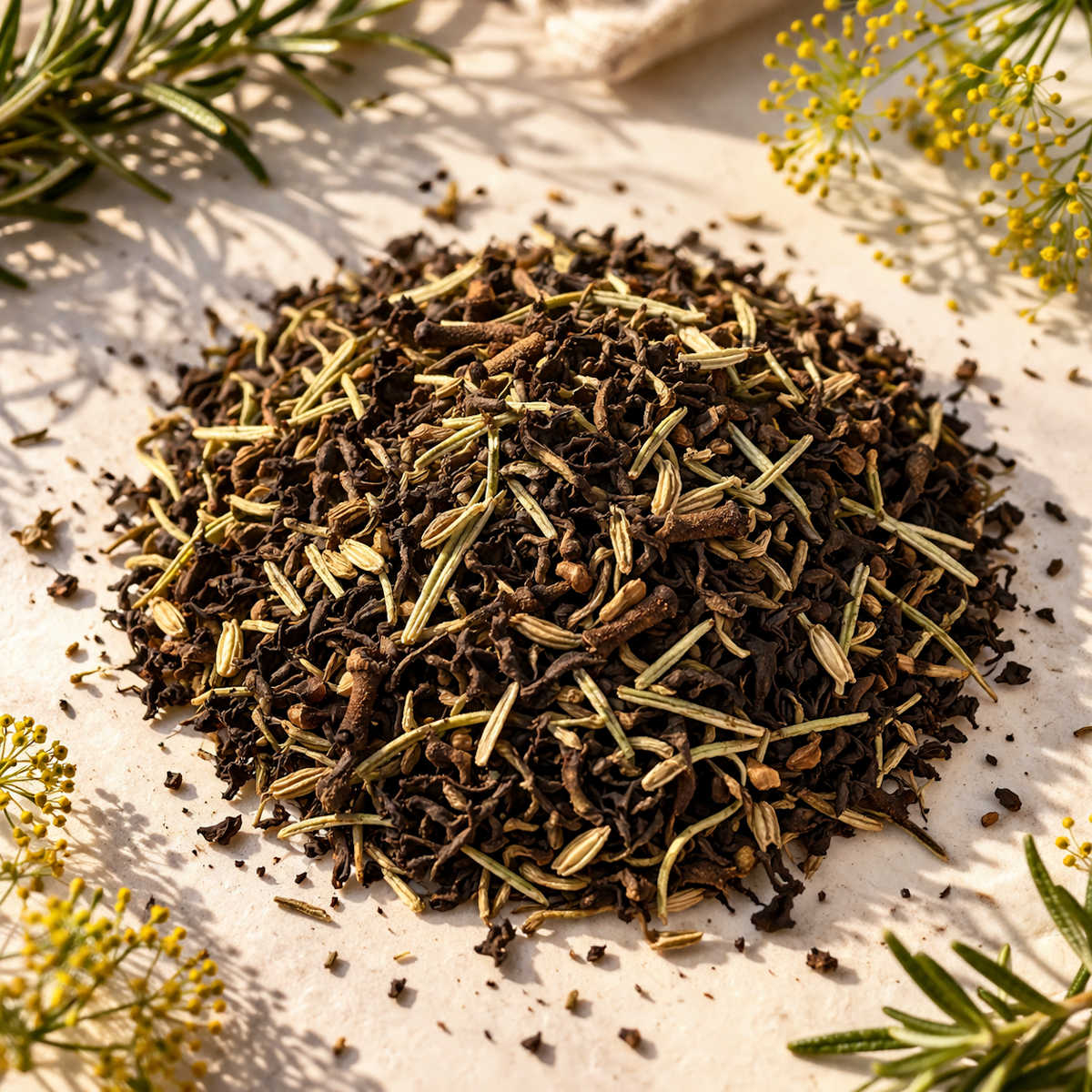
Black tea is the leaf of Camellia sinensis (L.) Kuntze, of the Theaceae family (POWO, n.d.), the same species as green and white tea. What changes is the process: the leaf undergoes full oxidation before drying, and during this stage many of the fresh leaf’s catechins condense into theaflavins and thearubigins, reddish pigments that give the liquor its color (Wikipedia, n.d.).
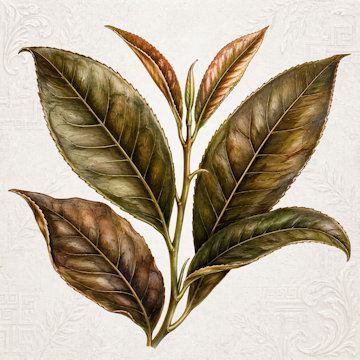
Black tea is also the reference for an international tasting standard, ISO 3103. Designed for preparing the liquor in sensory tests and comparing batches, not for guiding home brewing, it calls for 2 g of tea per 100 ml of boiling water and a 6-minute steep for black tea (Wikipedia, n.d.), double the ratio recommended for Athena. In the blend, black tea is the full-bodied base that supports the other three ingredients and the source of the infusion’s amber color.
Anise
In Brazil, where this ingredient is sold as erva-doce, that common name covers both anise, Pimpinella anisum L., and fennel, Foeniculum vulgare Mill., two plants in the carrot family (Apiaceae), and an article in Revista Cultivar notes that the erva-doce most widely grown in the country is fennel, while anise is rarely cultivated there (Revista Cultivar, n.d.). The Athena product page does not give the ingredient’s scientific name, but the English description on the tin settles the question: it lists the ingredient as anise, Pimpinella anisum.
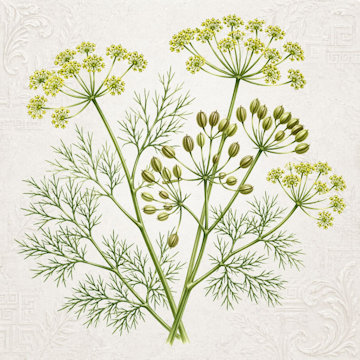
In both species, the part that goes into the infusion is the dried fruit, commonly called seeds, with the same aniseed fragrance. In Athena, anise closes the cup with a sweet note reminiscent of licorice, a counterpoint to the black tea and the clove.
Rosemary
Rosemary, which Plants of the World Online now lists as Salvia rosmarinus Schleid., with Rosmarinus officinalis L. as a synonym, is a species of the mint family (Lamiaceae) native to the Mediterranean basin, and the tin holds its dried leaves (POWO, n.d.). In Athena, it brings the resinous, herbal note that accompanies the body of the black tea from the first sip. The plant’s full story is in the article on Apollo Tea.
Clove
Clove, Syzygium aromaticum (L.) Merr. & L.M.Perry, is a species of the myrtle family (Myrtaceae) native only to the Maluku Islands, in Indonesia, and reaches the tin as dried flower buds (POWO, n.d.). In Athena, it marks the heart of the tasting with the intense, spicy touch the brand describes, rising together with the black tea on the mid-palate. The spice’s full story is in the article on Ares Tea, the other blend in the collection that contains clove.
Sensory Profile
Dry leaf aroma. When the tin is opened, rosemary and clove arrive almost together, one resinous and the other warm, over the earthy backdrop of the black tea. The anise comes last, with the sweet fragrance of its seeds, and the whole is more reminiscent of a spice pantry than an herb garden.
Infusion aroma. In near-boiling water, the black tea gains volume and the clove merges with it into a single spiced, full-bodied accord; the rosemary steps back into a balsamic background, and the anise becomes more distinct, with its licorice-like note.
Liquor color. Natublend describes the infusion as dark amber, almost copper, with reddish glints when light passes through the cup, the shade tasting glossaries call coppery (SV Tea, n.d.).
Flavor. The first sip brings the body of the black tea, with the firm astringency that tannins give the oxidized leaf, and the rosemary follows with its resinous note. On the mid-palate, clove and black tea reach the most intense point of the tasting, spicy and full-bodied, and the finish turns smooth and aniseed, the seeds leaving a residual sweetness that makes sugar unnecessary.
Body. Full-bodied, in the brand’s words, with the rich, round texture of a well-extracted black tea liquor that fills the mouth without weighing it down.
How to Brew Athena
With a black tea base, Athena calls for water just below boiling, much hotter than the water used for white or green tea.
- Heat 200 ml of water to between 90 and 95 °C; without a thermometer, the brand suggests waiting about 30 seconds after the water boils.
- Place 2 g of the blend in an infuser or teapot and pour the water over the leaves.
- Cover right away and let it steep for 4 to 5 minutes, while you warm the cup with a little hot water.
- Strain without pressing the leaves and serve in the prewarmed cup, without sugar.
- If you like, reuse the same leaves for one or two more infusions; for the second, the brand recommends water at 92 °C for 4 minutes.
According to the brand, black tea handles near-boiling water well and needs it to extract fully. Time still matters, though: tannins leave the leaf more slowly than the other flavor molecules, and controlling temperature and steeping time is what keeps astringency in check (Red Blossom Tea Company, n.d.), which is why going past the recommended time tends to make the liquor harsh. Natublend also recommends a cold-brew version, steeped for 6 to 8 hours in the refrigerator.
The Moment Natublend Suggests
On the product page, Natublend reserves Athena for the first cup of the morning and for the start of a study session or the workday. The ritual the brand describes suits the blend’s profile: warm the cup before serving, to preserve the aroma; cover right after pouring the water, so the rosemary keeps its resinous fragrance; and strain without squeezing the leaves.
The black tea base brings caffeine, and Natublend does not say how much is in each cup; the content varies with steeping time and temperature, and anyone who already drinks coffee early in the day should count both drinks together in their daily intake. The brand also notes that the blend is not recommended for children under 12 without professional guidance.
Other Blends in the Collection
Athena is one of the 15 blends in the Wisdom of the Gods collection, and four of them repeat one of its ingredients. Apollo Tea also has rosemary, over a green tea base with ginger and peppermint. Ares Tea is the other blend with clove, but it takes the spice to a white tea base, with ginger and peppermint, for a lighter, mintier profile. Gaia Tea shares the anise with Athena and does without Camellia sinensis, bringing together chamomile, lemon balm, and lemongrass in an all-herb infusion. And Salus Tea repeats the rosemary alongside green tea, hibiscus, and sage.
Frequently Asked Questions
How Much Caffeine Does Athena Tea Have?
Natublend does not publish the caffeine content per cup, but the blend does contain caffeine, because its base is black tea, the leaf of Camellia sinensis. The amount extracted depends on steeping time and temperature, and anyone keeping track of their daily intake should factor in this cup.
Can Athena Be Served Iced?
It can. The brand recommends a cold brew, with 6 to 8 hours in the refrigerator. If a cup brewed hot cools down and the liquor turns slightly cloudy, it is not a flaw: it is the film that forms in cold black tea, which the tasters’ glossary records as creamy (SV Tea, n.d.).
What Goes Well with Athena at the Table?
The clue lies in the anise itself. A slice of bolo de fubá com erva-doce, the cornmeal cake flavored with these seeds that is a classic on Brazilian tables, echoes the aniseed note in the cup, and aged cheese, broa de milho (Brazilian corn bread), or buttered toast pair well with the body of the black tea and the touch of clove.
Why Does a Brazilian Brand Spell It Athena?
Athena is the form used in English and several other languages for the Greek name of the goddess of wisdom; in Portuguese she is Atena, and in Rome she was Minerva. Natublend adopted the spelling Athena for the blend’s name, and that is the form that appears on the tin and on the product page.
This content is informational and describes teas and infusions as foods. It does not replace professional health guidance. Pregnant women, breastfeeding women, children, and people undergoing medical treatment should consult a health professional before adding any infusion to their routine.
References
View All 10 Cited References
- THEOI PROJECT. Athena. Theoi Greek Mythology, n.d. Available at: theoi.com.
- HESIOD. Theogony. Text hosted by the Theoi Project, n.d. Available at: theoi.com.
- ROYAL BOTANIC GARDENS, KEW. Camellia sinensis (L.) Kuntze. Plants of the World Online (POWO), n.d. Available at: powo.science.kew.org.
- WIKIPEDIA. Theaflavin. n.d. Available at: en.wikipedia.org.
- WIKIPEDIA. ISO 3103. n.d. Available at: en.wikipedia.org.
- REVISTA CULTIVAR. Erva-doce: Foeniculum vulgare Mill. ou Pimpinella anisum L.? (in Portuguese). n.d. Available at: revistacultivar.com.br.
- ROYAL BOTANIC GARDENS, KEW. Salvia rosmarinus Schleid. Plants of the World Online (POWO), n.d. Available at: powo.science.kew.org.
- ROYAL BOTANIC GARDENS, KEW. Syzygium aromaticum (L.) Merr. & L.M.Perry. Plants of the World Online (POWO), n.d. Available at: powo.science.kew.org.
- SV TEA. A Tea Taster’s Glossary. n.d. Available at: svtea.com.
- RED BLOSSOM TEA COMPANY. What Are Tannins in Tea. n.d. Available at: redblossomtea.com.