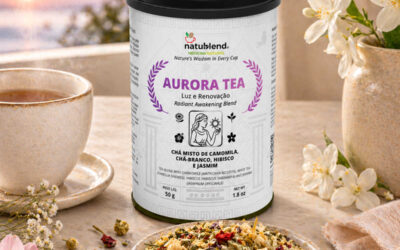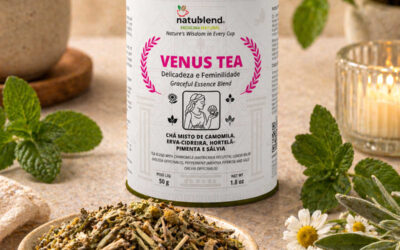
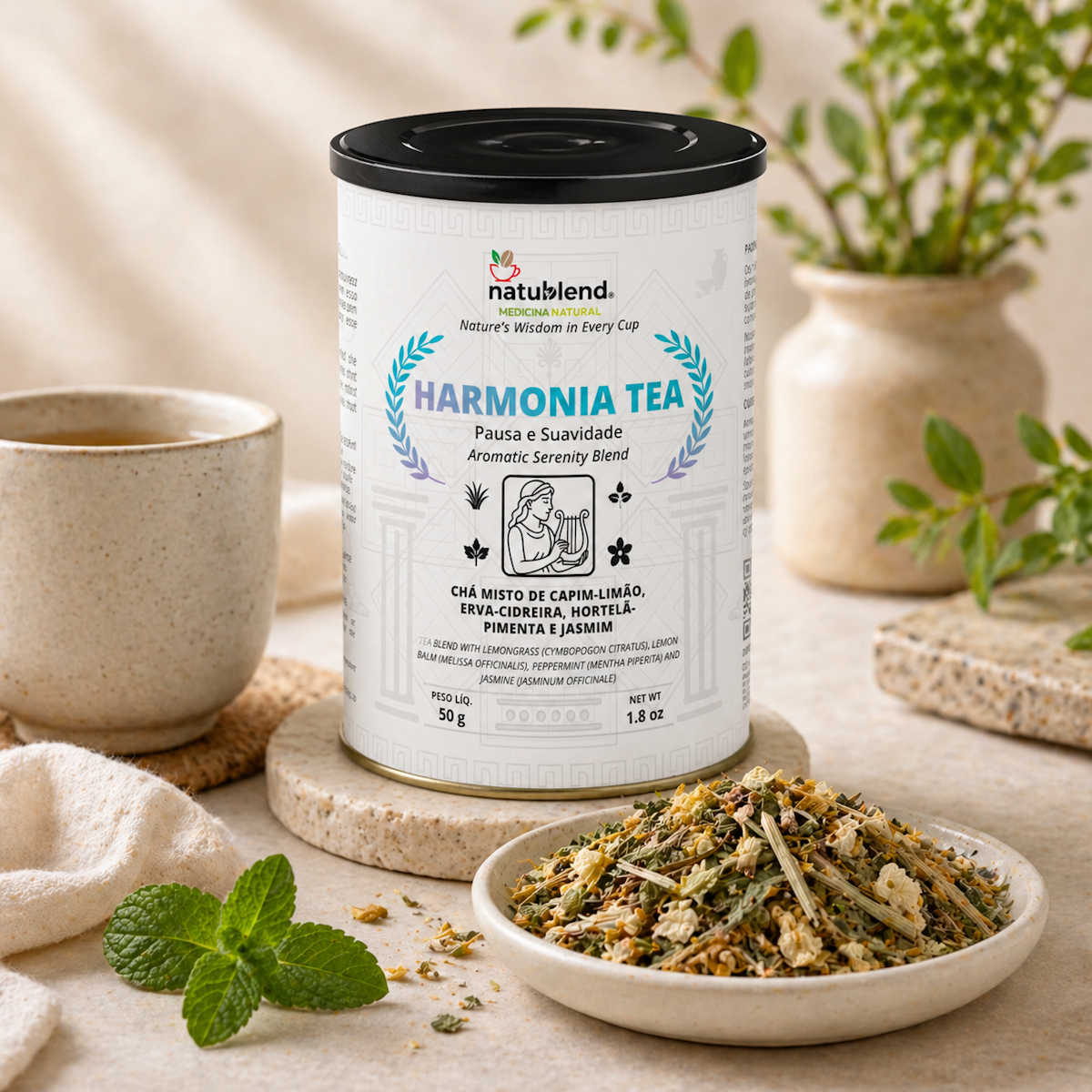
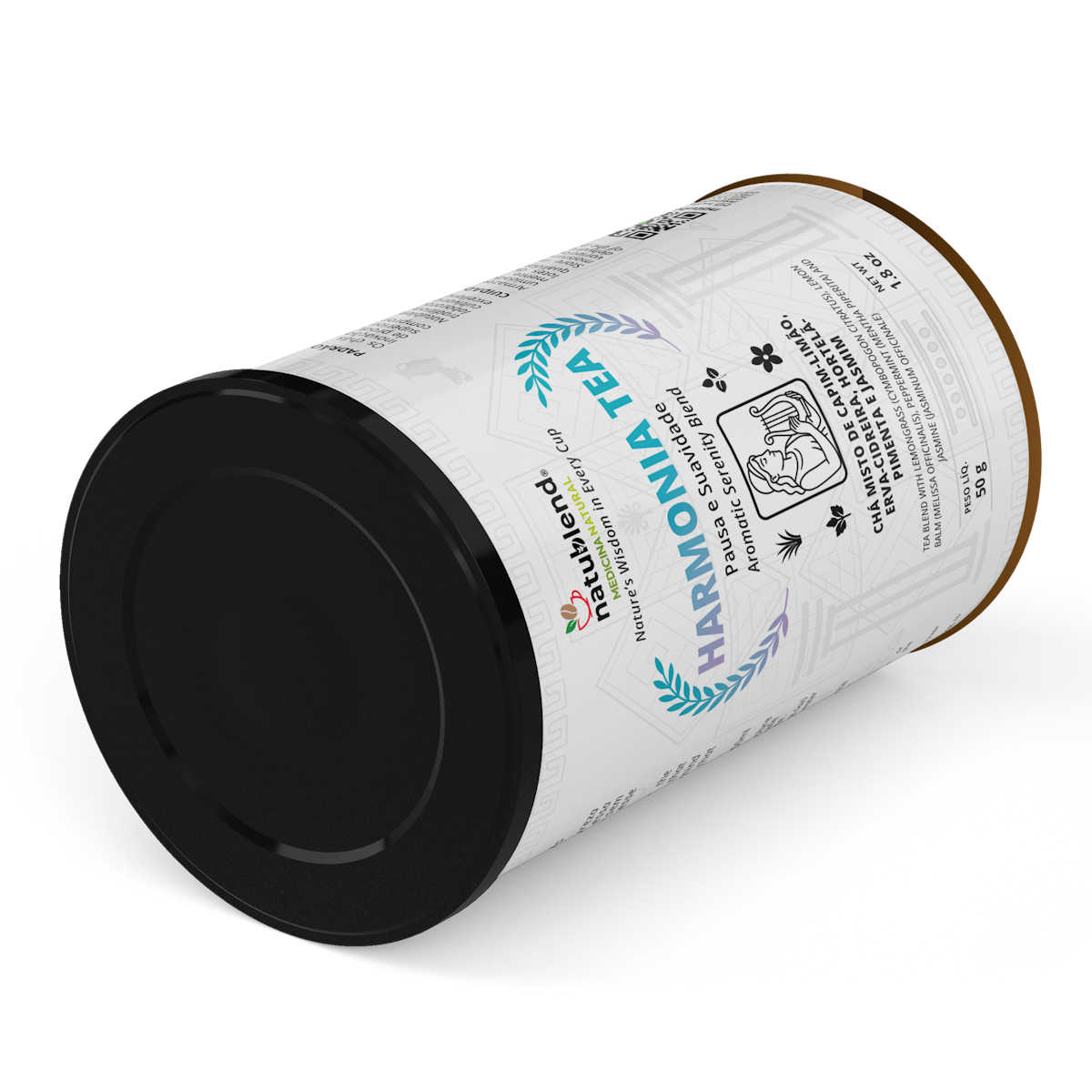
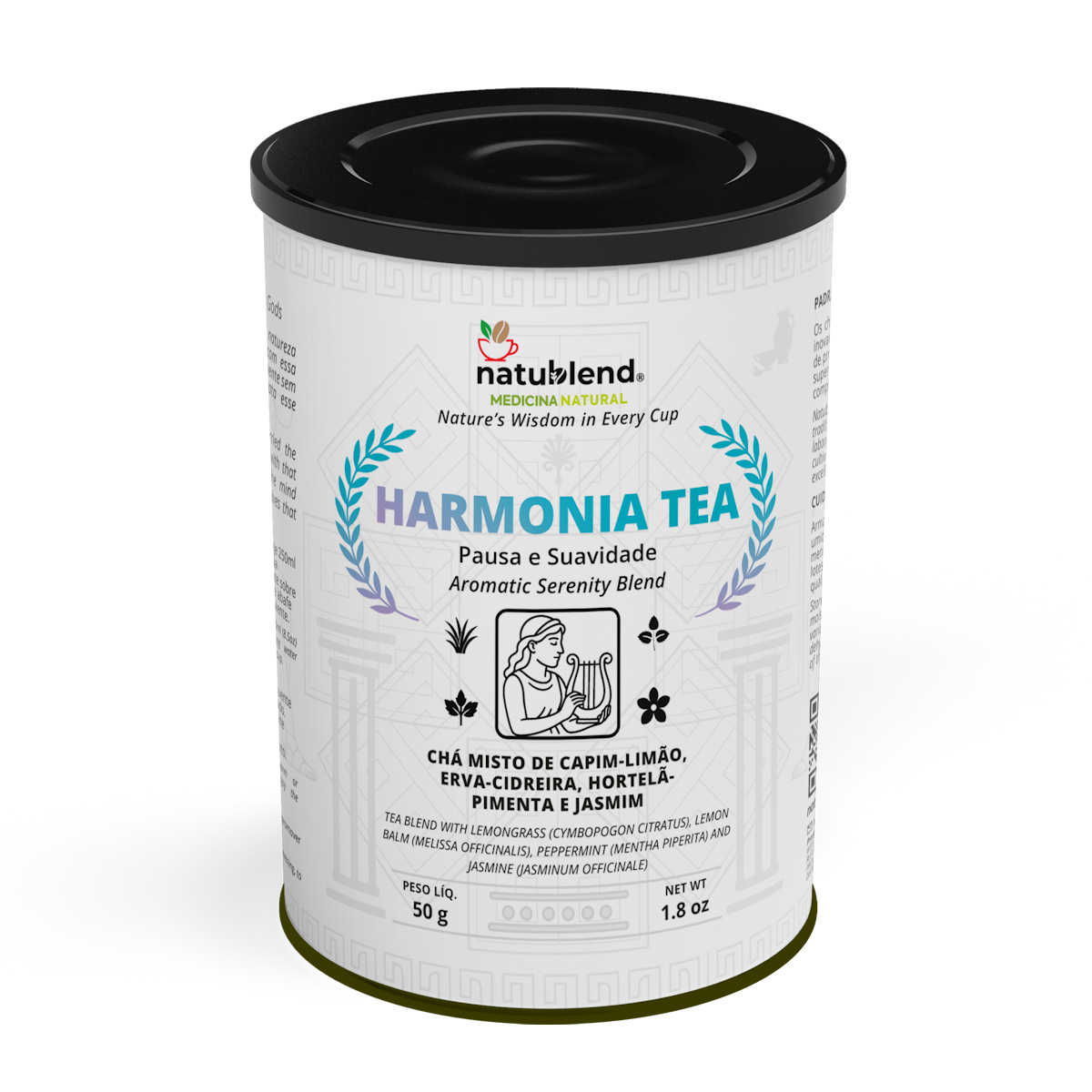
Harmonia Tea combines jasmine, lemon balm, lemongrass, and peppermint in a 50 g tin from Natublend’s Sabedoria dos Deuses (Wisdom of the Gods) collection. Unlike the blends in the collection built on black, green, or white tea, it contains no leaf of Camellia sinensis, the plant that supplies the caffeine in tea, which makes it a caffeine-free infusion of leaves and flowers; the difference between that leaf and infusion herbs becomes clear in the article on the history of tea, from China to the Ribeira Valley.
The name honors Harmonia, the Greek goddess of concord. Natublend suggests the blend for the afternoon break, and this is the article where the series looks most closely at lemon balm, which appears in four of the 15 tins and, in Harmonia Tea, sits at the center of the cup.
Why Harmonia

In Greek mythology, Harmonia is the goddess of harmony and concord, who presided over good relations between spouses and the settling of quarrels and disputes; her opposite is Eris, Discord (Theoi Project, n.d.). In the Theban tradition recorded by the Theoi Project, she was the daughter of Aphrodite, goddess of love, and Ares, god of war. She married Cadmus, founder and king of Thebes, and received at her wedding a necklace forged by Hephaestus that carried a curse; at the end of the story, the couple was turned into serpents (Theoi Project, n.d.). Natublend named the blend in honor of the goddess, and the reference lies in the name and in the illustration the brand uses, which shows Harmonia between a fire altar and the waves of the sea, with a golden lyre.
The Four Ingredients in Harmonia Tea
Lemon balm, presented in more detail in this article, comes first. The other three have their stories told in the articles of other blends, noted in each entry, and here they are described by the role they play in the sequence of flavors in this cup.
Lemon Balm
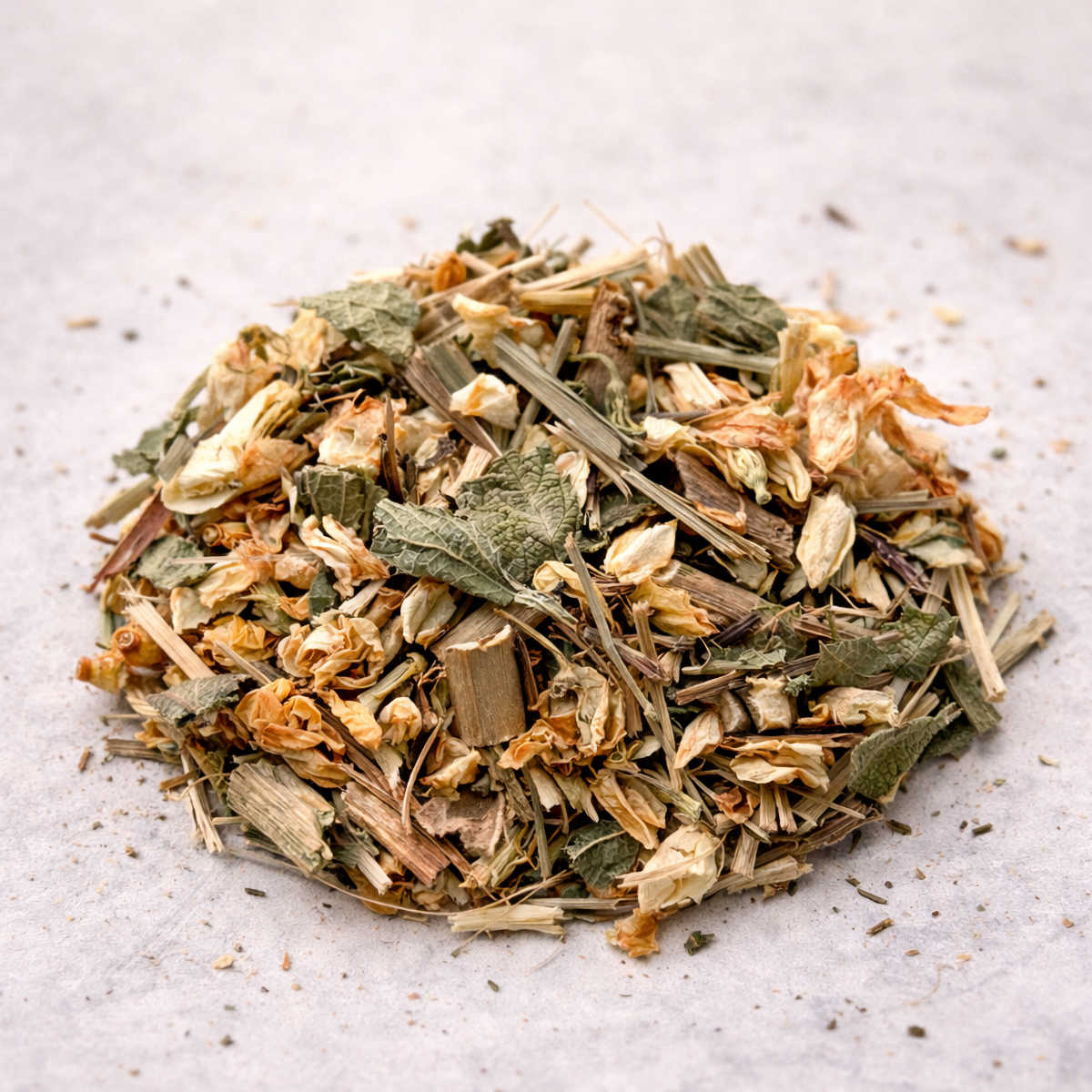
In Harmonia Tea, lemon balm bridges the floral jasmine and the minty peppermint, with the herbal sweetness Natublend attributes to it. Identifying the species calls for care, because the product page does not give the scientific name and, in Brazil, the ingredient’s Portuguese name, erva-cidreira, covers more than one plant: species of Cymbopogon, known as capim-cidreira; Lippia alba, a shrub native to the Americas, in the family Verbenaceae; and Melissa officinalis L., of Mediterranean origin, which Brazilians call erva-cidreira-verdadeira, the true erva-cidreira. Lemongrass already appears in the tin as a separate ingredient, which rules out Cymbopogon, but the page does not make it possible to tell the other two apart; this article treats the ingredient as melissa, in the family Lamiaceae, sold in English-speaking markets as lemon balm and used in the infusion for its leaves (POWO, n.d.).
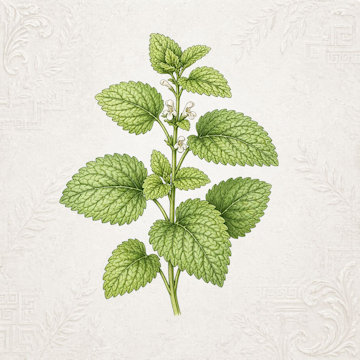
Plants of the World Online places the native range of melissa between the Mediterranean and Central Asia (POWO, n.d.). The Royal Horticultural Society describes it as an aromatic, bushy perennial up to 1 m tall and wide, whose heart-shaped, lemon-scented leaves, 2 to 8 cm long, have scalloped edges. In summer it produces spikes of creamy white or pale purple flowers, rich in nectar, that attract bees and other pollinators, and the leaves are often used as a culinary herb (RHS, n.d.).
Lemongrass
Lemongrass, Cymbopogon citratus (DC.) Stapf, is a perennial grass in the family Poaceae, native to southern India and Sri Lanka according to POWO, and its leaves are the part used in the blend (POWO, n.d.). In Harmonia Tea, it shares the opening with jasmine and accounts for the citrus freshness of the first impression, a sharper, drier lemon note than that of the lemon balm that follows. The plant’s story is told in the Zeus Tea article.
Peppermint
Peppermint, Mentha × piperita L., is a natural hybrid of Mentha aquatica and Mentha spicata in the family Lamiaceae, the same family as melissa, and it goes into the blend as dried leaf (POWO, n.d.). In Harmonia Tea, peppermint brings the cup to a close: the minty finish described by the brand carries the refreshing sensation that the lexicon by Kim and colleagues records under the attribute cooling (Kim et al., 2018). The plant’s story is told in the Venus Tea article.
Jasmine
The jasmine is most likely Jasminum sambac (L.) Aiton, Arabian jasmine, in the family Oleaceae (POWO, n.d.), the species whose flowers scent the traditional jasmine tea of China’s Fujian province (Zhang et al., 2023). In Harmonia Tea, however, the flowers go in with no tea leaf beneath them and account for the floral highlight that Natublend places at the opening. The reference article is the one for Aurora Tea.
Sensory Profile
Dry blend aroma. In the tin, jasmine comes forward first, with the sweet floral perfume of dried jasmine and the slightly musty undertone typical of dried flowers, as described in the lexicon by Kim and colleagues (Kim et al., 2018). Right behind come two distinct lemon notes: that of the lemongrass, drier and with the hint of hay that the same lexicon records, and that of the lemon balm, sweeter and more herbaceous. Peppermint rounds out the whole with a minty freshness that, according to the brand, can already be noticed in the dry blend.
Infusion aroma. With hot water, jasmine and lemongrass rise together, lemon balm fills the center with a sweetish herbal aroma, and peppermint gains strength in the steam. This is the stage where covering the cup makes a difference: the brand notes that the volatile aromas of jasmine and peppermint dissipate quickly on contact with air.
Liquor color. Natublend describes the infusion as a pale, translucent golden yellow, free of cloudiness, with slightly greenish glints that it attributes to lemongrass. If the liquor comes out like that, clean and sparkling, it is what tasting glossaries call bright, as opposed to an opaque, lifeless liquor, which is considered undesirable (SV Tea, n.d.).
Flavor. The first sip is floral and citrusy at once, with jasmine and lemongrass sharing the front. On the mid-palate, lemon balm brings the herbal sweetness Natublend points out, a softer citrus reminiscent of freshly picked leaves. The finish is minty: peppermint leaves a freshness that the brand describes as light and lingering, and that persists for a few moments after swallowing. Without sugar, as Natublend proposes, the progression from floral to minty comes through more clearly.
Body. Light and fluid. The jasmine at the start and the lemon balm in the middle give the cup its only impression of smoothness, and the menthol of the peppermint, concentrated in the finish, leaves the mouth feeling clean, so the sip seems to end lighter than it began.
How to Brew Harmonia Tea
Natublend’s recipe takes only a few steps, and the detail the product page makes a point of mentioning is covering the cup while the herbs steep.
- Heat the water to between 90 and 95 °C.
- Place 2 g of the blend in a cup, infuser, or teapot and pour 200 ml of the hot water over it.
- Cover the cup and let it steep for 5 to 7 minutes.
- Strain and serve without sugar, with a slice of lemon if you want to emphasize the citrus side.
- For a second or third infusion, reuse the same portion.
For the iced version, the brand recommends 2 g in 200 ml of cold water, for 6 to 8 hours in the refrigerator, and by Natublend’s count the 50 g tin makes about 25 cups.
Water this close to boiling may surprise anyone familiar with Chinese jasmine tea, which is brewed well below boiling when the base is green tea. There, the flowers scent the tea leaf (Zhang et al., 2023), and it is the leaf that calls for the lower temperature: for Chinese green tea, the recommendations of the Tea Association of the USA, as reproduced by Bunn, range from 77 to 82 °C (Bunn, n.d.). In Harmonia Tea, the jasmine goes in without that leaf, and the 90 to 95 °C range is consistent with a tin made only of herbs and flowers.
The Time of Day Natublend Suggests
Natublend is specific about when to serve Harmonia Tea: it suggests the blend for the afternoon, between 2 p.m. and 5 p.m., and cites as occasions the break between two appointments and the transition from the workday to the rest of the day. The recipe fits that proposal, since 5 to 7 minutes of steeping with the cup covered call for a real pause, and the reusable herbs allow a second cup later the same afternoon.
The brand also presents the tin as a gift option and, in its precautions section, recommends proper storage, advises consulting a health professional in specific cases, and discourages consumption by children under 12 without guidance.
Other Blends in the Collection
Harmonia Tea is one of the 15 blends in the Sabedoria dos Deuses collection, and two of them help show what sets it apart. Zeus Tea is its closest relative, with jasmine, lemongrass, and peppermint in common, but it uses chamomile in place of lemon balm and reverses the shape of the cup, which ends floral instead of minty. Venus Tea, which bears the Roman name of Aphrodite, Harmonia’s mother in the Theban tradition, shares lemon balm and peppermint with Harmonia Tea and completes its tin with chamomile and sage, in a more herbaceous register.
Frequently Asked Questions
Is There Caffeine in Harmonia Tea?
No. The caffeine in tea comes from the leaf of Camellia sinensis, and Harmonia Tea contains no black, green, or white tea; jasmine, lemon balm, lemongrass, and peppermint are also not among the few infusion plants that have caffeine of their own, such as guarana and yerba mate (Upton Tea Imports, n.d.).
Can Harmonia Tea Be Served Iced?
It can, and Natublend gives the recipe: 2 g of the blend in 200 ml of cold water, for 6 to 8 hours in the refrigerator. According to the brand, when the blend is served iced, the citrus of the lemongrass and the freshness of the peppermint become more pronounced, while the jasmine turns more subtle.
What Should I Serve with Harmonia Tea for an Afternoon Break?
Since jasmine is the most delicate note in the cup, it pays to choose accompaniments that do not compete with it: fresh fruit such as pears and strawberries; lemon or orange cake, which echoes the lemongrass; and plain butter cookies. Heavily spiced sweets, with cinnamon or cloves, tend to mask the floral notes and the minty finish.
Where Does the Name Harmonia Come From?
From the Greek goddess of concord, whom Natublend honors in the blend’s name. In the Theban tradition, Harmonia was the daughter of Aphrodite and Ares, and the collection also includes a blend named after each of them: Ares Tea and Venus Tea, the latter bearing Aphrodite’s Roman name.
This content is informational and describes teas and infusions as foods. It does not replace professional health guidance. Pregnant women, breastfeeding women, children, and people undergoing medical treatment should consult a health professional before adding any infusion to their routine.
References
View All 11 Cited References
Peer-Reviewed Scientific Studies (2)
- PMC2018 KIM, J. H. et al. A Lexicon for Descriptive Sensory Evaluation of Blended Tea. Preventive Nutrition and Food Science, vol. 23, no. 4, pp. 364-373, 2018. Available at: pmc.ncbi.nlm.nih.gov.
- PMC2023 ZHANG, C. et al. Volatilomics Analysis of Jasmine Tea during Multiple Rounds of Scenting Processes. Foods, vol. 12, no. 4, 812, 2023. Available at: pmc.ncbi.nlm.nih.gov.
Supplementary Readings (9)
- THEOI PROJECT. Harmonia. Theoi Greek Mythology, n.d. Available at: theoi.com.
- ROYAL BOTANIC GARDENS, KEW. Melissa officinalis L. Plants of the World Online (POWO), n.d. Available at: powo.science.kew.org.
- ROYAL HORTICULTURAL SOCIETY (RHS). Melissa officinalis. RHS Plants, n.d. Available at: rhs.org.uk.
- ROYAL BOTANIC GARDENS, KEW. Cymbopogon citratus (DC.) Stapf. Plants of the World Online (POWO), n.d. Available at: powo.science.kew.org.
- ROYAL BOTANIC GARDENS, KEW. Mentha × piperita L. Plants of the World Online (POWO), n.d. Available at: powo.science.kew.org.
- ROYAL BOTANIC GARDENS, KEW. Jasminum sambac (L.) Aiton. Plants of the World Online (POWO), n.d. Available at: powo.science.kew.org.
- SV TEA. A Tea Taster’s Glossary. n.d. Available at: svtea.com.
- BUNN. Tea Basics Brochure (temperature recommendations from the Tea Association of the U.S.A.). n.d. Available at: resource.bunn.com.
- UPTON TEA IMPORTS. A Closer Look at the Difference Between Teas, Tisanes and Herbal Infusions. n.d. Available at: uptontea.com.