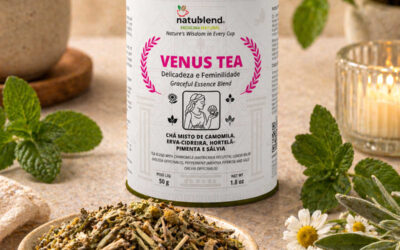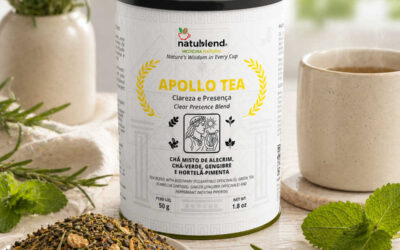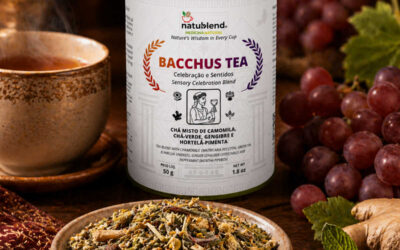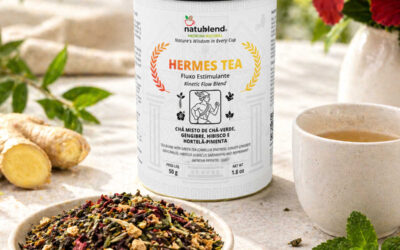
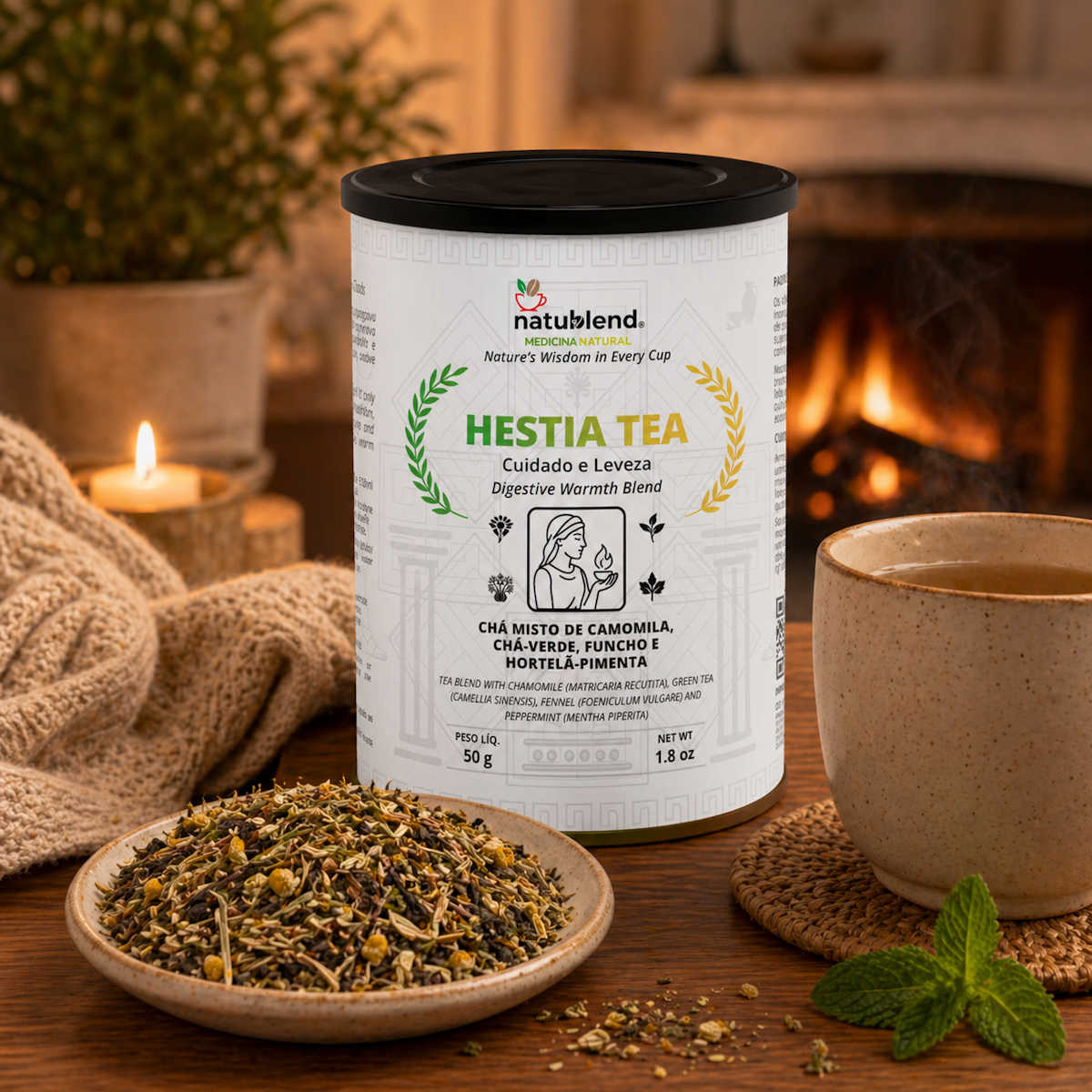
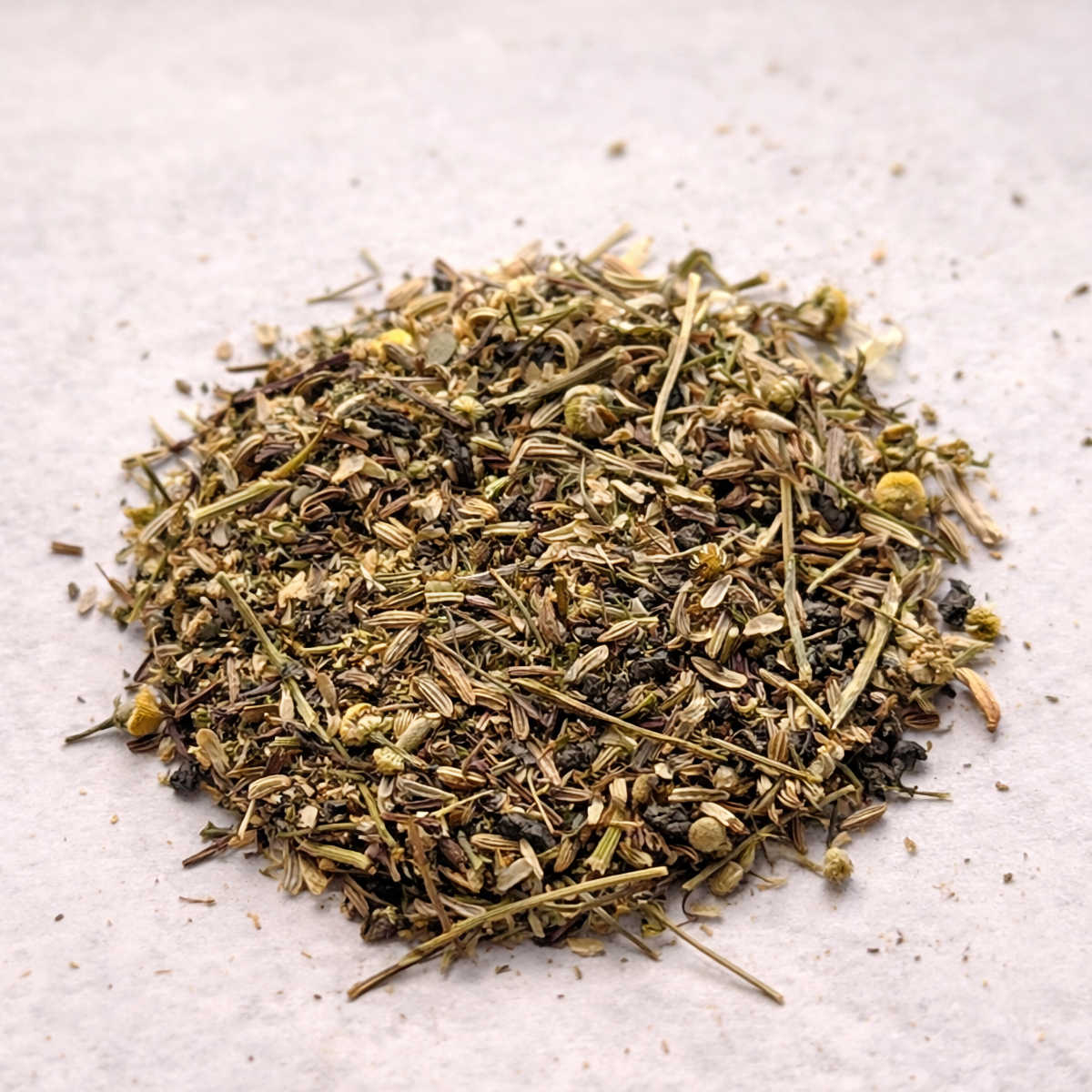
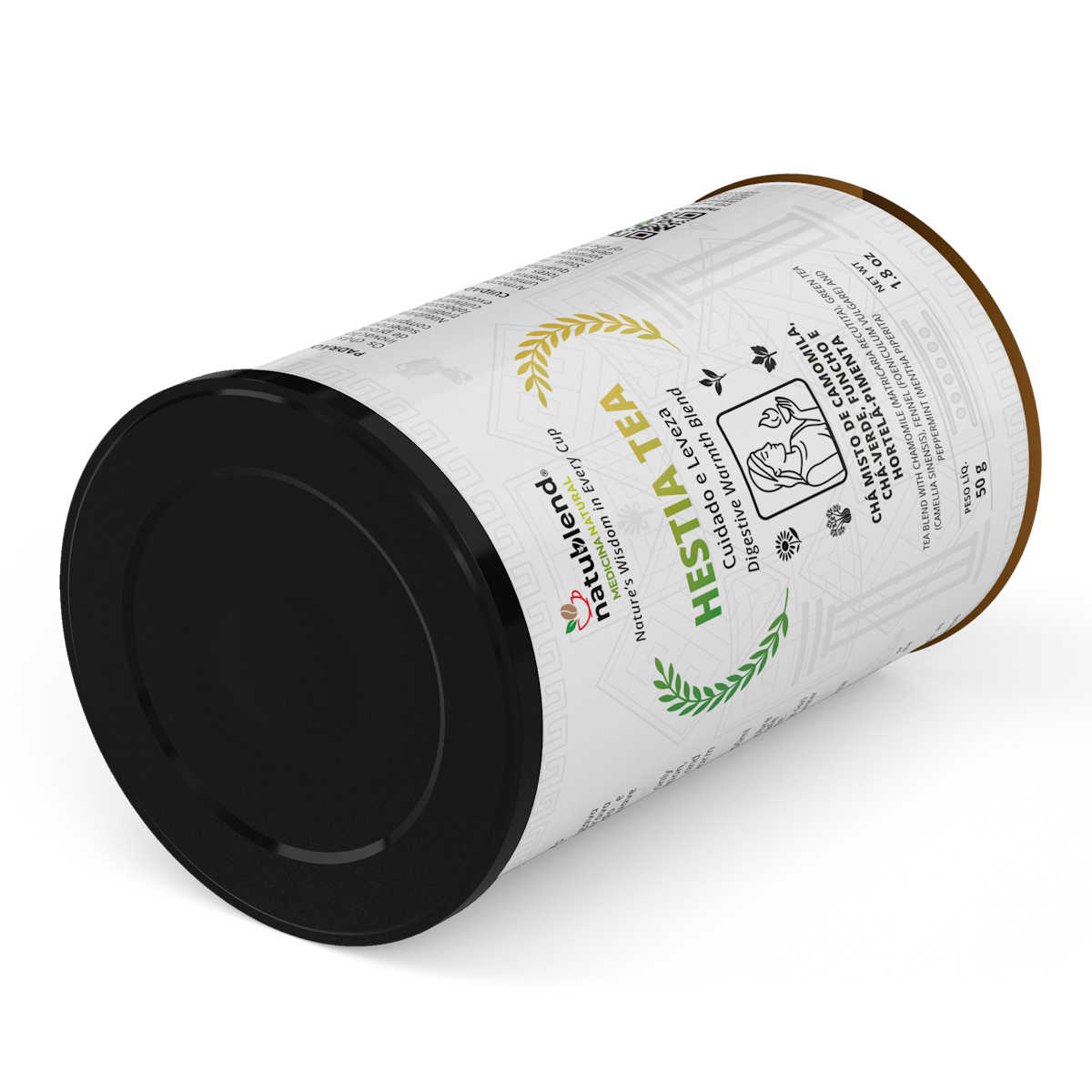
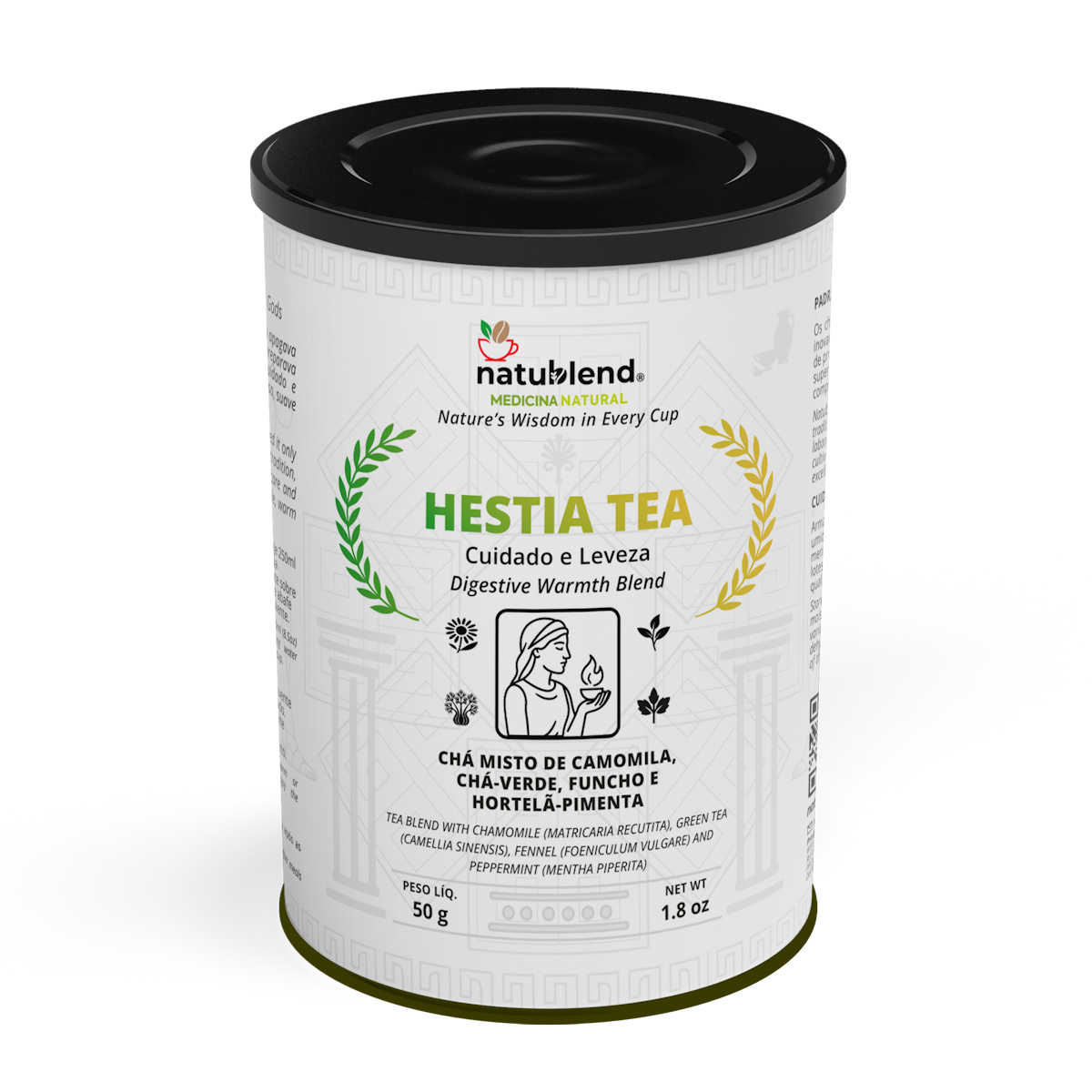
Hestia Tea brings together chamomile, fennel, green tea, and peppermint in a 50 g tin from Natublend’s Wisdom of the Gods collection. The green tea is Camellia sinensis leaf, the same plant whose journey is told in the article on the history of tea, from China to the Ribeira Valley, and it is the source of the blend’s caffeine, since the flower, the fruit, and the aromatic herb that complete the recipe contain none.
The name is a tribute to Hestia, the Greek goddess of the hearth and the sacred flame. Natublend suggests the blend for the minutes after lunch and dinner and presents it as an alternative to the customary after-meal coffee.
Why Hestia

In Greek mythology, Hestia is the virgin goddess of the hearth, both of the home and of the city. She also presided over the sacrificial flame and received a portion of every offering made to the gods (Theoi Project, n.d.). The eldest daughter of Cronus and Rhea, she was the sister of Demeter, Hades, Hera, Poseidon, and Zeus. Courted by Apollo and by Poseidon, she turned them both down and asked Zeus to let her remain a virgin forever. In Rome, her counterpart was Vesta (Theoi Project, n.d.). Natublend named the blend in Hestia’s honor, and the name suits the moment the brand proposes for the tin: the end of a meal, while the table is still set.
The Four Ingredients of Hestia
Fennel is the ingredient this article presents in detail, and only two blends in the collection list it by that name on the label: Hestia and Epione Tea. Chamomile, green tea, and peppermint have their stories told in the articles on other blends, linked in each entry; the product page does not give the proportion of each.
Fennel
POWO, the botanical catalog of the Royal Botanic Gardens, Kew, lists fennel as Foeniculum vulgare Mill., in the Apiaceae family, the same family as carrot, coriander, and dill (POWO, n.d.). The part that goes into the infusion is the dried fruit, a ridged grain the trade calls a seed, and the plant is native to a broad band from the Mediterranean to Ethiopia and western Nepal that takes in Anatolia, the Balkans, the Caucasus, Central Asia, the Iberian Peninsula, and North Africa (POWO, n.d.).
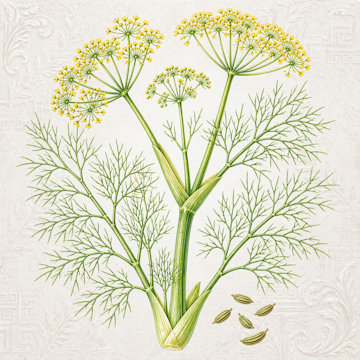
In Brazil, the common name is a source of confusion: the agricultural magazine Revista Cultivar notes that erva-doce can refer to either fennel or anise, Pimpinella anisum, and that in the Northeast of the country the term is more closely tied to anise (Revista Cultivar, n.d.). In the cup, fennel brings an aniseed sweetness reminiscent of licorice, the signature of anethole, the main aromatic compound in the fruit, and in Hestia it bridges the chamomile flower and the freshness of the mint.
Chamomile
From chamomile, Matricaria chamomilla L., in the Asteraceae family (POWO, n.d.), the blend uses the dried flower heads, the small flowers with yellow centers and white petals. In the tin, it carries the aroma that the sensory lexicon of Kim and colleagues describes as a floral fragrance associated with dried flowers, with a faint musty note in the background (Kim et al., 2018); in the cup, it opens the tasting with a soft floral note and sets the stage for the fennel. The plant’s story is told in the article on Bacchus Tea.
Green Tea
Green tea is the young leaf of Camellia sinensis (L.) Kuntze, in the Theaceae family, heated shortly after harvest so that oxidation stops early, which preserves its green color (WSU Extension, n.d.). It is the only ingredient in Hestia with caffeine, and in the cup it shows up mid-palate as a light astringency that gives the blend structure and keeps the sweet side of the recipe from turning heavy. The full story is in the article on Salus Tea.
Peppermint
Peppermint, Mentha × piperita L., a name published by Linnaeus in 1753, is a natural hybrid of Mentha aquatica and Mentha spicata in the Lamiaceae family (POWO, n.d.), and it goes into the blend as dried leaf. It carries Hestia’s finish, with a cooling sensation that lingers after each sip. The plant’s journey is told in the article on Venus Tea.
Sensory Profile
Aroma of the dry blend. In SV Tea’s tasting glossary, nose is the pleasant aroma of the dry leaf (SV Tea, n.d.). In Hestia, according to Natublend’s description, that first scent comes from the fennel, aniseed and sweet, with a distinct minty streak of peppermint on top and chamomile in the background, herbaceous and sweet.
Aroma of the infusion. In hot water, the aniseed and minty notes are joined by the herbaceous side the brand attributes to green tea, and chamomile, discreet in the tin, gains ground as a dried-flower perfume.
Liquor color. The brand describes the infusion as greenish gold, translucent, and clean. In taster’s language, it is a bright liquor, clear and lively, and the greenish tone, which would count as a flaw in a black tea, is exactly what to expect here from a cup made with green leaf (SV Tea, n.d.).
Flavor. The attack is floral and smooth, with chamomile up front. On the mid-palate come the aniseed sweetness of fennel and the light astringency of green tea, a subtle tug on the tongue that balances the sweet side of the seed, and the finish goes to peppermint, with what the lexicon by Kim and colleagues describes as a cooling sensation accompanied by herbaceous aromas (Kim et al., 2018).
Body. The brand does not classify the body, but the combination of a flower, a seed, and two leaves tends toward a light, fluid liquor, with the astringency of green tea giving it shape without weight.
How to Brew Hestia
Hestia is brewed like any blend built on green tea, with water below boiling and a short steep.
- Heat the water to between 80 and 85 °C (176 to 185 °F), short of boiling; without a thermometer, wait 3 to 4 minutes after it boils.
- Use 2 g of the blend for every 200 ml of water.
- Pour in the water and cover the cup right away.
- Let it steep for 4 to 5 minutes, then strain.
- Serve it plain, without sugar, as the brand suggests.
- If you like, reuse the same portion for one or two more infusions.
The temperature range is set by the green tea. For this type of tea, the Tea Association of the USA recommends water between 82 and 85 °C, or about 180 to 185 °F (Tea Association of the USA, n.d.), and the reason lies in the chemistry of the leaf: since it has not been oxidized, its catechins remain nearly intact and dissolve quickly in boiling water, drawing out bitterness and astringency, whereas the amino acids, responsible for the sweeter side, are extracted well in both hot and warm water (My Japanese Green Tea, n.d.). For the iced version, the brand suggests 2 g in 200 ml of cold water, for 6 to 8 hours in the refrigerator.
The Moment Natublend Suggests
Natublend had Hestia in mind for the minutes after lunch and dinner, and its brewing note specifies 10 to 15 minutes after the meal. The brand presents the blend as an alternative to the cafezinho, the small cup of coffee that in many Brazilian homes arrives right after the main course, and the choice makes sense at the table, because the anise notes of the fennel and the minty finish of the peppermint close the meal in a register quite different from the roasted bitterness of coffee.
Swapping coffee for Hestia does not mean leaving caffeine behind, since green tea is part of the recipe. Natublend does not state the amount per cup, which varies with steeping time and temperature, and anyone who avoids caffeine after dinner should take that into account. The brand also states that the blend is not recommended for children under 12 without professional guidance.
Other Blends in the Collection
Hestia is one of the 15 blends in the Wisdom of the Gods collection, and two of them are its close relatives. Bacchus Tea repeats three of Hestia’s four ingredients, chamomile, green tea, and peppermint, and swaps fennel for ginger, which removes the aniseed note and puts a mid-palate spiciness in its place. Epione Tea is the only other blend in the collection with fennel on the label and also keeps the chamomile, but it has neither tea leaf nor caffeine and finishes on the earthy register of sage rather than the freshness of mint.
Frequently Asked Questions
Does Hestia Contain Caffeine?
It does, because green tea, the leaf of Camellia sinensis, is part of the recipe. The swap Natublend proposes is one of flavor and ritual, and the caffeine stays in the cup, in an amount the brand does not state and that changes with steeping time and temperature.
Does Hestia Work as an Iced Tea?
It does, and the brand provides the recipe: 2 g of the blend in 200 ml of cold water, for 6 to 8 hours in the refrigerator. Without heat, the catechins in green tea dissolve less, which usually makes the iced version less astringent than the hot one.
Which Desserts Pair with Hestia?
Since Natublend places Hestia right after the meal, it often shares the table with dessert. Chocolate and mint are a classic pairing in pastry, and fennel, with its hint of anise and licorice, goes well with fruits such as apples and pears; a square of dark chocolate or a simple fruit salad keeps the minty finish of the cup in the spotlight.
Is Hestia Spelled the Same Way as the Goddess’s Name?
It is: on the tin, Natublend used the unaccented spelling, the same one used in English, while in Portuguese the hearth goddess honored by the blend is written Héstia.
This content is informational and describes teas and infusions as foods. It does not replace professional health guidance. Pregnant women, breastfeeding women, children, and people undergoing medical treatment should consult a health professional before adding any infusion to their routine.
References
View All 10 Cited References
Peer-Reviewed Scientific Studies (1)
- PMC2018 KIM et al. A Lexicon for Descriptive Sensory Evaluation of Blended Tea. Preventive Nutrition and Food Science, vol. 23, no. 4, pp. 364-373, 2018. Available at: pmc.ncbi.nlm.nih.gov.
Institutional Sources (1)
- GOV WASHINGTON STATE UNIVERSITY EXTENSION. Tea Types and Home Processing. n.d. Available at: vegetables.wsu.edu.
Supplementary Readings (8)
- THEOI PROJECT. Hestia. Theoi Greek Mythology, n.d. Available at: theoi.com.
- ROYAL BOTANIC GARDENS, KEW. Foeniculum vulgare Mill. Plants of the World Online (POWO), n.d. Available at: powo.science.kew.org.
- REVISTA CULTIVAR. Erva-doce: Foeniculum vulgare Mill. ou Pimpinella anisum L.? n.d. Available at: revistacultivar.com.br.
- ROYAL BOTANIC GARDENS, KEW. Matricaria chamomilla L. Plants of the World Online (POWO), n.d. Available at: powo.science.kew.org.
- ROYAL BOTANIC GARDENS, KEW. Mentha × piperita L. Plants of the World Online (POWO), n.d. Available at: powo.science.kew.org.
- SV TEA. A Tea Taster’s Glossary. n.d. Available at: svtea.com.
- TEA ASSOCIATION OF THE U.S.A. Tea preparation brochure (distributed by Bunn). n.d. Available at: resource.bunn.com.
- MY JAPANESE GREEN TEA. Bitterness in Green Tea. n.d. Available at: myjapanesegreentea.com.