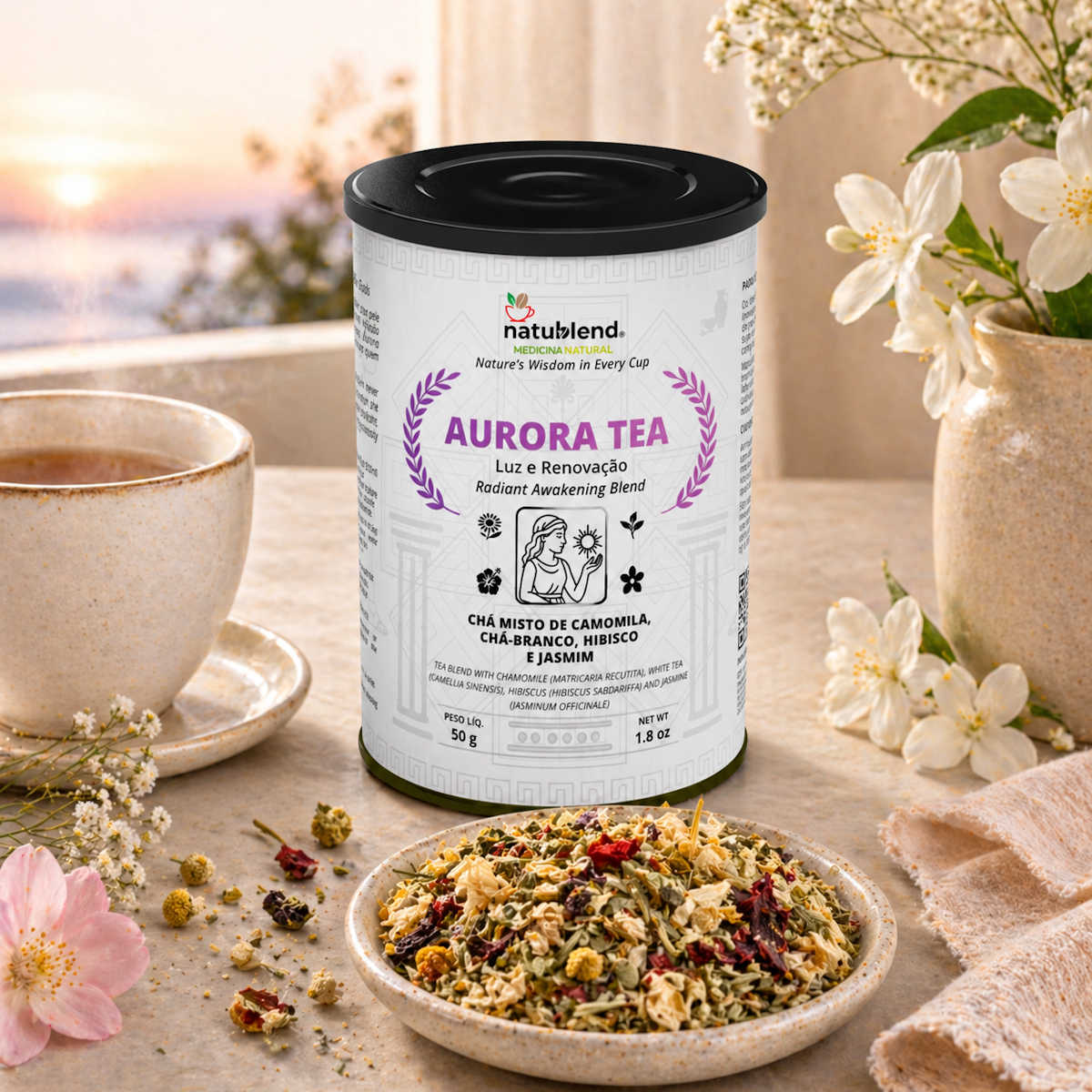
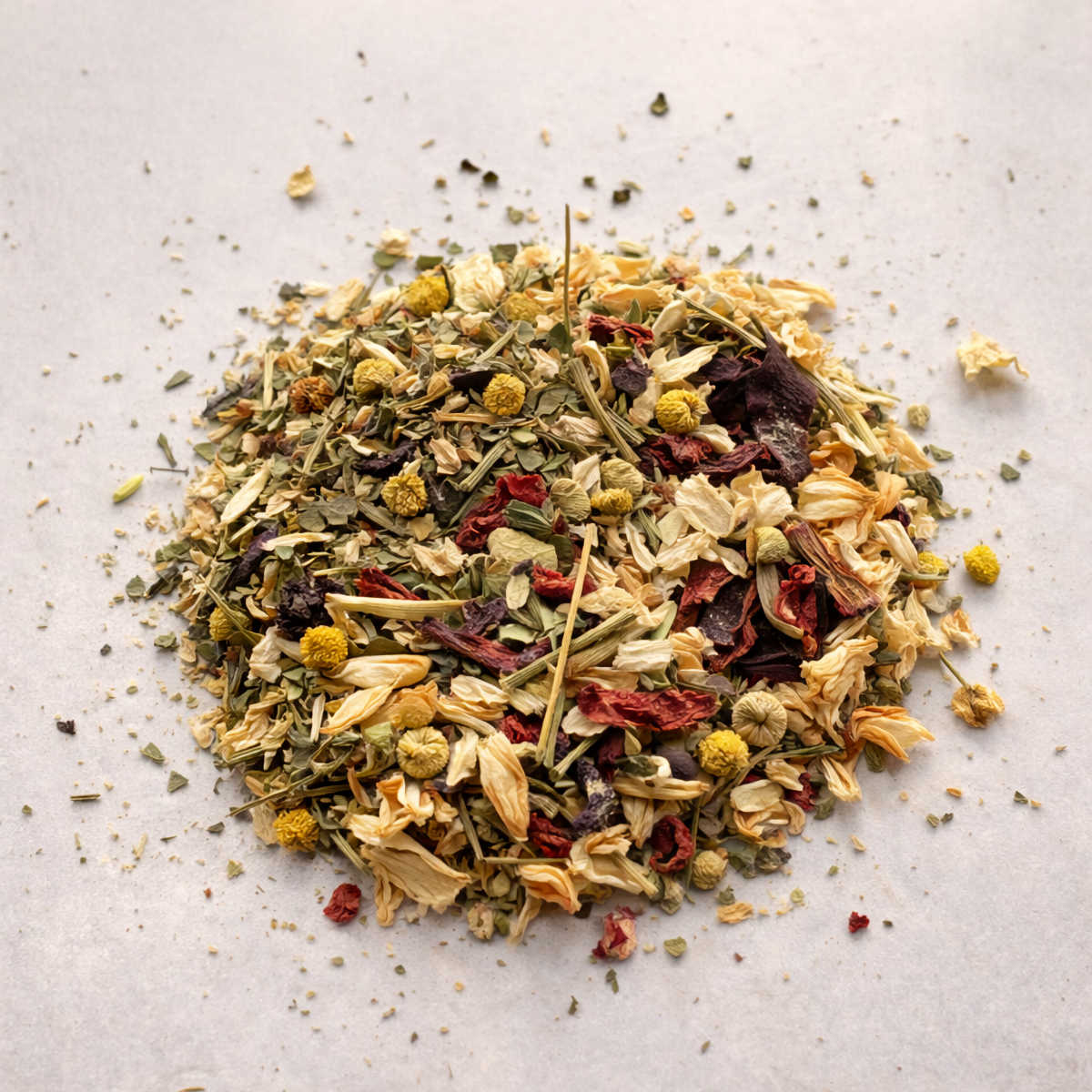
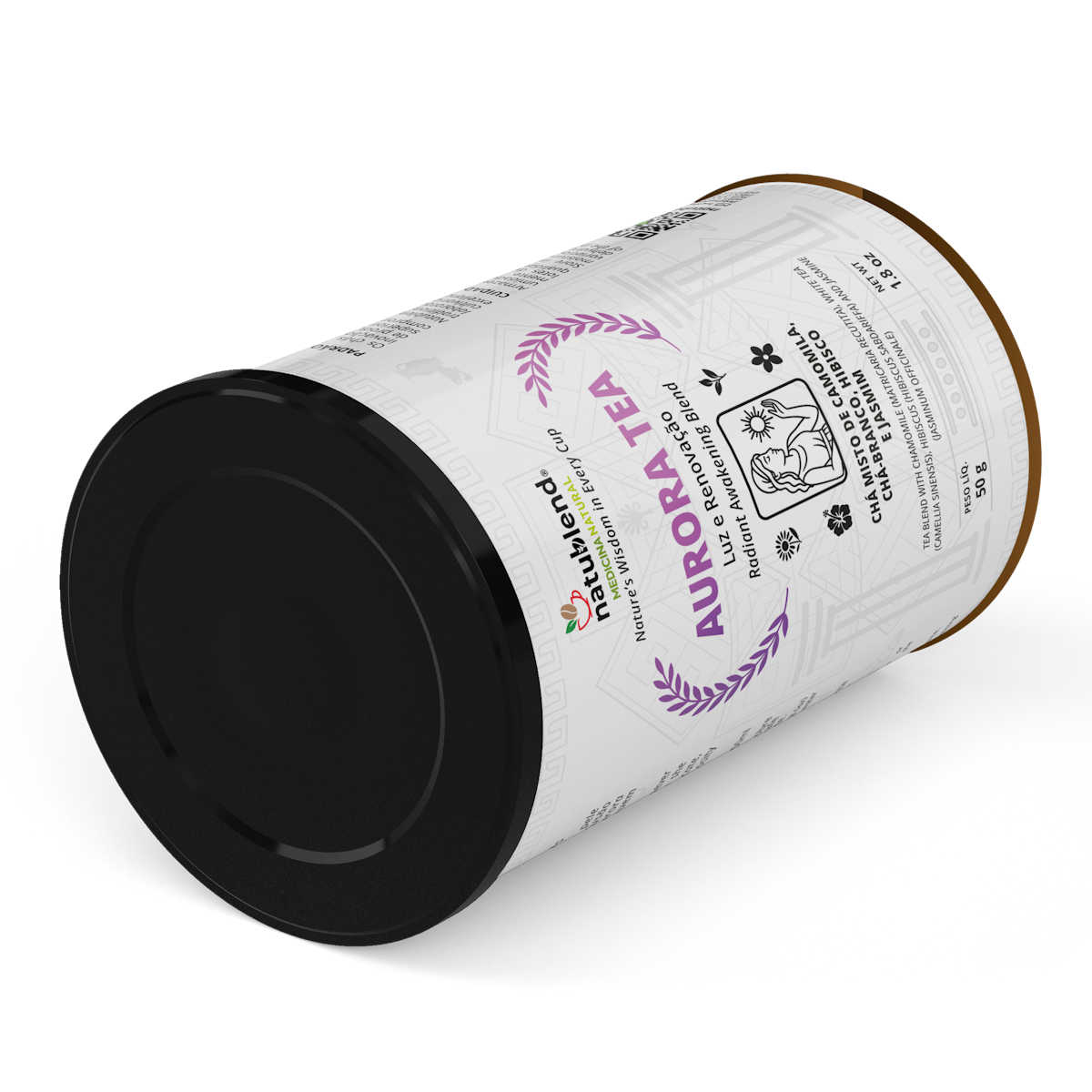
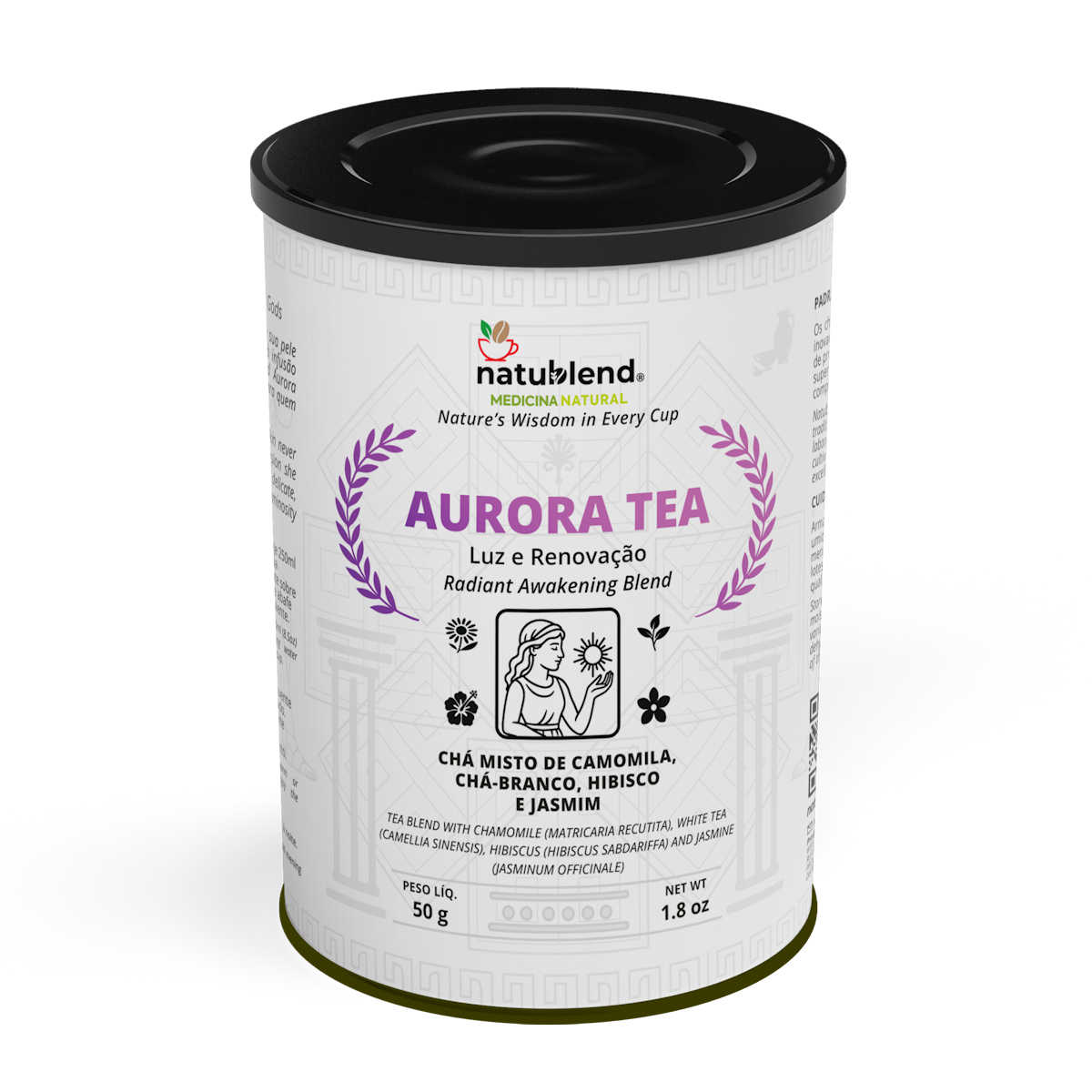
Aurora Tea brings together chamomile, hibiscus, jasmine, and white tea in a 50 g tin from Natublend’s Wisdom of the Gods collection. White tea, made from the buds and young leaves of Camellia sinensis, the plant behind black tea and green tea, is the only one of the four ingredients that contains caffeine; the path this leaf took to Brazil is traced in the article on the history of tea, from China to the Ribeira Valley.
The name honors Aurora, the Roman goddess of dawn, whom the Greeks called Eos. Natublend suggests Aurora Tea for the first cup of the morning, before the day’s routine gets underway, and draws attention to the color of the infusion, which starts out pale gold and reaches ruby within a few minutes.
Why Aurora

Aurora is the Roman name for Eos, the Greek goddess of dawn. According to the Theoi Project, she is a second-generation Titaness who rises from the river Oceanus every morning to scatter the mists of night and crosses the sky in a chariot drawn by winged horses, or flies on her own wings (Theoi Project, n.d.). She is the daughter of Hyperion and Theia, and the sister of Helios, the Sun, and of Selene, the Moon. The myths credit her with a long list of mortal lovers, among them Cephalus, Orion, and Tithonus, and tradition explains this behavior as the result of a curse laid on her by Aphrodite. Natublend named the blend in honor of the goddess, and the collection’s illustration, at the top of this page, shows her in a golden chariot drawn by horses, among clouds tinted by the sunrise.
The Four Ingredients in Aurora Tea
White tea and jasmine come first and get more detail, because this is the article in which the series tells the story of these two; chamomile and hibiscus get a summary and a link to the article where each of them is introduced.
White Tea
Botanically speaking, there is no such thing as a white tea plant. White tea comes from the same Camellia sinensis (L.) Kuntze, in the family Theaceae, that gives us black tea and green tea (POWO, n.d.), and what sets the three apart is how the leaf is harvested and processed. For white tea, the buds and youngest leaves are picked, and the processing is the simplest of the three: the leaves are only dried, without being rolled or crushed, and they barely oxidize. For green tea, heat applied right at the start halts oxidation, and black tea is the most oxidized of all, according to the Washington State University extension guide (WSU Extension, n.d.).
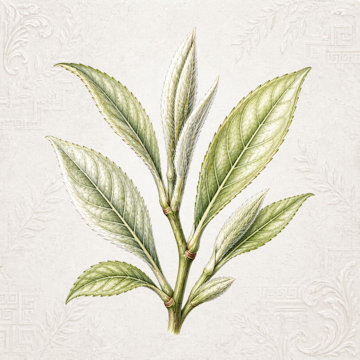
The species is native to a range that stretches from the eastern Himalayas to southern China, northern Indochina, and the island of Hainan (POWO, n.d.), and Natublend does not say where the white tea in Aurora Tea comes from. In the cup, its role has more to do with texture than with fragrance: according to the brand, the leaf is barely noticeable in the dry aroma and only reveals itself in the water, with an almost silky texture and no harshness.
Jasmine
Jasmine is the first thing you notice when you open a tin of Aurora Tea and the last thing that lingers after the sip. The product page does not name the species, but the most likely candidate is Jasminum sambac (L.) Aiton, Arabian jasmine, in the family Oleaceae, the same family as the olive tree (POWO, n.d.). The part of the plant that goes into the blend is the flower.
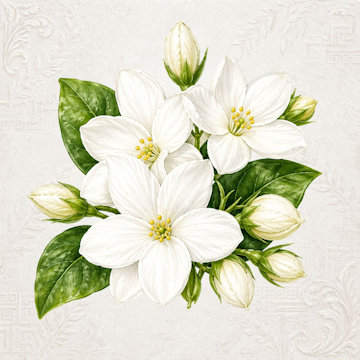
According to PROSEA, a compendium of the plant resources of Southeast Asia, the flowers of J. grandiflorum and J. sambac are the ones traditionally used to scent jasmine tea, in which the flower lends its aroma to the tea leaf (PROSEA, n.d.). In Aurora Tea, jasmine is listed as an ingredient in its own right, alongside the white tea. The sensory lexicon for blended teas published by Kim and colleagues describes the aroma of dried jasmine as floral and sweet, with a faint musty touch typical of dried flowers (Kim et al., 2018). In a cup of Aurora Tea, according to the brand, it is the floral side of that fragrance that stays on the lips after the last sip.
Chamomile
The chamomile in Aurora Tea is Matricaria chamomilla L., in the family Asteraceae, used as dried flower heads; Matricaria recutita, a name often seen on labels, is considered a synonym of the same species (POWO, n.d.). Here it opens the sip, with the floral, slightly sweet base the brand compares to apple and honey, and it carries the cup while the hibiscus has yet to tint the infusion. The story of the plant is told in the article on Bacchus Tea.
Hibiscus
The hibiscus in Aurora Tea is Hibiscus sabdariffa L., in the family Malvaceae, and the infusion uses its dried calyces, the fleshy sepals that enclose the fruit after the flower falls, rather than its petals (POWO, n.d.). The hibiscus is behind Aurora Tea’s change of color as it steeps, from gold to ruby, and also behind the gentle, fruity tartness that appears in the middle of the sip; the longer it stays in the water, the more the hibiscus takes over, in both color and flavor. The plant is covered in depth in the article on Hermes Tea.
Sensory Profile
Aroma of the dry blend. When the tin is opened, the jasmine arrives first, floral and sweet. Beneath it come the chamomile, with the apple-and-honey scent the brand highlights, and the hibiscus, with a discreet hint of red fruit; the white tea barely registers in this first impression.
Aroma of the infusion. In hot water, the chamomile and jasmine spread through the steam within the first few seconds, which is why the brand asks for the vessel to be covered. Then the hibiscus gains ground, with the profile Monteiro and colleagues describe for its calyces, made up of red-fruit, sour, and sweet notes and a touch reminiscent of candy (Monteiro et al., 2017).
Liquor color. In the first few minutes, the liquor is pale gold, as white tea would have it; then the hibiscus tints it rosé and, between the fourth and fifth minute, a vivid ruby that stays translucent against the light, according to the brand. On the liquor color atlas by Su and colleagues, which runs from pale greenish yellow to red (Su et al., 2021), Aurora Tea travels a good part of the scale within a single cup.
Flavor. On the attack, the chamomile opens with its floral, slightly sweet base, and the white tea adds its almost silky texture. The gentle tartness of the hibiscus comes in on the mid-palate and takes the lead once the infusion reaches 5 minutes. The finish belongs to the jasmine, a floral fragrance that lingers after the sip.
Body. Light and fluid: the white tea softens the sip, and the tartness of the hibiscus gives the cup definition.
How to Brew Aurora Tea
Natublend’s recipe for Aurora Tea uses the lowest temperature range in the collection, the same one used for Ares Tea, which also contains white tea.
- Heat the water to between 75 and 80 °C; if you have no thermometer, wait 5 to 6 minutes after it boils or mix in a little cold water.
- Measure out 2 g of the blend for every 200 ml of water.
- Pour the water in gently and cover the vessel.
- Steep for 4 to 5 minutes: at 4, the cup is more floral; at 5, the hibiscus and the color gain intensity.
- Strain without pressing the flowers and leaves, and serve without sugar, as the brand recommends.
- If you like, reuse the same portion for one or two more infusions.
According to Natublend, the range exists because of the white tea, which turns bitter above 80 °C. In a lightly oxidized leaf, the catechins, responsible for much of the bitterness and astringency, remain almost intact and dissolve easily in boiling water, while the amino acids, which taste sweeter, are readily extracted at any temperature (My Japanese Green Tea, n.d.); with water below the boil, the cup leans toward the sweet side.
For the iced version, Natublend recommends 2 g in 200 ml of cold water, left in the refrigerator for 8 to 10 hours. The brand also advises against metal infusers, because of the acidity of the hibiscus, and recommends ceramic, food-grade plastic, or glass instead.
Natublend’s Suggested Moment
On its store page, Natublend presents Aurora Tea with the line “The Cup That Opens the Day.” The idea is a short ritual before the day’s schedule starts making demands, in which the brewing itself is part of the pleasure, from the wait after the water boils to the color changing under the lid. The brand also mentions Aurora Tea for breaks throughout the day and presents it as a gift option.
The caffeine in the white tea counts toward the day’s total: Natublend does not state the amount, which varies with steeping time and water temperature, and anyone who keeps track of their own intake should count Aurora Tea along with the coffee and other teas they drink. The brand does not recommend the blend for children under 12 without professional guidance.
Other Blends in the Collection
Aurora Tea is one of the 15 blends in the Wisdom of the Gods collection, and several of them share one of its ingredients; two of them help explain Aurora Tea by contrast. Ares Tea is the other blend in the collection made with white tea, but it swaps the flowers for cloves, ginger, and peppermint, which puts the same leaf in a spiced, pungent register. Harmonia Tea uses jasmine without any Camellia sinensis leaf, alongside lemon balm, lemongrass, and peppermint, in a more citrusy, caffeine-free cup.
Frequently Asked Questions
Does Aurora Tea Contain Caffeine?
Yes, because of the white tea, which is a leaf of Camellia sinensis, the same plant as black tea and green tea; chamomile, hibiscus, and jasmine add no caffeine to the cup. Natublend does not state the amount.
What Is Aurora Tea Like When Cold-Brewed?
Tarter and fruitier. In the iced version Natublend recommends, with 8 to 10 hours in the refrigerator, the ruby turns deeper, the hibiscus moves to the front, and the jasmine recedes.
What Goes Well with Aurora Tea?
Since the brand suggests Aurora Tea for the start of the day, it suits a breakfast table that leans more sweet than savory: berries, orange cake, pão de mel (a Brazilian honey cake), or plain yogurt go well with the tartness of the hibiscus and the fragrance of the jasmine.
Is Aurora a Greek or a Roman Name?
Roman. Aurora is the name the Romans gave to the goddess of dawn, whom the Greeks called Eos. Natublend chose the Latin form to name the blend, in honor of the goddess.
This content is informational and describes teas and infusions as foods. It does not replace professional health guidance. Pregnant women, breastfeeding women, children, and people undergoing medical treatment should consult a health professional before adding any infusion to their routine.
References
View All 11 Cited References
Peer-Reviewed Scientific Studies (2)
- PMC2018 KIM, J. H. et al. A Lexicon for Descriptive Sensory Evaluation of Blended Tea. Preventive Nutrition and Food Science, v. 23, n. 4, p. 364-373, 2018. Available at: pmc.ncbi.nlm.nih.gov.
- PMC2021 SU, T.-C. et al. Using Sensory Wheels to Characterize Consumers’ Perception for Authentication of Taiwan Specialty Teas. Foods, v. 10, n. 4, 836, 2021. Available at: pmc.ncbi.nlm.nih.gov.
Institutional Sources (1)
- GOV WASHINGTON STATE UNIVERSITY EXTENSION. Tea Types and Home Processing. n.d. Available at: vegetables.wsu.edu.
Supplementary Readings (8)
- THEOI PROJECT. Eos. Theoi Greek Mythology, n.d. Available at: theoi.com.
- ROYAL BOTANIC GARDENS, KEW. Camellia sinensis (L.) Kuntze. Plants of the World Online (POWO), n.d. Available at: powo.science.kew.org.
- ROYAL BOTANIC GARDENS, KEW. Jasminum sambac (L.) Aiton. Plants of the World Online (POWO), n.d. Available at: powo.science.kew.org.
- PROSEA (PLANT RESOURCES OF SOUTH-EAST ASIA). Jasminum. Pl@ntUse, n.d. Available at: uses.plantnet-project.org.
- ROYAL BOTANIC GARDENS, KEW. Matricaria chamomilla L. Plants of the World Online (POWO), n.d. Available at: powo.science.kew.org.
- ROYAL BOTANIC GARDENS, KEW. Hibiscus sabdariffa L. Plants of the World Online (POWO), n.d. Available at: powo.science.kew.org.
- 2017 MONTEIRO, M. J. P. et al. Cross-cultural development of hibiscus tea sensory lexicons for trained and untrained panelists. Journal of Sensory Studies, v. 32, n. 5, e12297, 2017. DOI: 10.1111/joss.12297. Table 3 available at: gala.gre.ac.uk.
- MY JAPANESE GREEN TEA. Bitterness in Green Tea. n.d. Available at: myjapanesegreentea.com.