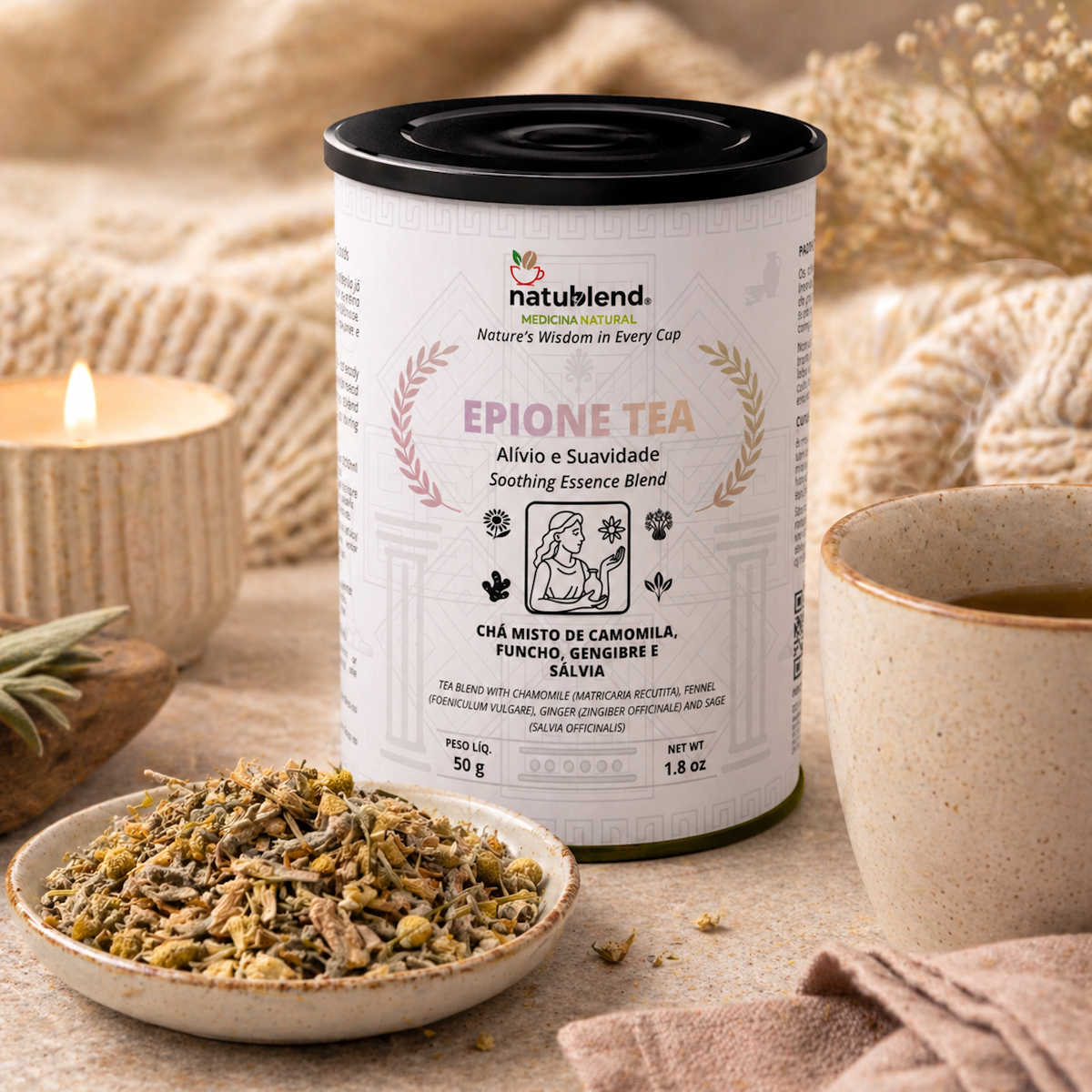
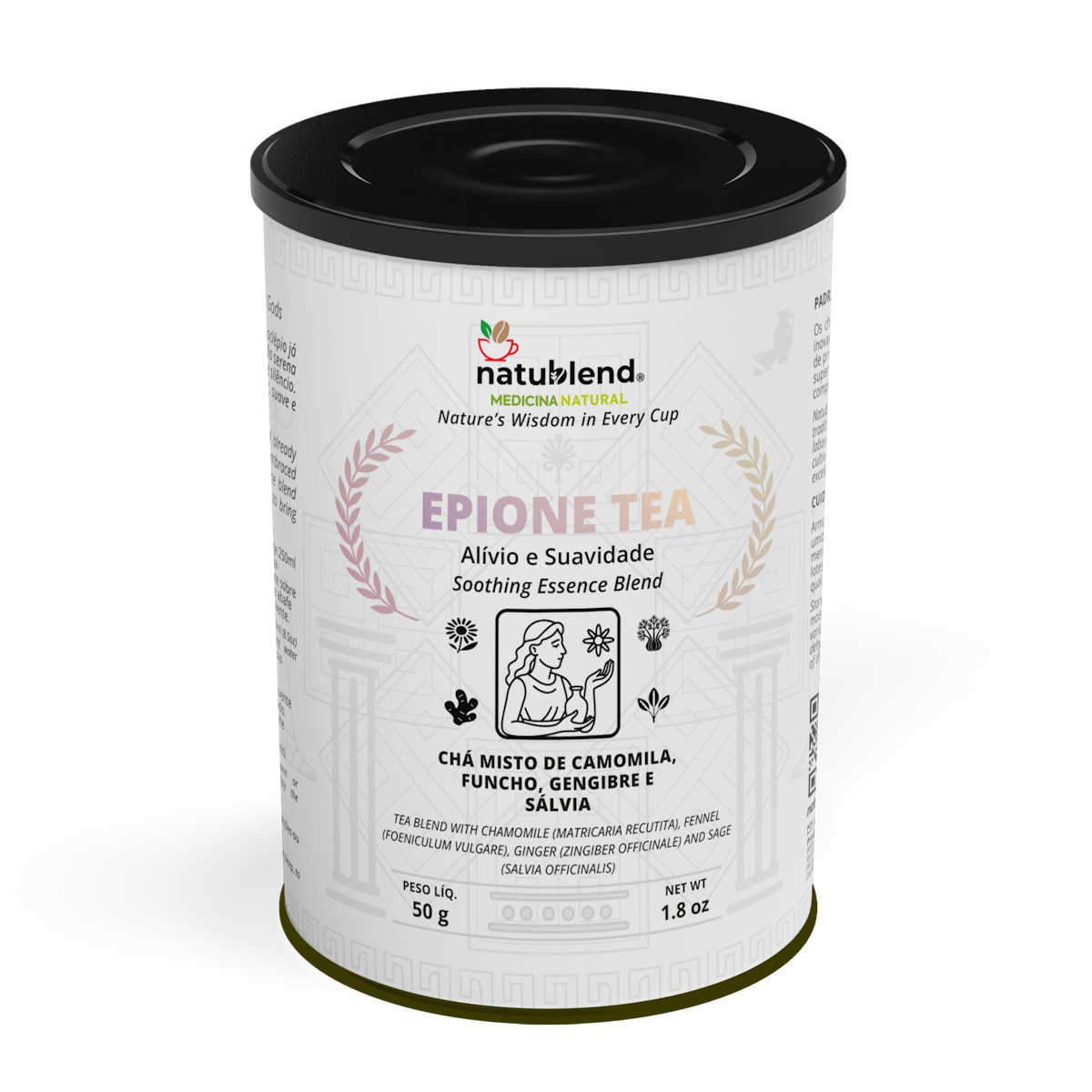
Flower, fruit, rhizome, and leaf: chamomile, fennel, ginger, and sage are the four plants Natublend combines in Epione Tea, a 50 g tin from the Sabedoria dos Deuses (Wisdom of the Gods) collection. Unlike much of the collection, the blend does without the leaf of Camellia sinensis, the plant traced from its origins in the article on the history of tea, from China to the Ribeira Valley. Since none of the four ingredients is a natural source of caffeine, Epione reaches the cup without any.
Epione, the goddess honored in the name, is a minor figure in Greek mythology, presented by tradition as the wife of Asclepius. Rather than tying Epione to a fixed time of day, the brand associates it with the day’s pauses, the ones with room for a long infusion of 6 to 8 minutes with the cup covered.
Why Epione
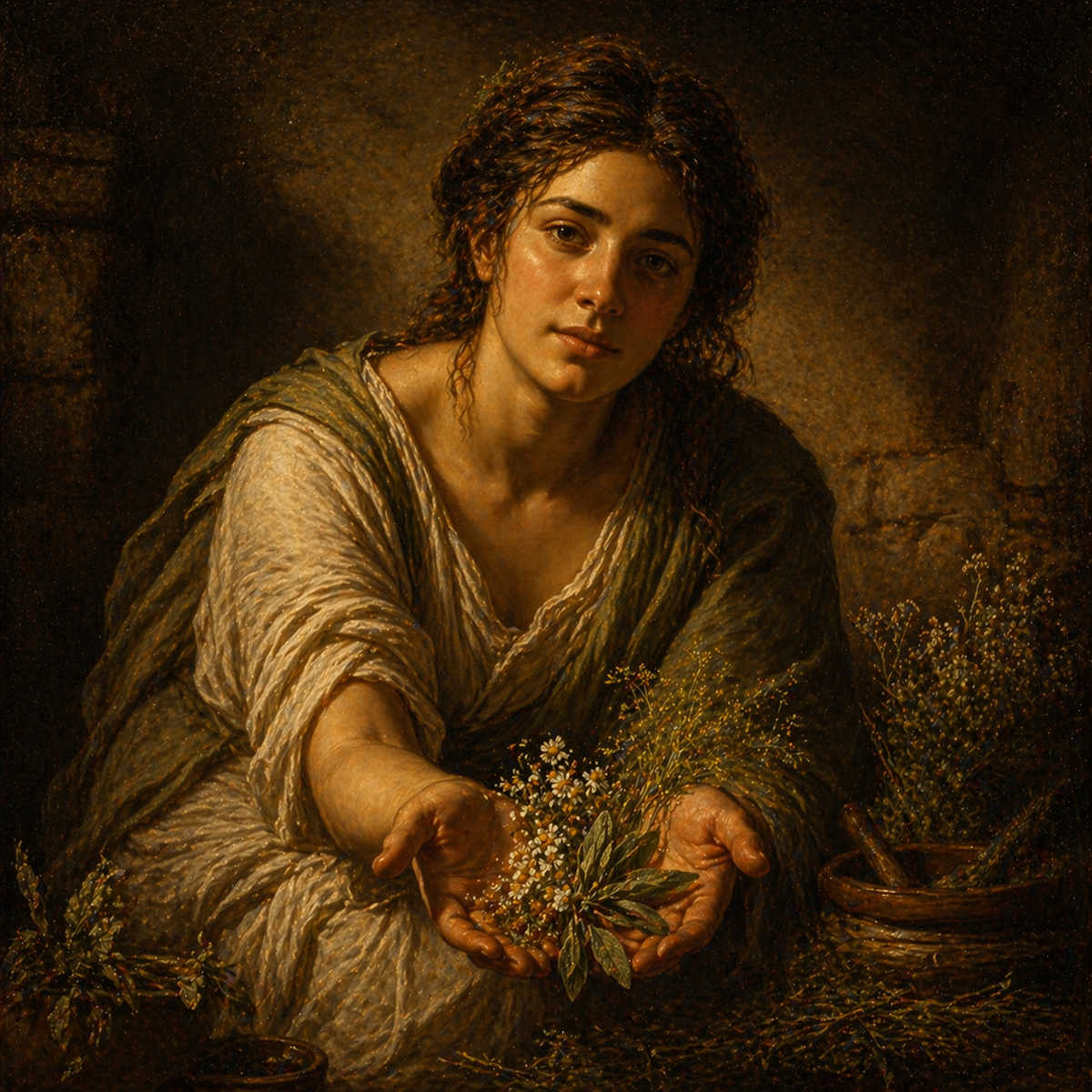
In Greek mythology, Epione is a minor goddess associated with the easing of pain, and her name comes from the adjective êpios, meaning gentle or mild (Theoi Project, n.d.). Describing a sacred precinct at Epidaurus with images of her and of Asclepius, the god of medicine, Pausanias notes that Epione was said to be his wife; the ancient sources collected by the Theoi Project do not record the goddess’s parents. The Byzantine lexicon known as the Suda makes her the mother of Aceso, Aegle, Hygieia, Iaso, and Panacea, but an inscription from Erythrae explicitly names only Aegle and Panacea as Epione’s daughters (Theoi Project, n.d.). Natublend named the blend in her honor, in a collection where her daughter Iaso also lends her name to Iaso Tea, and the tribute begins and ends with the name: nothing in it describes what goes into the cup.
The Four Ingredients of Epione
Ginger and sage are covered in detail in this article, while the stories of chamomile and fennel are told in the articles on other blends, linked in each entry. Natublend describes Epione as a blend of ingredients in natura, in their natural state, with no artificial colorings, flavorings, or preservatives.
Ginger
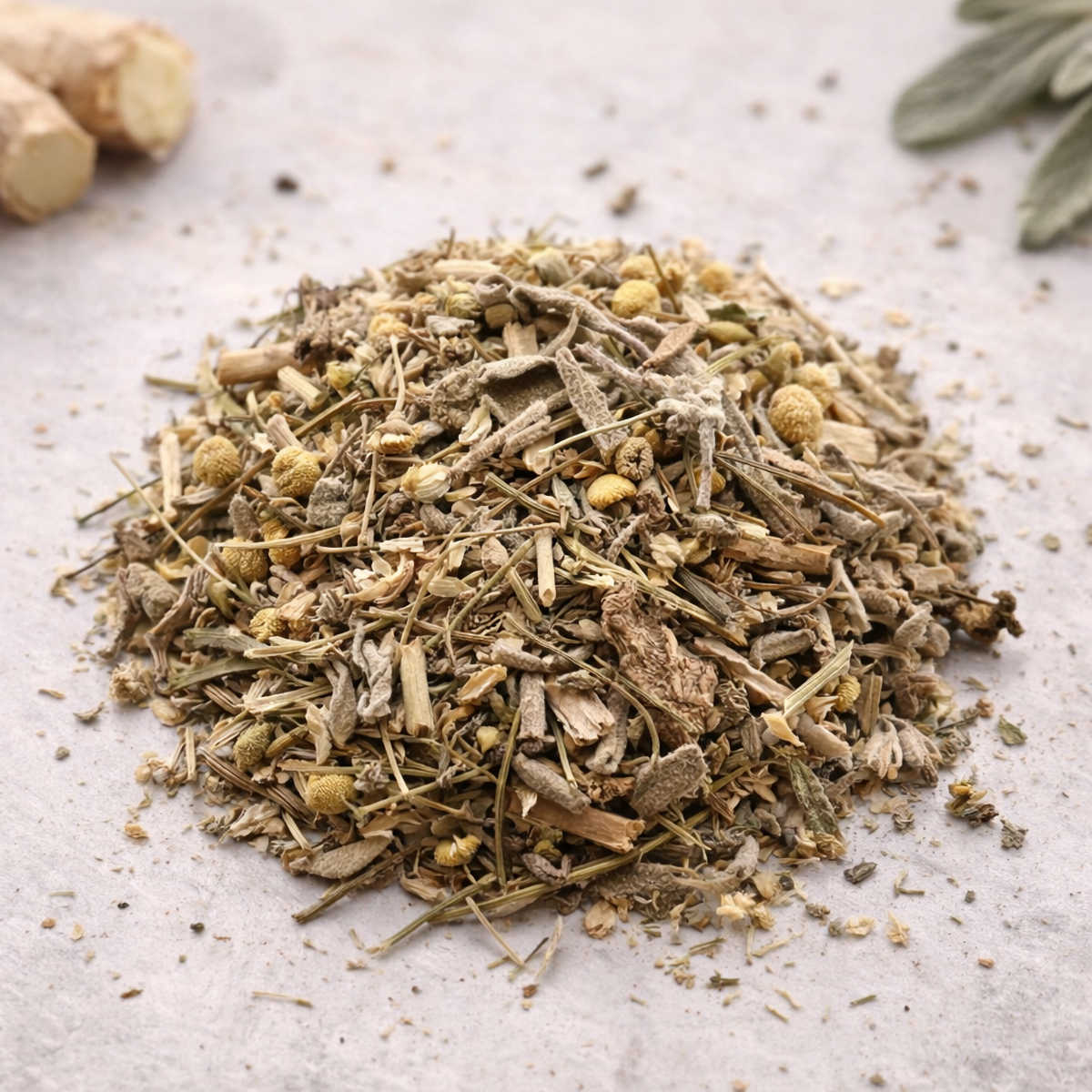
Ginger goes into Epione as dried rhizome and accounts for the spicy heat on the mid-palate. Plants of the World Online, the botanical catalog of the Royal Botanic Gardens, Kew, lists the species as Zingiber officinale Roscoe, in the Zingiberaceae family (POWO, n.d.). The part used is not a root, as it is often called, but an underground stem that grows horizontally just below the surface.
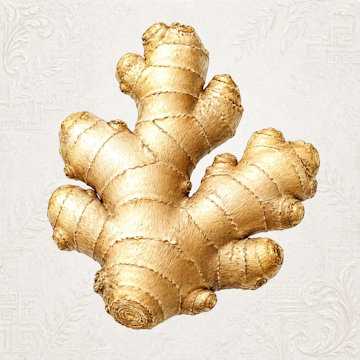
In the cup, ginger is more than heat: the sensory lexicon for blended teas by Kim and colleagues describes ground ginger as having sweet aromatics and a citrusy, lemon-like note alongside its pungency (Kim et al., 2018), and it is this sweeter side that bridges the floral opening of Epione and the herbaceous finish of the sage.
Sage
Sage closes Epione with its herbaceous, slightly bitter edge, which the brand sums up as understated. The species is Salvia officinalis L., in the Lamiaceae family, and the infusion uses its leaves, which are oval, gray-green, and velvety; POWO lists the species as native from southwestern Germany to southern Europe, including Albania, France, Greece, Italy, and Switzerland (POWO, n.d.). Since rosemary was reclassified as Salvia rosmarinus, the two plants have shared a genus, and anyone familiar with Apollo Tea will notice the family resemblance in aroma.
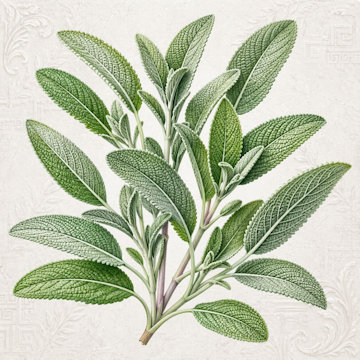
Once in the cup, sage takes over the finish with notes of dried herb and damp earth, two descriptors from the herbal tea lexicon of Malongane and colleagues (Malongane et al., 2020), and the subtle bitterness it leaves behind offsets the sweetness of the opening.
Chamomile
Chamomile is Matricaria chamomilla L., the name accepted by POWO for the species that many labels still call Matricaria recutita, in the Asteraceae family; the blend uses the dried flower heads (POWO, n.d.). In Epione, it opens the cup alongside fennel, with the floral, faintly musky fragrance that the Kim lexicon associates with dried flowers (Kim et al., 2018). The plant’s story is told in the article on Bacchus Tea.
Fennel
Fennel is Foeniculum vulgare Mill., in the Apiaceae family, and goes into the blend as dried fruit, the ridged grain the trade calls a seed (POWO, n.d.). In Brazil, the Portuguese name erva-doce is sometimes applied to fennel itself, but Natublend’s line keeps the two apart: the erva-doce in other blends of the collection is anise. In Epione, fennel brings the aniseed perfume of the opening and a quiet sweetness. The plant’s journey is told in the article on Hestia Tea.
Sensory Profile
Aroma of the dry blend. In the tin, before any water, ginger and sage dominate, according to Natublend itself: the rhizome warm and spicy, the leaf herbaceous and resinous, while chamomile and fennel stay underneath, more discreet.
Aroma of the infusion. Once the hot water goes in, the order reverses: fennel releases its aniseed perfume, reminiscent of licorice, and chamomile reveals its dried-flower fragrance, with ginger and sage now forming a warm, herbaceous background.
Liquor color. The brand describes the infusion as golden amber, warm-toned, and translucent, and gold and amber appear side by side in the liquor color atlas that Su and colleagues used for Taiwanese teas (Su et al., 2021).
Flavor. The attack is smooth and lightly sweet, led by chamomile and fennel, with the aniseed note up front. On the mid-palate, ginger comes in slowly, with a heat that grows sip by sip without taking over, and the finish belongs to the sage, herbaceous, with an earthy touch and a restrained bitterness. This is the sequence Natublend sums up as an understated final impression.
Body. Natublend does not classify the body, but without tea leaf the liquor tends to be fluid, light to medium in body, and the ginger’s heat gives it more presence than its actual weight would suggest.
How to Brew Epione
Epione calls for hotter water and a longer steep than the green tea blends in the collection.
- Heat the water to between 90 and 95 °C (194 and 203 °F); without a thermometer, wait about 30 seconds after it boils.
- Use 2 g of the blend for every 200 ml of water.
- Pour in the water, cover the vessel, and let it steep for 6 to 8 minutes.
- Strain without pressing and serve without sugar, as the brand advises, once the cup has cooled to 55 to 60 °C (131 to 140 °F); a few drops of lemon are optional.
- To steep the same portion again, use water at 95 °C (203 °F) for 7 to 8 minutes; Natublend recommends up to two re-steeps.
Near-boiling water follows the logic of infusions without Camellia sinensis: the chamomile brewing guide from The Republic of Tea calls for water close to boiling (Republic of Tea, n.d.), unlike green tea, which needs a lower temperature because the catechins in the leaf, responsible for much of its bitterness, dissolve readily in boiling water (My Japanese Green Tea, n.d.). For an iced version, Natublend suggests a cold brew of 8 to 10 hours in cold water; keep the container covered in the refrigerator the whole time.
The Moment Natublend Suggests
The product page talks about pauses, and the recipe proves the brand right. Between heating the water, waiting out the infusion with the cup covered, and letting the drink cool to 55 to 60 °C (131 to 140 °F), Epione asks for a good quarter of an hour, time that fits into a break at work or a free afternoon, but not into the rush between two appointments.
With no caffeine in its makeup, Epione does not count toward the daily total for anyone tracking their caffeine intake. The brand adds that the blend is not recommended for children under 12 without professional guidance and that breastfeeding women, people on long-term medication, people with specific health conditions, and pregnant women should consult a health professional before drinking it.
Other Blends in the Collection
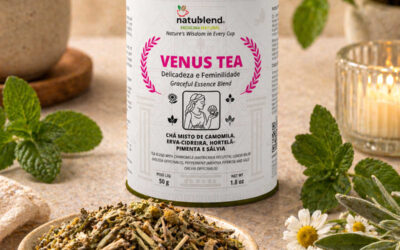
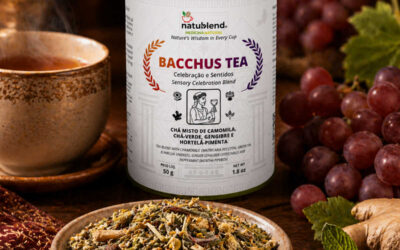
Epione is one of the 15 blends in the Sabedoria dos Deuses collection, and chamomile alone connects it to much of the line, with four blends repeating two of its ingredients. Bacchus Tea pairs chamomile and ginger with green tea and peppermint. Hestia Tea is the only other blend in the collection with fennel and repeats the chamomile, but it adds green tea and peppermint, which brings caffeine into the cup and trades the earthy close of sage for a minty finish. Iaso Tea repeats the Bacchus pair, chamomile and ginger, this time with cinnamon and green tea. Venus Tea keeps the chamomile and sage pairing but swaps fennel and ginger for lemon balm and peppermint, and it also has no tea leaf.
Frequently Asked Questions
Does Epione Tea Contain Any Source of Caffeine?
It doesn’t, because the blend contains no Camellia sinensis leaf, whether black, green, or white, and none of its four ingredients (chamomile, fennel, ginger, and sage) is a natural source of caffeine.
How Do You Make an Iced Version of Epione?
Natublend suggests a cold brew, with the blend in cold water for 8 to 10 hours, because without heat the aromas are extracted slowly. Keep the container covered in the refrigerator the whole time and, since ginger and sage are the ingredients with the strongest presence, taste it at 8 hours before extending the steep.
Does Epione Pair Well with Sweet or Savory Snacks?
It pairs well with both, and Italian cooking offers a clue: sage is a classic partner for butter, and fennel turns up in breads and savory crackers such as taralli. Ginger cookies, plain unfrosted cake, or sourdough bread with butter go with Epione without competing with the subtle bitterness of the sage.
Who Was Epione, the Goddess Who Gives the Blend Its Name?
Epione is a minor figure in Greek mythology, mentioned by Pausanias as the wife of Asclepius. Natublend chose the name as a cultural tribute, as it did with the other 14 blends in the collection, and the name describes no property of the drink.
This content is informational and describes teas and infusions as foods. It does not replace professional health guidance. Pregnant women, breastfeeding women, children, and people undergoing medical treatment should consult a health professional before adding any infusion to their routine.
References
View All 10 Cited References
Peer-Reviewed Scientific Studies (3)
- PMC2018 KIM et al. A Lexicon for Descriptive Sensory Evaluation of Blended Tea. Preventive Nutrition and Food Science, vol. 23, no. 4, pp. 364-373, 2018. Available at: pmc.ncbi.nlm.nih.gov.
- PMC2020 MALONGANE et al. Sensory Characteristics and Volatile Compounds of Herbal Teas and Mixtures of Bush Tea with Other Selected Herbal Teas of South Africa. Foods, vol. 9, no. 4, 496, 2020. Available at: pmc.ncbi.nlm.nih.gov.
- PMC2021 SU et al. Using Sensory Wheels to Characterize Consumers’ Perception for Authentication of Taiwan Specialty Teas. Foods, vol. 10, no. 4, 836, 2021. Available at: pmc.ncbi.nlm.nih.gov.
Supplementary Readings (7)
- THEOI PROJECT. Asklepias Epione. Theoi Greek Mythology, n.d. Available at: theoi.com.
- ROYAL BOTANIC GARDENS, KEW. Zingiber officinale Roscoe. Plants of the World Online (POWO), n.d. Available at: powo.science.kew.org.
- ROYAL BOTANIC GARDENS, KEW. Salvia officinalis L. Plants of the World Online (POWO), n.d. Available at: powo.science.kew.org.
- ROYAL BOTANIC GARDENS, KEW. Matricaria chamomilla L. Plants of the World Online (POWO), n.d. Available at: powo.science.kew.org.
- ROYAL BOTANIC GARDENS, KEW. Foeniculum vulgare Mill. Plants of the World Online (POWO), n.d. Available at: powo.science.kew.org.
- THE REPUBLIC OF TEA. Guide on How Long to Steep Chamomile Tea. n.d. Available at: republicoftea.com.
- MY JAPANESE GREEN TEA. Bitterness in Green Tea. n.d. Available at: myjapanesegreentea.com.