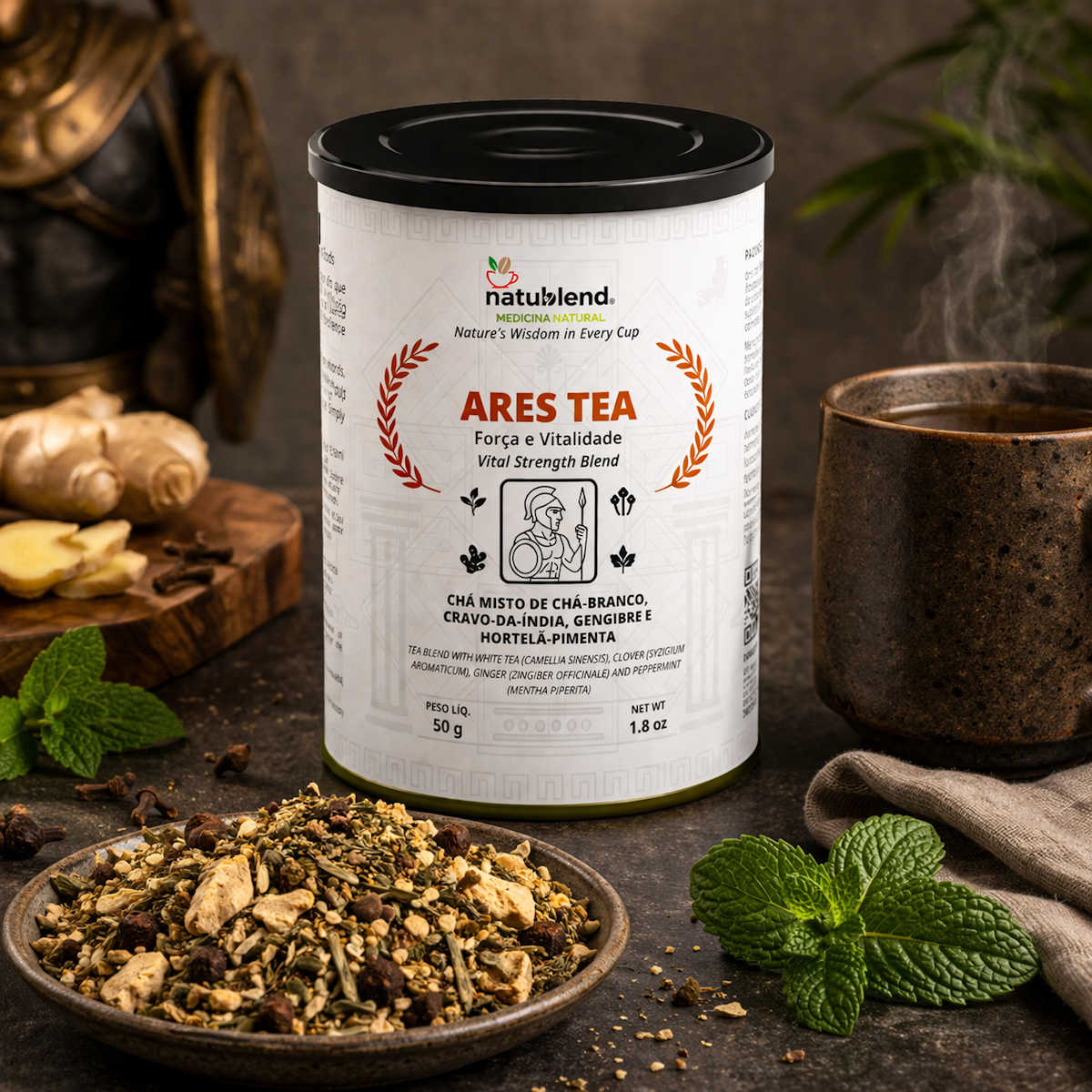
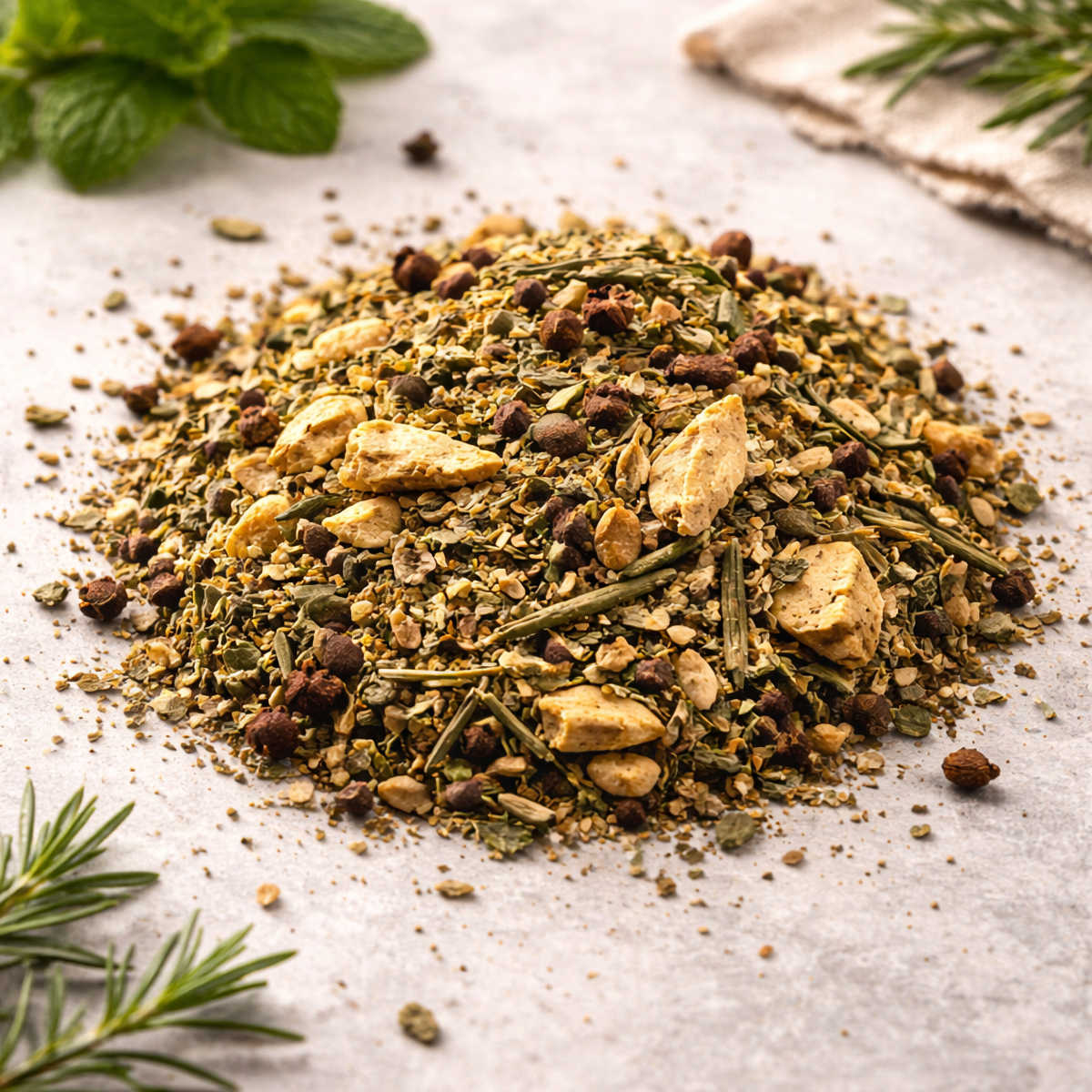
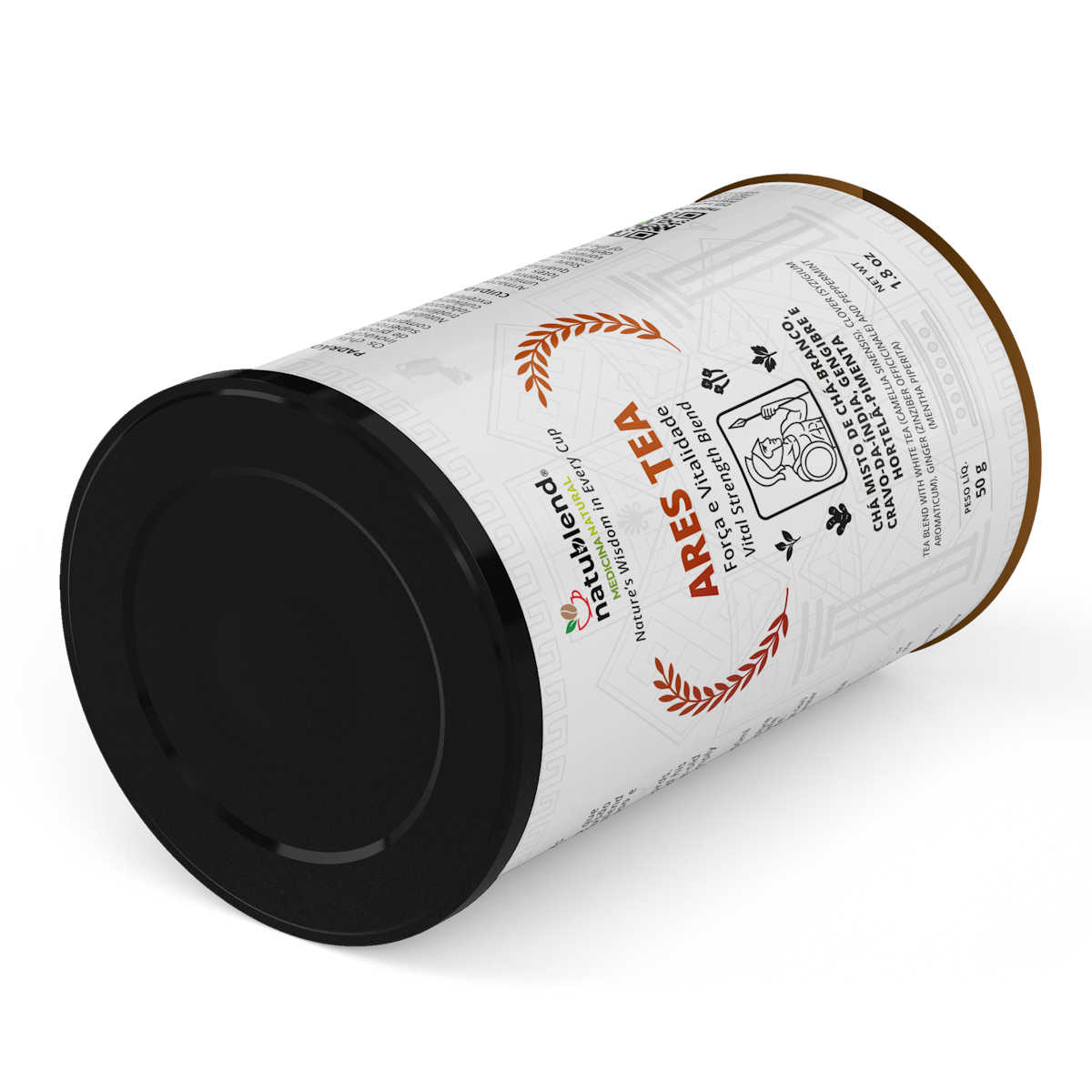
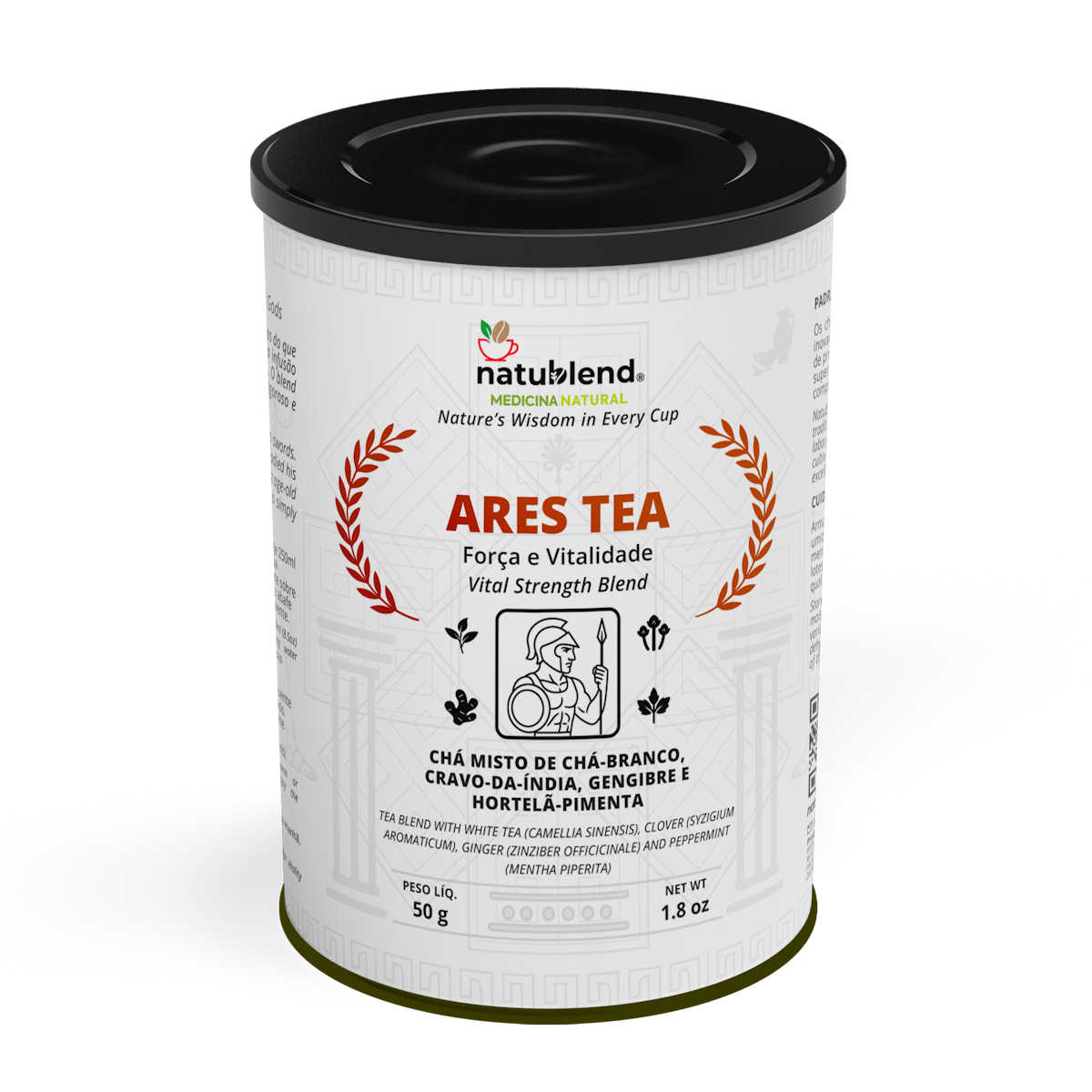
Ares Tea brings together clove, ginger, peppermint, and white tea in a 50 g tin from the Wisdom of the Gods collection by Natublend. Its base is white tea, made from the buds and young leaves of Camellia sinensis, and that base gives the blend its natural caffeine, which most herbal infusions lack; the story of how this leaf reached Brazil is told in the article on the history of tea, from China to the Ribeira Valley.
The name is a tribute to Ares, the Greek god of war. Natublend suggests the blend for a morning or afternoon cup, served without sugar, and this article takes an in-depth look at clove, the spice that defines the character of Ares.
Why Ares

In Greek mythology, Ares is the Olympian god of war, and also of battle lust, civil order, and courage; Greek art depicts him at times as a bearded warrior and at times as a beardless youth (Theoi Project, n.d.). The son of Zeus and Hera, he is at the center of one of the most talked-about affairs on Olympus, his romance with Aphrodite, which produced Deimos, Harmonia, and Phobos; Harmonia, the goddess of concord, gives her name to Harmonia Tea, another blend in the collection (Theoi Project, n.d.). Another well-known episode takes him to the Areopagus, the hill of Ares in Athens, where he was tried for murder and ultimately acquitted (Theoi Project, n.d.). Natublend named the blend in honor of Ares, and the reference lives on in the name and in the collection’s illustrations, which show the god with armor, a red cloak, a shield, and a spear.
The Four Ingredients in Ares
Clove, the blend’s aromatic signature, is the ingredient this article covers in full. Ginger, peppermint, and white tea have their stories told in the articles on other blends, noted under each entry, and appear here for the role each one plays in the cup.
Clove
Clove is Syzygium aromaticum (L.) Merr. & L.M.Perry, of the Myrtaceae family, the same family as the guava and jabuticaba trees, and what goes into the tin are the dried flower buds, with their rounded heads and long stems (POWO, n.d.). Plants of the World Online, from the Royal Botanic Gardens, Kew, gives the Maluku Islands, in eastern Indonesia, as the species’ only native range; anywhere else in the world, clove arrived by human hand (POWO, n.d.).
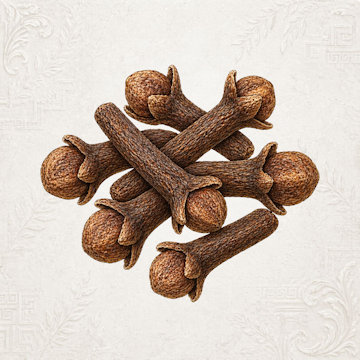
The species profile kept by Kew records that, in the 17th century, under Dutch rule, cultivation was deliberately restricted to Ambon and the neighboring islands, and that expansion began only in the 18th century, when French expeditions took seedlings to Mauritius, the source of the plantations in Madagascar and Zanzibar (Kew, n.d.). In Ares, clove is the first thing you notice when the tin opens, and it anchors the mid-palate, with a warm, penetrating aroma that Natublend describes as striking, though it never overshadows the delicacy of the white tea.
White Tea
The base of the blend and the source of its caffeine, white tea comes from the same Camellia sinensis (L.) Kuntze, of the Theaceae family, that gives us black and green tea (POWO, n.d.). What changes is the harvest: it uses still-closed buds and very young leaves, covered in a whitish down, which undergo minimal processing and barely oxidize (Tea Association of the USA, n.d.). In Ares, it provides the delicate opening on which clove and ginger build. The full story is in the article on Aurora Tea.
Ginger
From ginger, Zingiber officinale Roscoe, of the Zingiberaceae family, Ares uses the dried rhizome (POWO, n.d.). In the lexicon for blended teas developed by Kim and colleagues, the flavor associated with ground ginger combines citrus, pungent, and sweet notes (Kim et al., 2018), but in this blend what stands out is the pungency, which comes through as a subtle heat just behind the clove. The rhizome’s journey is told in the article on Epione Tea.
Peppermint
Peppermint, Mentha × piperita L., a natural hybrid of Mentha aquatica and Mentha spicata in the Lamiaceae family, goes into Ares as dried leaf (POWO, n.d.). It brings the cup to a close: after the spice comes a minty freshness on the finish, the cold sensation the same lexicon calls cooling, which has nothing to do with the temperature of the liquid (Kim et al., 2018). The plant gets an article of its own in the piece on Venus Tea.
Sensory Profile
Dry aroma. Clove dominates the moment the tin is opened, warm and penetrating, with that sweetish side that recalls the kitchens of Brazil’s June festivals, from canjica, a sweet hominy pudding, to pumpkin preserves. Dried ginger sits just beneath it as a background warmth, and the peppermint adds a minty streak that contrasts with the intensity of the clove; the white tea is barely noticeable in the dry blend.
Infusion aroma. In hot water, the sequence Natublend describes becomes clear: first the clove, then the pungency of the ginger, and finally the minty note of the peppermint, all over the soft, young-leaf vegetal backdrop that the white tea reveals only once it is wet.
Liquor color. According to the brand, the infusion pours a pale, translucent gold and, held up to the light, shows honey glints with a coppery touch. That places it close to the range that the infusion color atlas by Su and colleagues records for Taiwanese teas, between honey yellow and gold (Su et al., 2021).
Flavor. The attack is soft, typical of an almost unoxidized leaf, and the product page makes a point of saying there is no aggressive astringency. On the mid-palate, clove and ginger form a warm, spicy center that is more aromatic than fiery, and the finish brings the peppermint, which lingers beyond the sip and leaves the pairing of spice and mint on the palate, with no bitterness to mask it.
Body. The brand does not classify the body of Ares, but the white tea base points to a light, fluid liquor in which the fullness on the palate comes more from the spice than from the weight of the liquid.
How to Brew Ares
Because the base is white tea, the water for Ares needs to stay well below boiling.
- Heat the water to between 75 and 80 °C without letting it boil. If you don’t have a thermometer, Natublend suggests waiting 5 to 6 minutes after the water boils or mixing a little cold water into the boiled water.
- Use 2 g of the blend for every 200 ml of water, in an infuser or teapot.
- Cover right after pouring the water and let it steep for 4 to 5 minutes.
- Strain without pressing the leaves and serve unsweetened, as the brand recommends.
- Reuse the same portion for one or two more infusions; for the second, the recommendation is water at 80 °C for 5 to 6 minutes.
The temperature range comes from the base tea. Lightly oxidized leaves retain intact catechins, which dissolve readily in boiling water and account for much of the bitterness and astringency (My Japanese Green Tea, n.d.), and Natublend itself warns that above 80 °C white tea loses aroma and turns bitter. For a cold brew, the brand recommends 2 g in 200 ml of cold water, left in the refrigerator for 8 to 10 hours.
The Moment Natublend Suggests
Natublend fits Ares into morning or afternoon routines and turns its preparation into a small ritual: a few minutes to let the water come down from the boil, cover the infuser, and keep track of the time. In its flavor description, the brand sums up the drink as intense, spiced, and hard to ignore, and it is this profile that sets Ares apart within the collection.
Because it has a white tea base, Ares contains caffeine. The brand does not state the amount, and anyone who limits their daily caffeine should count this cup. Natublend also notes that the blend is not recommended for children under 12 without professional guidance.
Other Blends in the Collection
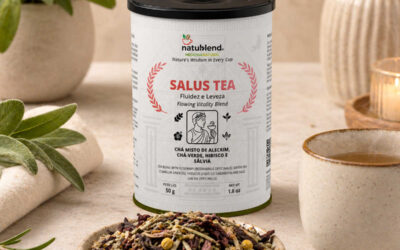
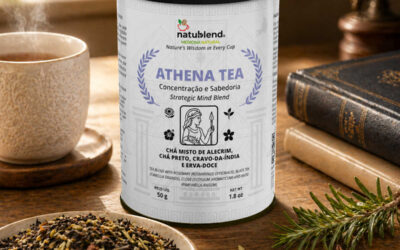
Ares is one of the 15 blends in the Wisdom of the Gods collection, and only two of them share the ingredients that define it. Athena Tea is the only other blend in the collection with clove, but it swaps the white tea for black tea and adds erva-doce (a Brazilian name used for both anise and fennel) and rosemary, for a fuller-bodied profile with an aniseed note. Aurora Tea is the only other one built on white tea, and it takes that base in a floral, fruity direction, with chamomile, hibiscus, and jasmine.
Frequently Asked Questions
Does Ares Tea Have Caffeine Even with a White Tea Base?
It does. White tea is made from the same Camellia sinensis as black and green tea, and every leaf of this plant naturally contains caffeine. Natublend does not state the amount per cup, which varies with steeping time and temperature; anyone keeping an eye on their daily intake should count this cup along with their coffee.
How Do You Make an Iced Version of Ares?
Natublend recommends a cold brew, with 2 g of the blend in 200 ml of cold water, for 8 to 10 hours in the refrigerator. Without heat, extraction is slow, which is why the time goes from minutes to hours.
What Sweet and Savory Foods Pair with Ares?
Clove and ginger are longtime partners in Brazilian baking, and the most natural route is to serve Ares with butter cookies, orange cake, or pão de mel, a Brazilian spiced honey cake. For a savory option, pão de queijo, Brazil’s cheese bread, fresh from the oven, makes a nice contrast with the minty finish of the peppermint.
Why the Name Ares and Not Mars?
Ares is the Greek name of the god of war, son of Zeus and Hera, and Mars is his Roman equivalent. The Wisdom of the Gods collection mixes both traditions, with Roman names such as Aurora, Salus, and Venus, and for this blend Natublend chose the Greek form, a tribute that lives on in the name and in the collection’s illustrations.
This content is informational and describes teas and infusions as foods. It does not replace professional health guidance. Pregnant women, breastfeeding women, children, and people undergoing medical treatment should consult a health professional before adding any infusion to their routine.
References
View All 11 Cited References
Peer-Reviewed Scientific Studies (2)
- PMC2018 KIM, J. H. et al. A Lexicon for Descriptive Sensory Evaluation of Blended Tea. Preventive Nutrition and Food Science, vol. 23, no. 4, pp. 364-373, 2018. Available at: pmc.ncbi.nlm.nih.gov.
- PMC2021 SU et al. Using Sensory Wheels to Characterize Consumers’ Perception for Authentication of Taiwan Specialty Teas. Foods, vol. 10, no. 4, 836, 2021. Available at: pmc.ncbi.nlm.nih.gov.
Supplementary Readings (9)
- THEOI PROJECT. Ares. Theoi Greek Mythology, n.d. Available at: theoi.com.
- THEOI PROJECT. Ares Myths. Theoi Greek Mythology, n.d. Available at: theoi.com.
- ROYAL BOTANIC GARDENS, KEW. Syzygium aromaticum (L.) Merr. & L.M.Perry. Plants of the World Online (POWO), n.d. Available at: powo.science.kew.org.
- ROYAL BOTANIC GARDENS, KEW. Syzygium aromaticum: species profile (General Information). Plants of the World Online (POWO), n.d. Available at: powo.science.kew.org.
- ROYAL BOTANIC GARDENS, KEW. Camellia sinensis (L.) Kuntze. Plants of the World Online (POWO), n.d. Available at: powo.science.kew.org.
- ROYAL BOTANIC GARDENS, KEW. Zingiber officinale Roscoe. Plants of the World Online (POWO), n.d. Available at: powo.science.kew.org.
- ROYAL BOTANIC GARDENS, KEW. Mentha × piperita L. Plants of the World Online (POWO), n.d. Available at: powo.science.kew.org.
- TEA ASSOCIATION OF THE U.S.A. Recommendations for the Preparation of Iced & Hot Tea. Bunn-O-Matic, n.d. Available at: resource.bunn.com.
- MY JAPANESE GREEN TEA. Bitterness in Green Tea. n.d. Available at: myjapanesegreentea.com.