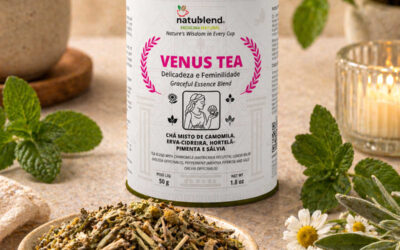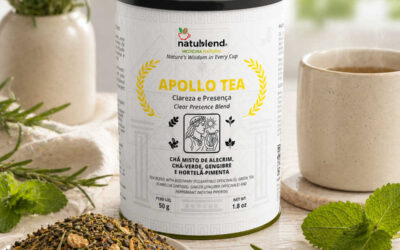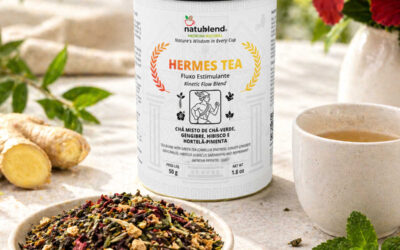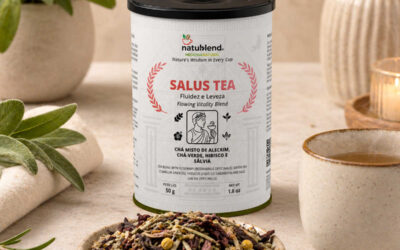
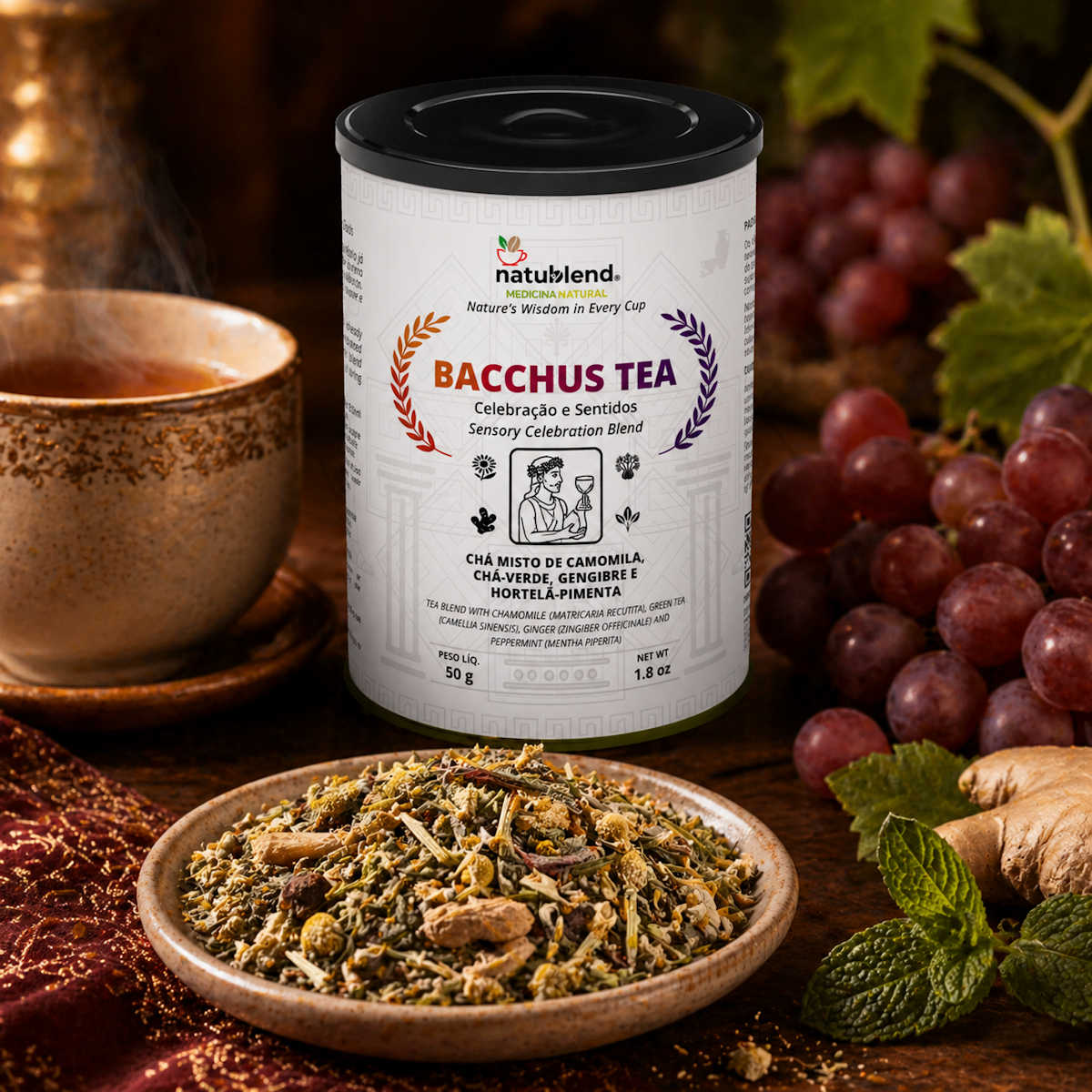
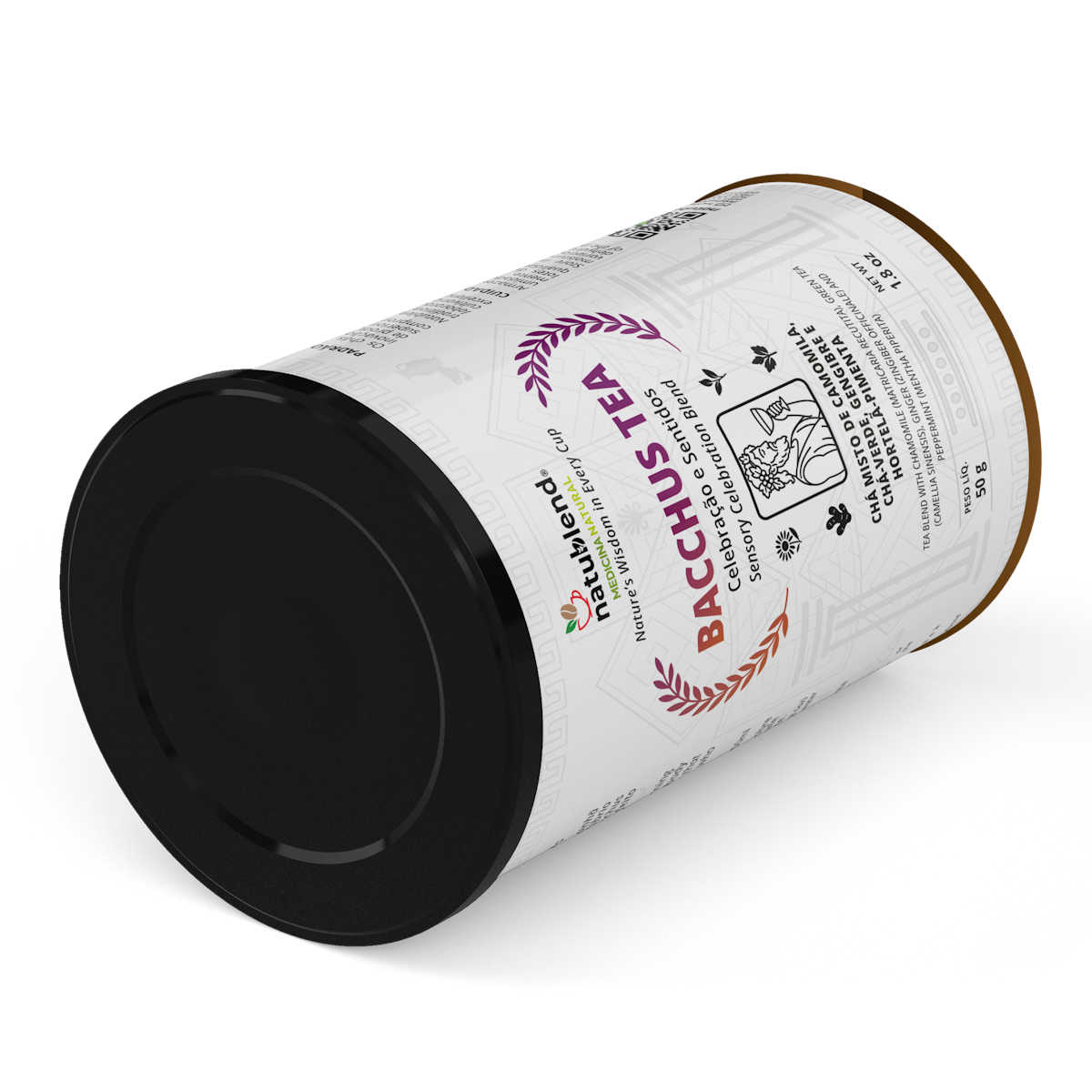
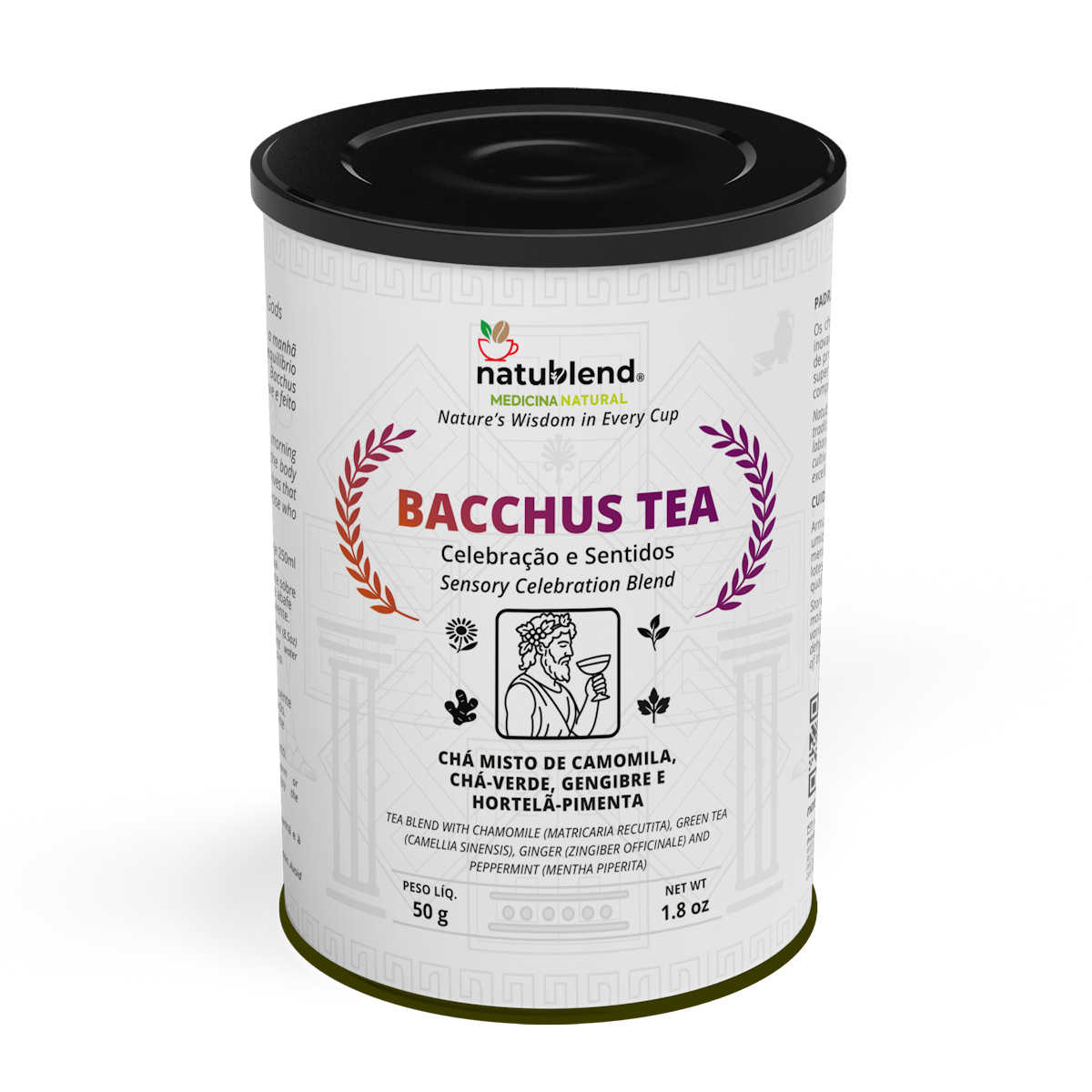
Bacchus Tea brings together chamomile, ginger, green tea, and peppermint in a 50 g tin from Natublend’s Wisdom of the Gods collection. Brewed on its own, chamomile makes a caffeine-free infusion, like most drinks made only from flowers and herbs (Upton Tea Imports, n.d.). In Bacchus, however, it shares the tin with green tea, the leaf of Camellia sinensis, so every cup contains caffeine; the path this leaf took to Brazil is traced in the article on the history of tea, from China to the Ribeira Valley.
The name honors Bacchus, the Roman form of Dionysus, the Greek god of festivities, theater, and wine. Natublend suggests Bacchus Tea for after lunch or dinner, served without sugar.
Why Bacchus
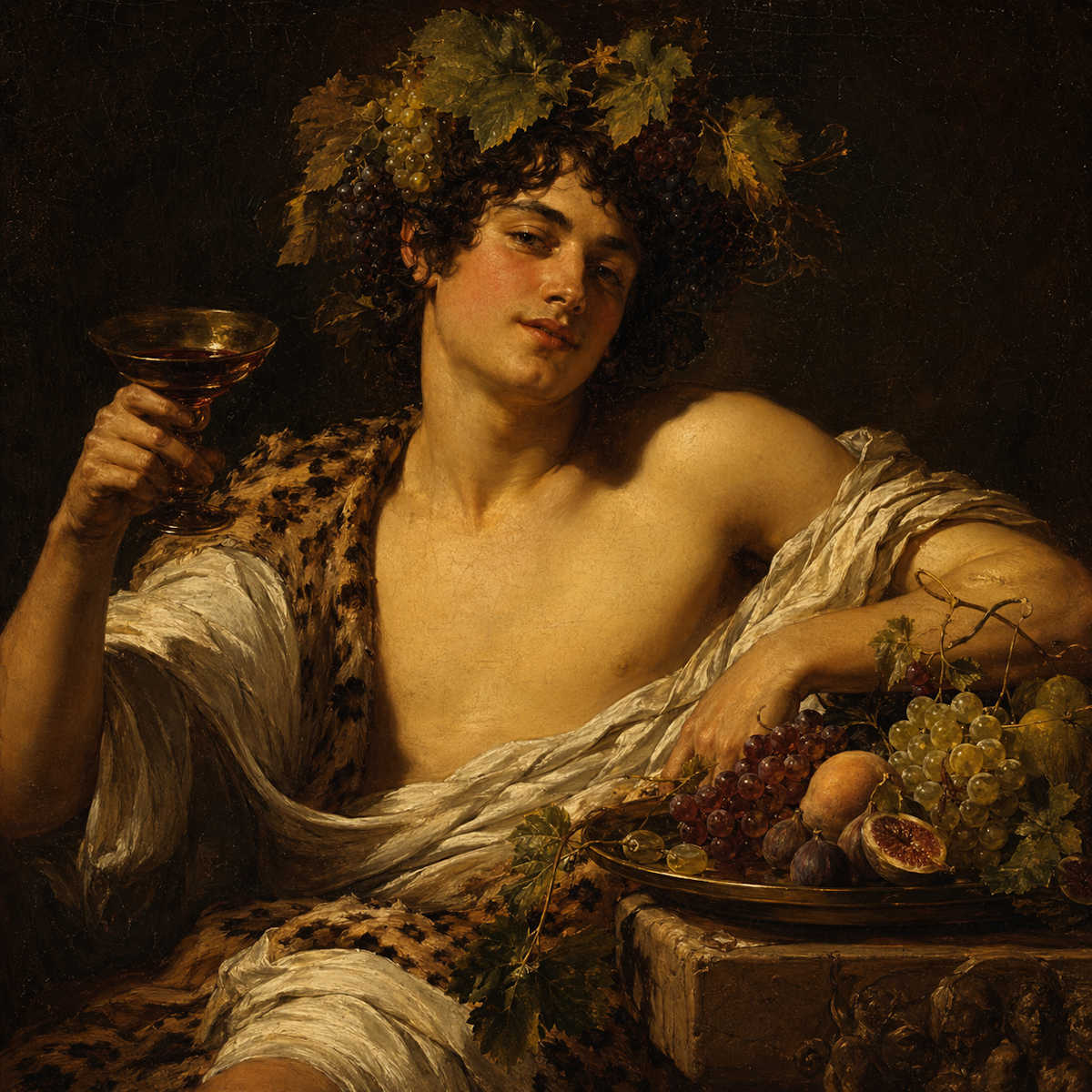
In Greek mythology, Dionysus is the Olympian god of festivities, vegetation, and wine, also associated with theater and viticulture. The Romans called him Bacchus, and also Liber. The son of Zeus and Semele, he was cared for in infancy by the nymphs of Nysa, the Nysiads (Theoi Project, n.d.). Natublend named the blend in honor of Bacchus, using the Latin name rather than the Greek Dionysus, and the name appears on the tin beside an illustration of the bearded god, crowned with leaves and raising a cup.
The Four Ingredients of Bacchus
Ginger, green tea, and peppermint form a trio that Natublend repeats in Apollo and Hermes, but only in Bacchus does it meet chamomile. That is why the flower comes first and in more detail, while the other three are described through the role they play alongside it.
Chamomile
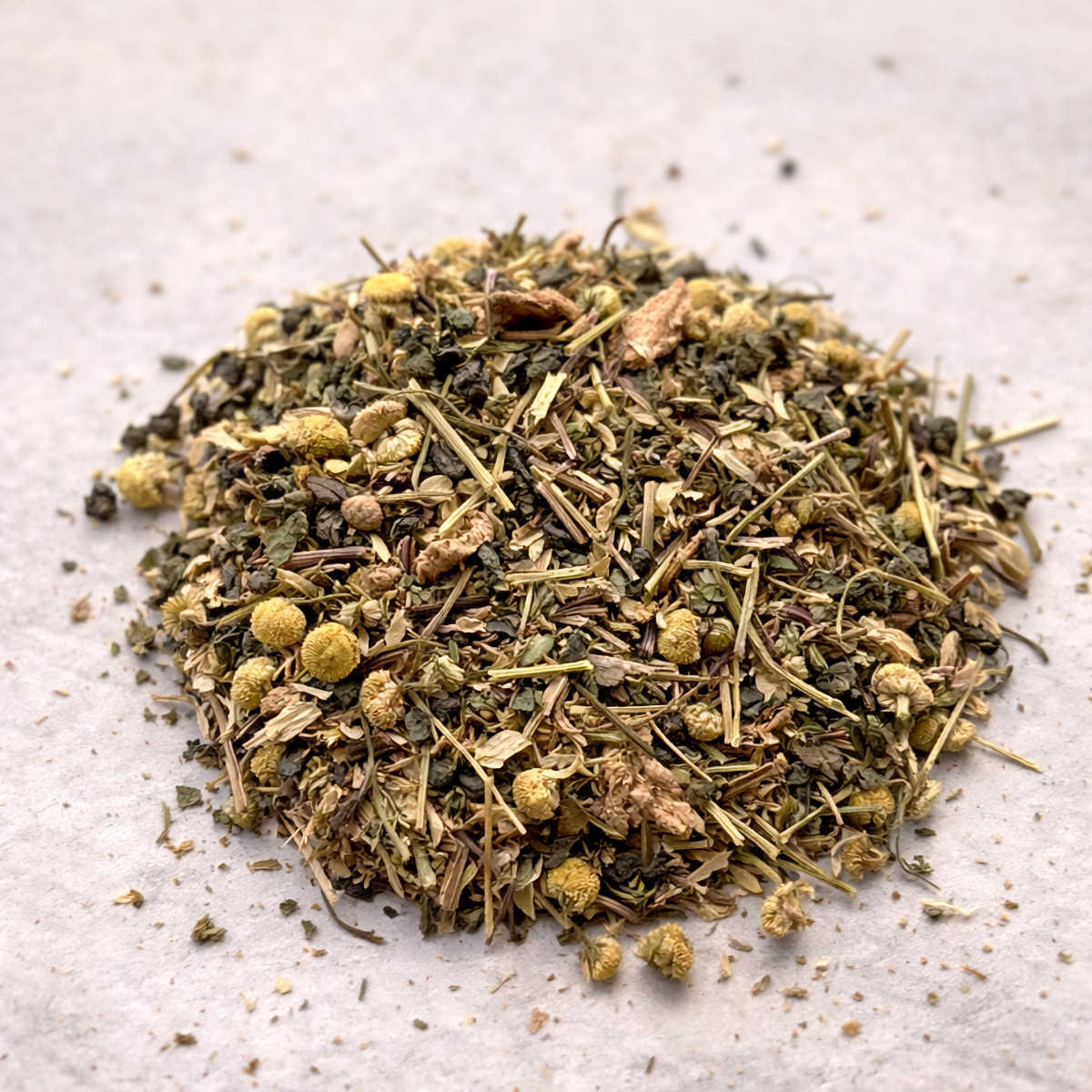
On the Bacchus label, chamomile appears as Matricaria recutita, a name that Plants of the World Online, the botanical catalog of the Royal Botanic Gardens, Kew, now treats as a synonym of Matricaria chamomilla L., the accepted name (POWO, n.d.). A member of the family Asteraceae, the same family as the sunflower, it goes into the tin as dried flower heads, each a small “flower” that is in fact a cluster of many tiny flowers, white ones around the rim and yellow ones in the center. The species is native to a range that stretches from Macaronesia and northern Africa to temperate Eurasia and Indochina (POWO, n.d.).
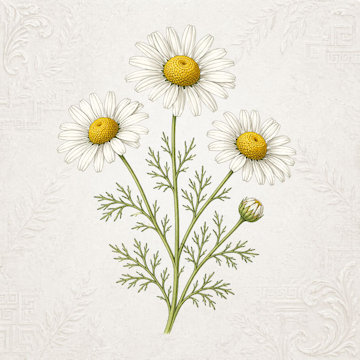
Roman chamomile, Chamaemelum nobile (L.) All., is another species in the same family that shares its common name with the one in Bacchus (POWO, n.d.). The one in the tin is German chamomile, which the blended tea lexicon by Kim and colleagues describes as a floral fragrance associated with dried flowers, with a faint musty note (Kim et al., 2018).
Green Tea
Green tea is the base of Bacchus and the source of its caffeine: the leaf of Camellia sinensis (L.) Kuntze, of the family Theaceae, processed so that its catechins remain almost intact, without the oxidation that darkens black tea (My Japanese Green Tea, n.d.). Next to the chamomile, it provides a vegetal counterpoint to the floral sweetness, with a subtle astringency that keeps the cup from being merely perfumed. The plant is introduced in full in the Salus Tea article.
Ginger
Bacchus uses the dried rhizome of ginger, Zingiber officinale Roscoe, of the family Zingiberaceae (POWO, n.d.). It supplies the pungent warmth that shows up on the mid-palate, and the steeping time decides how noticeable it becomes, as the brewing instructions show. The rhizome is covered in detail in the Epione Tea article.
Peppermint
Born of a natural cross between Mentha aquatica and Mentha spicata, peppermint (Mentha × piperita L.) belongs to the family Lamiaceae and goes into the blend as dried leaf (POWO, n.d.). In Bacchus, it closes the sequence with the refreshing sensation that the lexicon by Kim and colleagues calls cooling (Kim et al., 2018), in direct contrast with the sweetish floral note at the start. The Venus Tea article offers a full portrait of peppermint.
Tasting Notes
Aroma of the dry blend. In tasting jargon, the smell of the dry blend has a name of its own, the nose (SV Tea, n.d.), and in Bacchus it belongs to the chamomile: a dried-flower note that Natublend describes as gentle the moment the tin is opened. Peppermint follows, while the ginger and green tea stay in the background.
Aroma of the infusion. In hot water, the floral note of the chamomile becomes rounder; only then does the green tea show its vegetal side, with the ginger emerging underneath.
Color of the infusion. Natublend describes it as pale gold and translucent, with a slight greenish tint that comes from the green tea.
Flavor. The attack is soft and floral, led by the chamomile, with the quiet sweetness of the dried flower; next, the astringency of the green tea brings a slight dryness and gives the cup its structure. On the mid-palate, the ginger adds a pungent warmth that builds gradually without overpowering the flower, and the finish belongs to the peppermint, a fresh, minty close that contrasts with the sweetish beginning. The brand recommends serving Bacchus without sugar, and the choice also makes sense in the cup: any added sweetness would pile onto that of the chamomile and erase the contrast.
Body. Natublend credits the green tea with the body of the infusion and describes the result as a light cup, with structure but no heaviness. In the vocabulary of tea tasters, the profile sits closer to smooth, pleasant and rounded, than to brisk, lively and with noticeable astringency (SV Tea, n.d.).
How to Brew Bacchus
Natublend’s recipe for Bacchus even makes allowances for anyone without a thermometer at home, and the steeping time works as an intensity dial.
- Heat the water to between 80 and 85 °C, without letting it boil; if you have no thermometer, wait 3 to 4 minutes after the water boils.
- Place 2 g of the blend in the infuser or teapot for every 200 ml of water and pour the hot water in slowly.
- Cover the cup or teapot right away and steep for 3 minutes for a lighter profile, or for 4 minutes if you want the ginger to come through more.
- Strain without pressing the ingredients and serve without sugar.
- For a second infusion with the same portion of blend, use water at 83 °C for 4 minutes; one portion can be re-steeped up to two times.
On its own, chamomile is usually brewed with water close to boiling, between 95 and 100 °C, for about 5 minutes (Republic of Tea, n.d.); in Bacchus, the temperature is set by the green tea base, whose catechins, still barely oxidized, dissolve easily in very hot water and would leave the cup more bitter and astringent (My Japanese Green Tea, n.d.). The cold-brew version, according to the brand, calls for 2 g in 200 ml of cold water, left for 6 to 8 hours in the refrigerator.
When Natublend Suggests Serving It
Natublend suggests Bacchus for after lunch or dinner and, on the product page, also for a small late-afternoon ceremony. The recommendation is to serve it without sugar, and the same page presents the tin as a gift idea.
Because of its green tea base, Bacchus contains caffeine, in an amount the brand does not disclose. Since Natublend also suggests it for after dinner, anyone who prefers to avoid caffeine at that hour can save it for after lunch or choose one of the blends in the collection made only with flowers, herbs, and spices. The product page also notes that Bacchus is not recommended for children under 12 without professional guidance.
Other Blends in the Collection
Bacchus is one of the 15 blends in the Wisdom of the Gods collection, and two of them keep the chamomile while changing just one of the other ingredients. Hestia Tea keeps chamomile, green tea, and peppermint but trades the ginger for fennel, so the pungency on the mid-palate gives way to an anise-like register. Iaso Tea holds on to chamomile, ginger, and green tea and replaces the peppermint with cinnamon, so the finish turns spiced rather than minty.
Frequently Asked Questions
Why Does Bacchus Have Caffeine If It Contains Chamomile?
Because the chamomile shares the tin with green tea, the leaf of Camellia sinensis, which naturally contains caffeine. An infusion made only from chamomile has no caffeine; in Bacchus, the green tea base brings caffeine to the cup, in an amount Natublend does not disclose.
Can Bacchus Be Cold-Brewed?
It can. Natublend recommends 2 g of the blend in 200 ml of cold water, left for 6 to 8 hours in the refrigerator. According to the brand, the cold-brewed profile is lighter, with the chamomile and peppermint more present and the ginger in the background.
Does Bacchus Pair Well with Dessert?
Since Natublend suggests it for after lunch or dinner, it often shares the table with dessert. The floral note of the chamomile and the minty finish go well with fresh fruit, lightly sweetened treats, and plain cakes; very sweet desserts tend to mask the sequence of flavors.
Bacchus or Dionysus: Where Does the Name Come From?
Bacchus is the Latin name the Romans gave to Dionysus, the Greek god of festivities, theater, and winemaking. Natublend named the blend in his honor and kept the Latin form on the tin, beside an illustration of the god raising a cup.
This content is informational and describes teas and infusions as foods. It does not replace professional health guidance. Pregnant women, breastfeeding women, children, and people undergoing medical treatment should consult a health professional before adding any infusion to their routine.
References
View All 10 Cited References
Peer-Reviewed Scientific Studies (1)
- PMC2018 KIM et al. A Lexicon for Descriptive Sensory Evaluation of Blended Tea. Preventive Nutrition and Food Science, v. 23, n. 4, p. 364-373, 2018. Available at: pmc.ncbi.nlm.nih.gov.
Supplementary Readings (9)
- UPTON TEA IMPORTS. A Closer Look at the Difference Between Teas, Tisanes and Herbal Infusions. n.d. Available at: uptontea.com.
- THEOI PROJECT. Dionysos. Theoi Greek Mythology, n.d. Available at: theoi.com.
- ROYAL BOTANIC GARDENS, KEW. Matricaria chamomilla L. Plants of the World Online (POWO), n.d. Available at: powo.science.kew.org.
- ROYAL BOTANIC GARDENS, KEW. Chamaemelum nobile (L.) All. Plants of the World Online (POWO), n.d. Available at: powo.science.kew.org.
- MY JAPANESE GREEN TEA. Bitterness in Green Tea. n.d. Available at: myjapanesegreentea.com.
- ROYAL BOTANIC GARDENS, KEW. Zingiber officinale Roscoe. Plants of the World Online (POWO), n.d. Available at: powo.science.kew.org.
- ROYAL BOTANIC GARDENS, KEW. Mentha × piperita L. Plants of the World Online (POWO), n.d. Available at: powo.science.kew.org.
- SV TEA. A Tea Taster’s Glossary. n.d. Available at: svtea.com.
- THE REPUBLIC OF TEA. Guide on How Long to Steep Chamomile Tea. n.d. Available at: republicoftea.com.