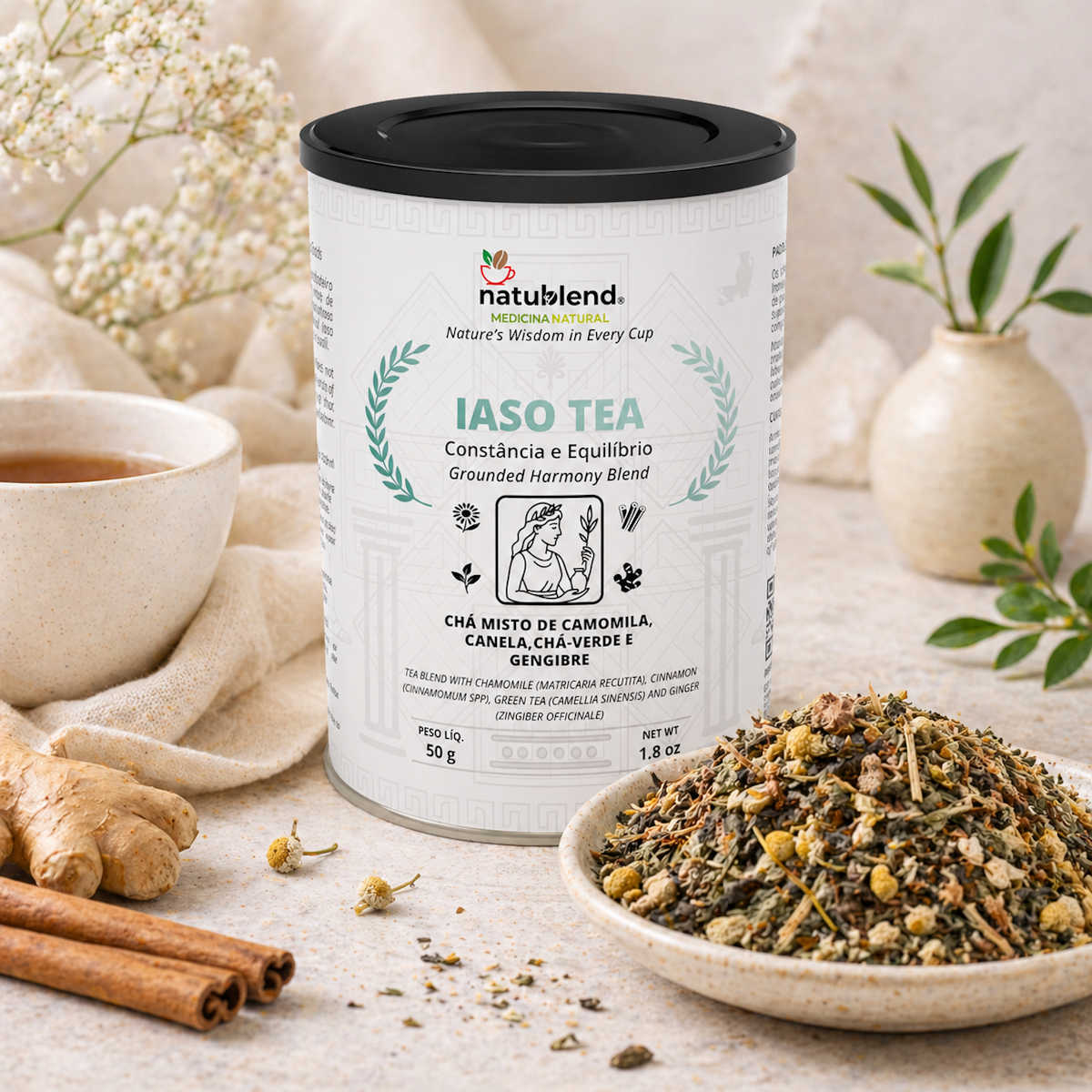
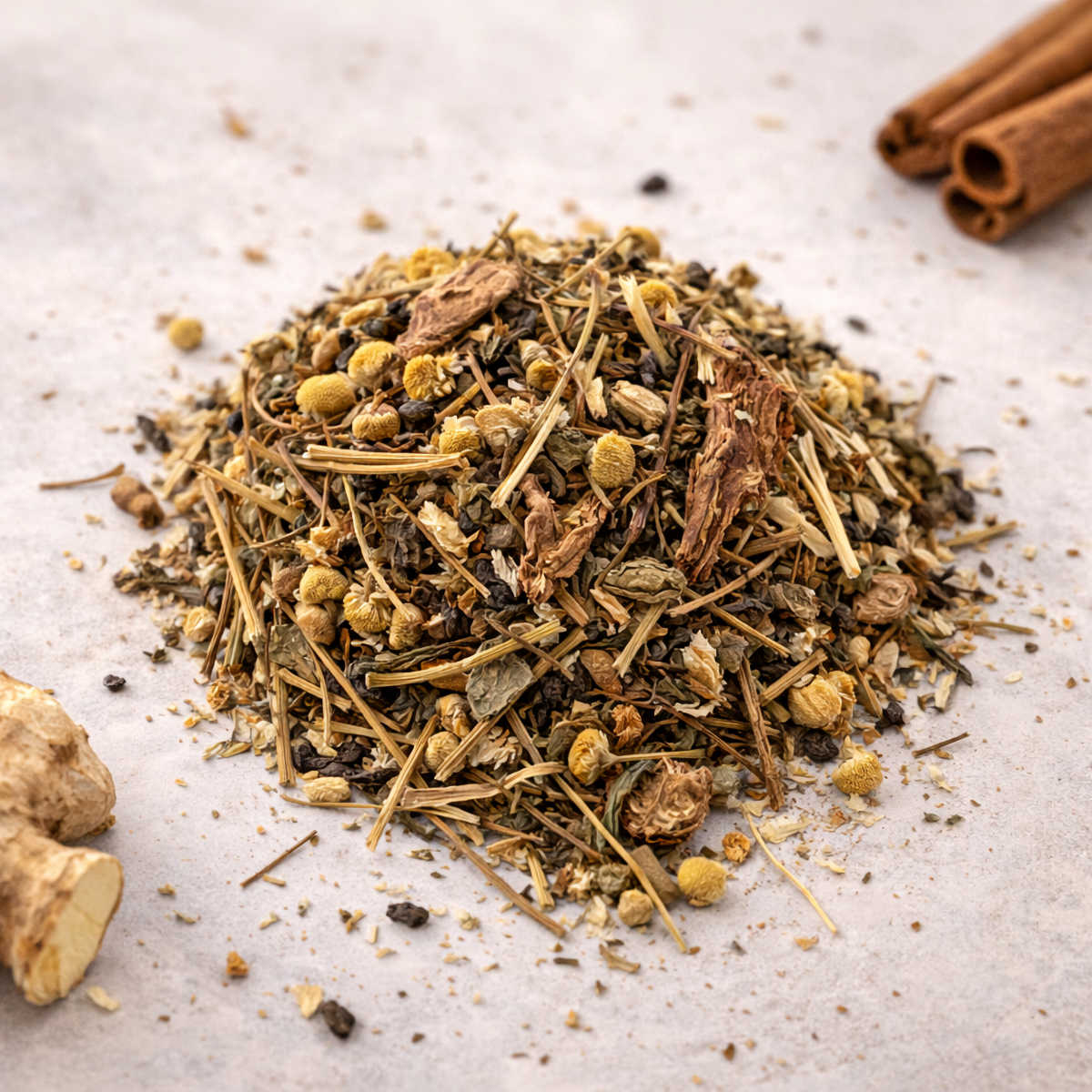
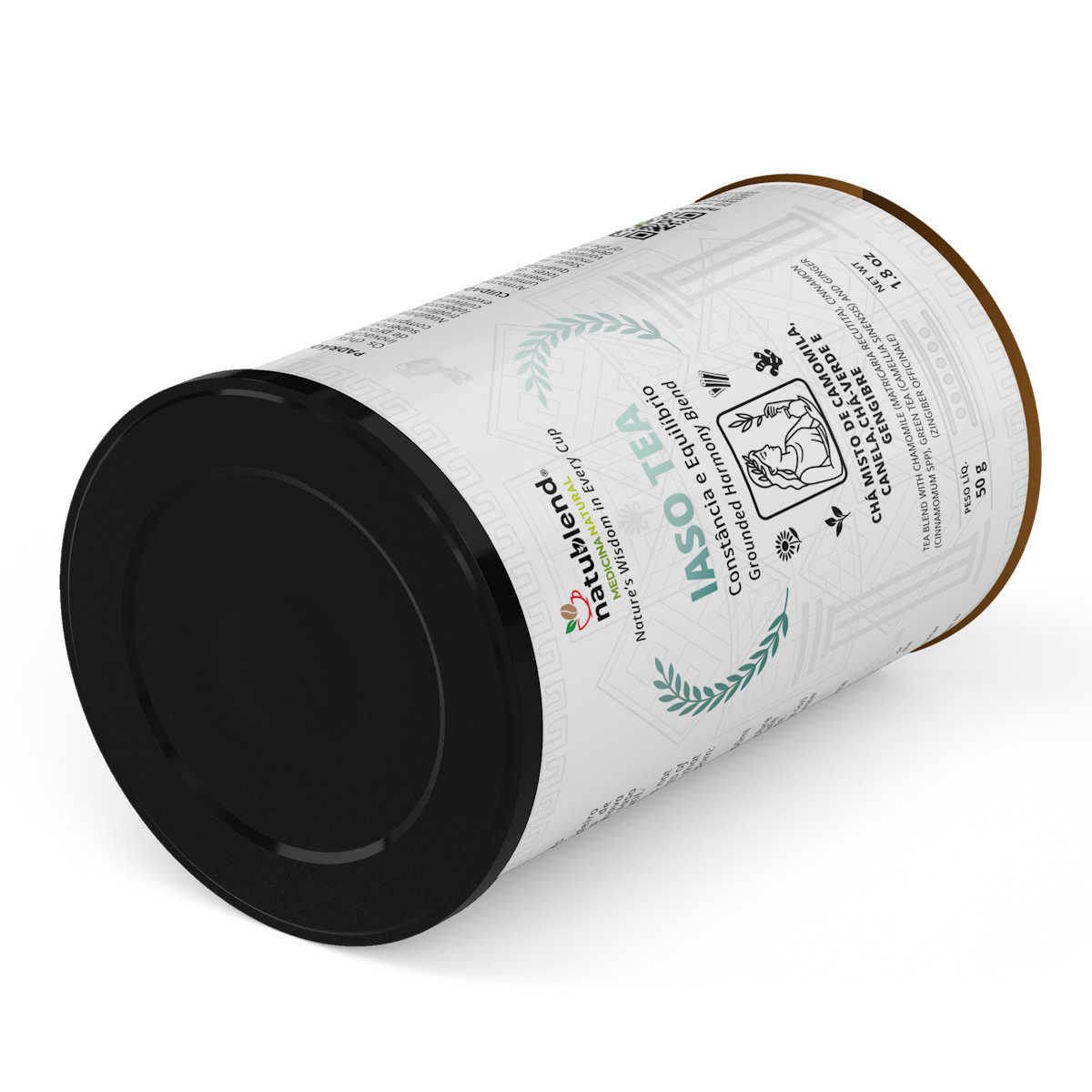
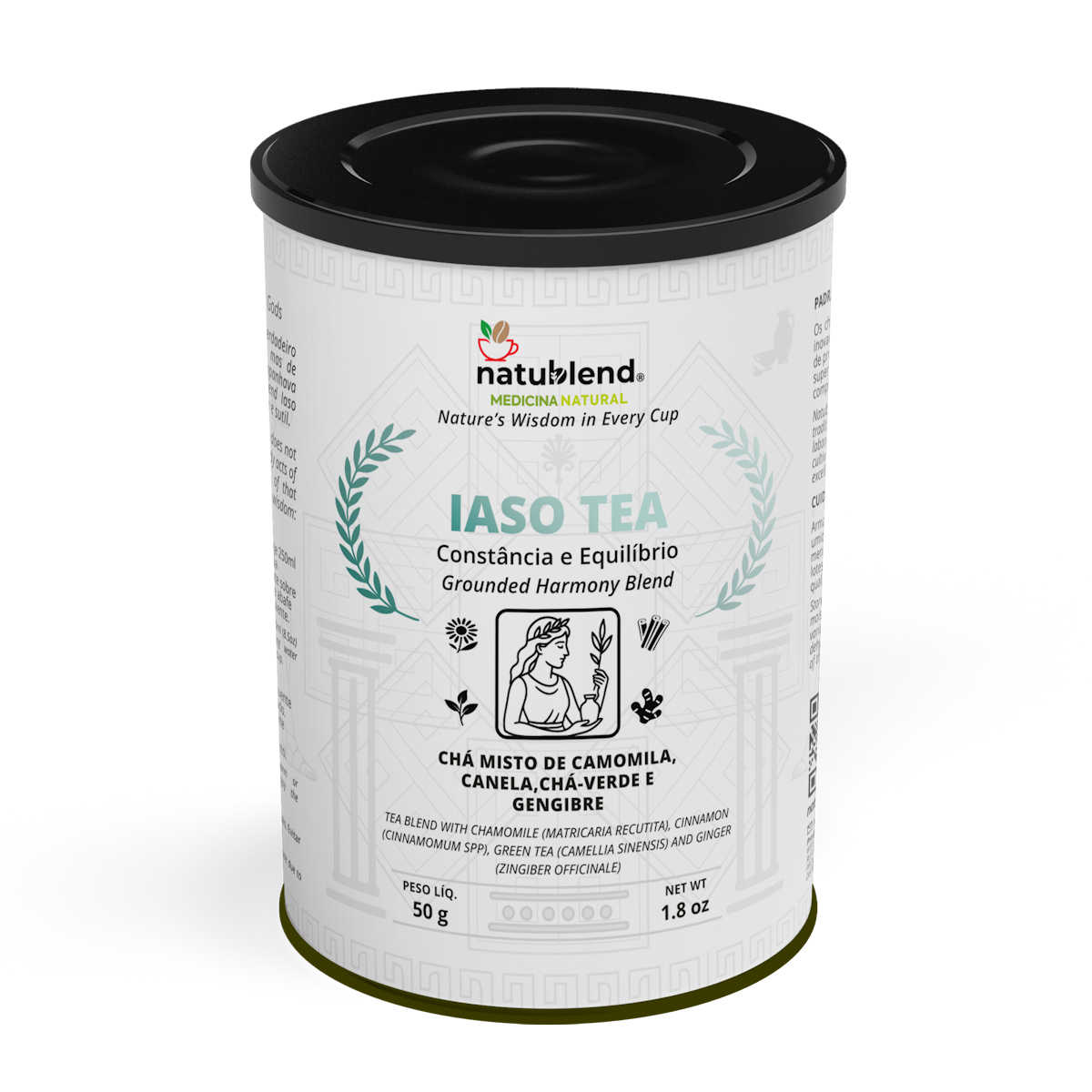
Iaso Tea brings together chamomile, cinnamon, ginger, and green tea in a 50 g tin from Natublend’s Sabedoria dos Deuses (Wisdom of the Gods) collection. Of the four, only green tea contains caffeine: it is the leaf of Camellia sinensis, whose journey is told in the article on the history of tea, from China to the Ribeira Valley. The other three are a flower, a bark, and a rhizome.
The name is a tribute to Iaso, a minor goddess of Greek mythology linked to the circle of Asclepius. Natublend suggests the blend for the first cup of the day.
Why Iaso
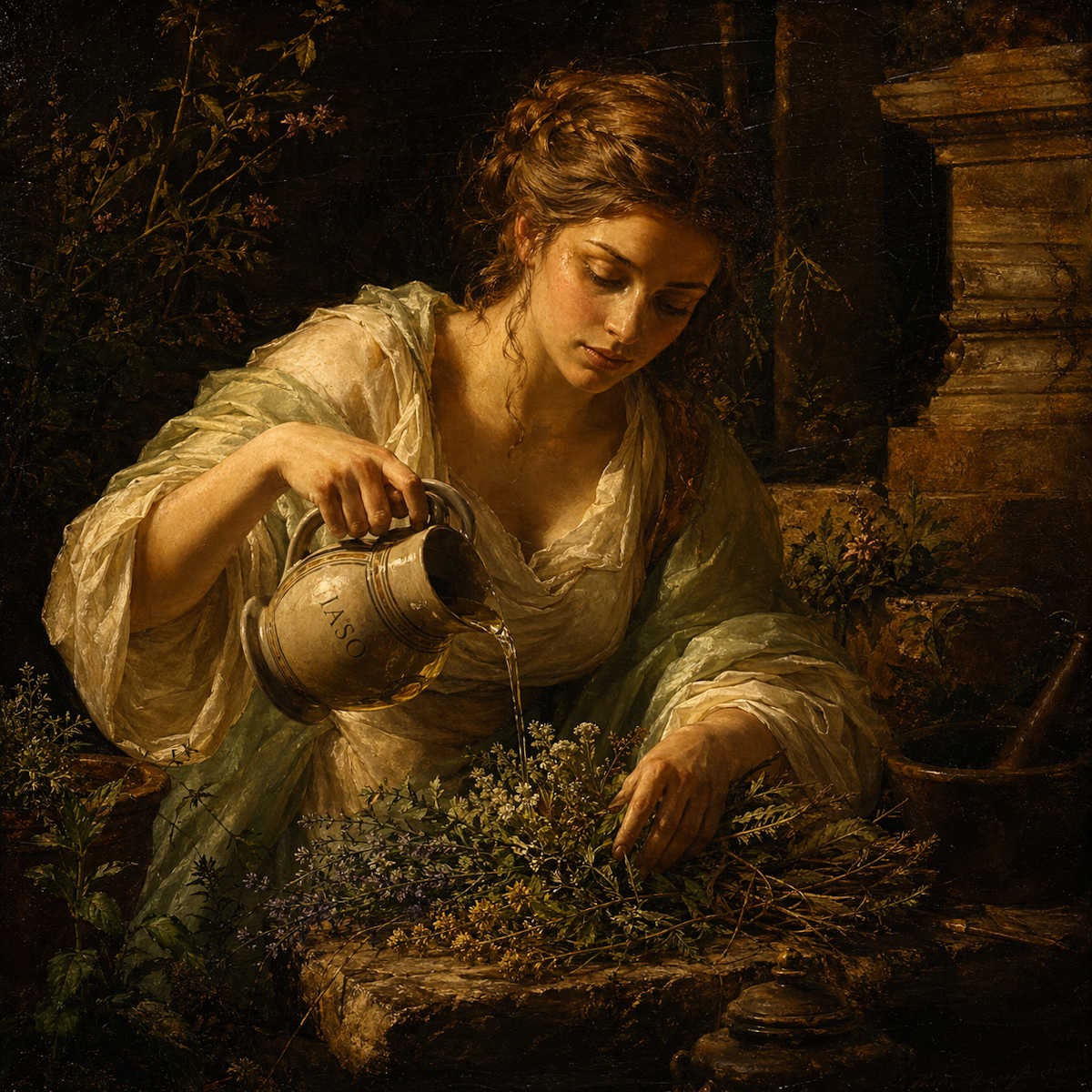
Iaso is a minor goddess in the circle of Asclepius, the Greek god of medicine. William Smith’s Dictionary of Greek and Roman Biography and Mythology describes her as the goddess of recovery, and her name derives from the Greek íasis (Theoi Project, n.d.). Aristophanes mentions her in his comedy Plutus, at line 701, as a daughter of Asclepius without naming her mother, and an inscription from Erythrae also includes her among the god’s children. The Byzantine lexicon known as the Suda lists her, alongside Hygieia and Panacea, among the daughters of Epione, the wife of Asclepius who gives her name to Epione Tea. Pausanias further records, at the sanctuary of Amphiaraus at Oropus, an altar whose fifth part she shares with Aphrodite, Athena Paeonia, Hygieia, and Panacea (Theoi Project, n.d.). Natublend chose the name as a tribute, and that is all it carries: a reference to mythology, not a description of the drink.
The Four Ingredients of Iaso
Cinnamon, which Natublend itself calls the most distinctive ingredient in Iaso, gets the full introduction here, while the stories of chamomile, ginger, and green tea are told in the articles on other blends, linked in each entry. According to the brand, everything goes into the tin in natura, whole rather than ground to a powder, with no artificial colorings, flavorings, or preservatives.
Cinnamon
The Iaso product page says only cinnamon, without naming the species, and the common name covers more than one tree. All of them belong to the genus Cinnamomum, in the Lauraceae family, and the same part is used from each, the dried bark, often sold rolled into sticks. Ceylon cinnamon is Cinnamomum verum J.Presl, native only to Sri Lanka according to POWO, which records the later introduction of the species to places such as southern India and Vietnam (POWO, n.d.). The old epithet zeylanicum, still seen on labels, preserves the colonial name of the island, Ceylon (World Agroforestry, n.d.).
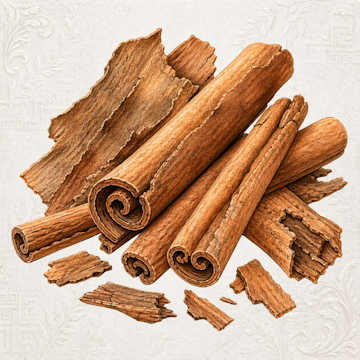
The cassias, for their part, include Chinese cassia, Cinnamomum aromaticum Nees, native from southeastern China to Vietnam (POWO, n.d.), and Indonesian cassia, Cinnamomum burmanni (Nees & T.Nees) Blume, common in the bulk cinnamon trade. With no species on the label, there is no way to say which of them is in the tin. What Natublend describes is the result in the cup: a warm, woody sweetness that the tea flavor wheel places in the spice family, alongside clove (Herbs & Kettles, n.d.), and that also pulls the color of the liquor toward reddish tones.
Chamomile
Chamomile is Matricaria chamomilla L., in the Asteraceae family, which POWO lists as native to Macaronesia, North Africa, and temperate Eurasia as far as Indochina; the blend uses the dried flower heads (POWO, n.d.). In Iaso, it opens the cup with a soft, sweetish floral note, the delicate base on which cinnamon and ginger later build. The story of the flower is in the article on Bacchus Tea.
Green Tea
The young leaf of Camellia sinensis (L.) Kuntze, in the Theaceae family, green tea is heated soon after harvest, which halts oxidation early and preserves its color (WSU Extension, n.d.). It is the source of the caffeine in Iaso and, according to the brand, the ingredient that keeps the blend from becoming too sweet, with a light vegetal astringency that leaves the finish clean. The full story of the plant is told in the article on Salus Tea.
Ginger
Ginger, Zingiber officinale Roscoe, in the Zingiberaceae family, goes into the blend as dried rhizome (POWO, n.d.). In Iaso, it shares the center of the cup with cinnamon and adds a spiciness that builds gradually; the sensory lexicon of Kim and colleagues points out that ginger also has citrus and sweet aromatics (Kim et al., 2018), which go well with the sweetness of cinnamon. The rhizome gets its own entry in the article on Epione Tea.
Sensory Profile
Aroma of the dry blend. According to Natublend, cinnamon announces Iaso as soon as the tin is opened, with a warm, woody aroma that is easy to recognize, and chamomile follows close behind as a soft floral base.
Aroma of the infusion. In hot water, cinnamon stays in front, now sweeter, while ginger tends to show its citrus side along with its heat and green tea adds a background of green leaf, with chamomile behind the spices.
Liquor color. Golden amber, warm-toned, and translucent, in the brand’s words, and deeper than that of a straight green tea, because cinnamon lends the liquor reddish tones.
Flavor. The attack is floral and sweetish, with chamomile setting the stage. On the mid-palate, cinnamon arrives with its woody sweetness and ginger joins in with a gradually building heat that stops short of burning. The finish is clean, marked by the light astringency of green tea, that subtle puckering in the mouth that sensory lexicons attribute to tannins (Monteiro et al., 2017); according to the brand, it is what keeps the cup from becoming heavy or cloying.
Body. The brand speaks of an elegant body, and in the cup it tends toward a medium-bodied liquor, more present than that of a straight green tea but still fluid. For the second infusion, at 83 °C (181 °F) for 5 minutes, Natublend describes a more intense, fuller-bodied cup, with cinnamon and ginger more pronounced.
How to Brew Iaso
Iaso is brewed at the same temperature as the other blends with green tea, and Natublend adds a note on steeping time to the recipe.
- Heat 200 ml of water to 80 to 85 °C (176 to 185 °F), below boiling point; without a thermometer, bring it to a boil and let it cool for 3 to 4 minutes.
- Place 2 g of the blend in an infuser or teapot and pour the water slowly over the ingredients.
- Cover right away and let it steep for 4 to 5 minutes: at 4, chamomile and cinnamon come through rounder and sweeter; at 5, the ginger deepens and the green tea gains structure.
- Strain without pressing the ingredients and serve without sugar, as the brand suggests.
- Reuse the same portion for one or two more infusions; for the second, Natublend recommends water at 83 °C (181 °F) for 5 minutes.
The difference between 4 and 5 minutes has a chemical explanation: aroma and flavor compounds leave the leaf before the tannins, which are extracted more slowly and increase with time and heat, bringing harshness and bitterness (Red Blossom Tea, n.d.). For a cold brew, the brand suggests 2 g in 200 ml of cold water, left for 6 to 8 hours in the refrigerator.
The Moment Natublend Suggests
Natublend places Iaso at the start of the day, as the first cup of the morning, and points out that the blend needs no sugar, since chamomile and cinnamon bring their own sweetness. For the rest of the day, the brand suggests the cold-brewed version, which can be left in the refrigerator overnight.
Because of the green tea, Iaso contains caffeine. The brand does not state the amount per cup, which varies with steeping time and temperature, and for anyone who already drinks coffee early in the day it is worth counting both drinks toward the day’s total. Natublend adds that the blend is not recommended for children under 12 without professional guidance.
Other Blends in the Collection
Iaso is one of the 15 blends in the Sabedoria dos Deuses collection, and two of them are directly connected to it. Bacchus Tea shares three ingredients with Iaso (chamomile, ginger, and green tea) and swaps cinnamon for peppermint, which moves the cup from woody notes to a minty finish. Epione Tea, which honors the goddess that tradition names as the mother of Iaso, keeps chamomile and ginger but has no green tea and no caffeine, and adds fennel and sage for an aniseed, herbaceous profile.
Frequently Asked Questions
How Much Caffeine Is in a Cup of Iaso?
Natublend does not state the amount, which depends on the green tea, the only source of caffeine in the blend, and changes with steeping time and temperature. Since green tea shares the tin with three caffeine-free ingredients, a 2 g serving of the blend is not equivalent to 2 g of straight green tea.
What Is Iaso Like as a Cold Brew?
It comes out different from the hot version, according to Natublend: with 2 g in 200 ml of cold water, for 6 to 8 hours in the refrigerator, the cinnamon becomes softer, chamomile and green tea gain presence, and ginger moves into the background.
Which Breakfast Dishes Go with Iaso?
Cinnamon and ginger are longtime partners in baking: baked apples, banana bread, honey cake, or oatmeal topped with cinnamon echo the notes in the cup. For those who prefer something savory, toast with butter and fresh cheese puts the woody sweetness of cinnamon in the foreground.
Where Does the Name Iaso Come From?
From Iaso, a minor goddess of Greek mythology, daughter of Asclepius and, according to the Suda lexicon, of Epione. Natublend chose the name as a tribute, as it did with the other deities in the line, and the name describes no property of the drink.
This content is informational and describes teas and infusions as foods. It does not replace professional health guidance. Pregnant women, breastfeeding women, children, and people undergoing medical treatment should consult a health professional before adding any infusion to their routine.
References
View All 11 Cited References
Peer-Reviewed Scientific Studies (1)
- PMC2018 KIM et al. A Lexicon for Descriptive Sensory Evaluation of Blended Tea. Preventive Nutrition and Food Science, vol. 23, no. 4, pp. 364-373, 2018. Available at: pmc.ncbi.nlm.nih.gov.
Institutional Sources (1)
- GOV WASHINGTON STATE UNIVERSITY EXTENSION. Tea Types and Home Processing. n.d. Available at: vegetables.wsu.edu.
Supplementary Readings (9)
- THEOI PROJECT. Asklepias Iaso. Theoi Greek Mythology, n.d. Available at: theoi.com.
- ROYAL BOTANIC GARDENS, KEW. Cinnamomum verum J.Presl. Plants of the World Online (POWO), n.d. Available at: powo.science.kew.org.
- WORLD AGROFORESTRY CENTRE. Cinnamomum verum. Agroforestree Database, n.d. Available at: worldagroforestry.org.
- ROYAL BOTANIC GARDENS, KEW. Cinnamomum aromaticum Nees. Plants of the World Online (POWO), n.d. Available at: powo.science.kew.org.
- HERBS & KETTLES. Tea Flavor Wheel. n.d. Available at: herbsandkettles.com.
- ROYAL BOTANIC GARDENS, KEW. Matricaria chamomilla L. Plants of the World Online (POWO), n.d. Available at: powo.science.kew.org.
- ROYAL BOTANIC GARDENS, KEW. Zingiber officinale Roscoe. Plants of the World Online (POWO), n.d. Available at: powo.science.kew.org.
- 2017 MONTEIRO, M. J. P. et al. Cross-cultural development of hibiscus tea sensory lexicons for trained and untrained panelists. Journal of Sensory Studies, vol. 32, no. 5, e12297, 2017. Table 3 available at: gala.gre.ac.uk.
- RED BLOSSOM TEA COMPANY. What Are Tannins in Tea. n.d. Available at: redblossomtea.com.