
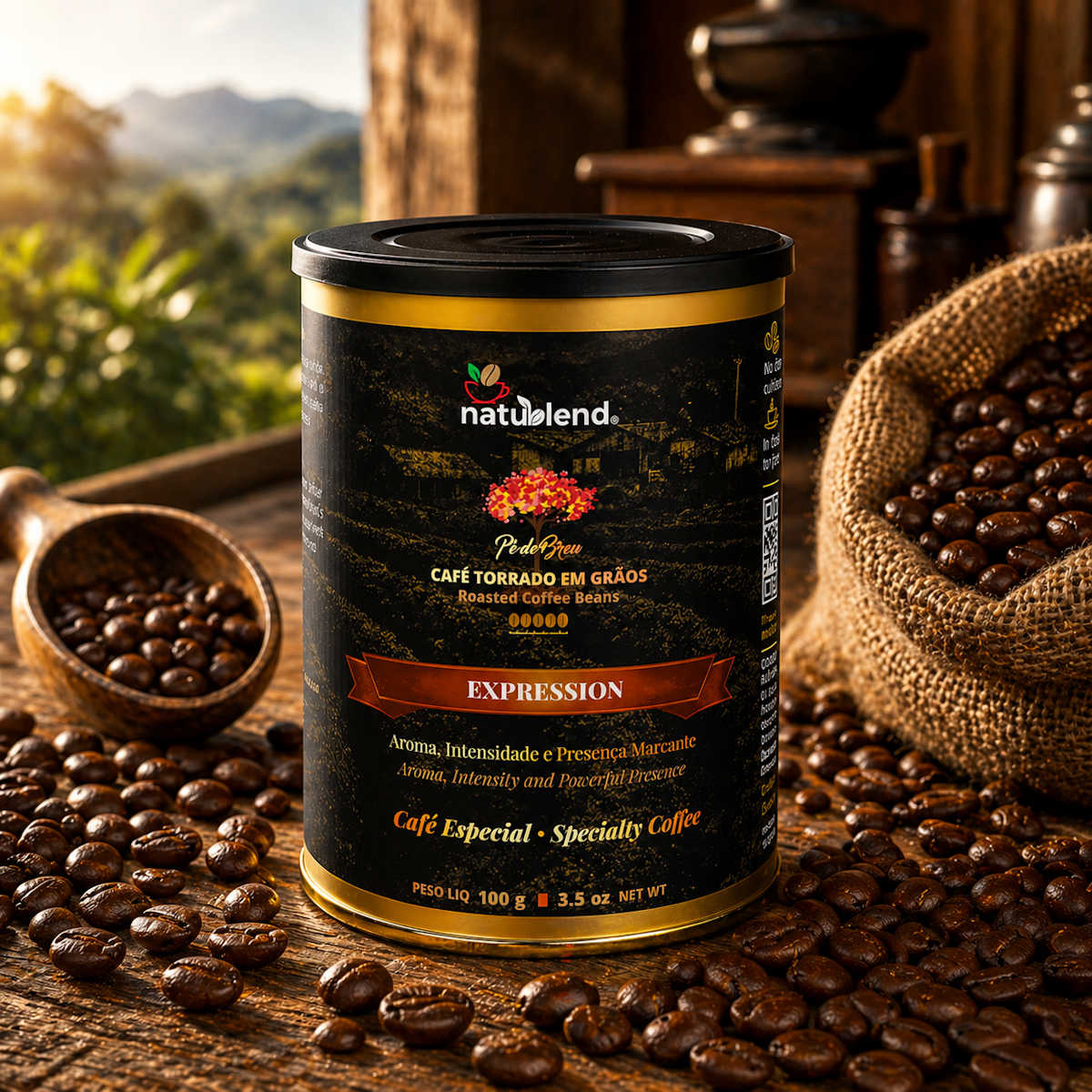
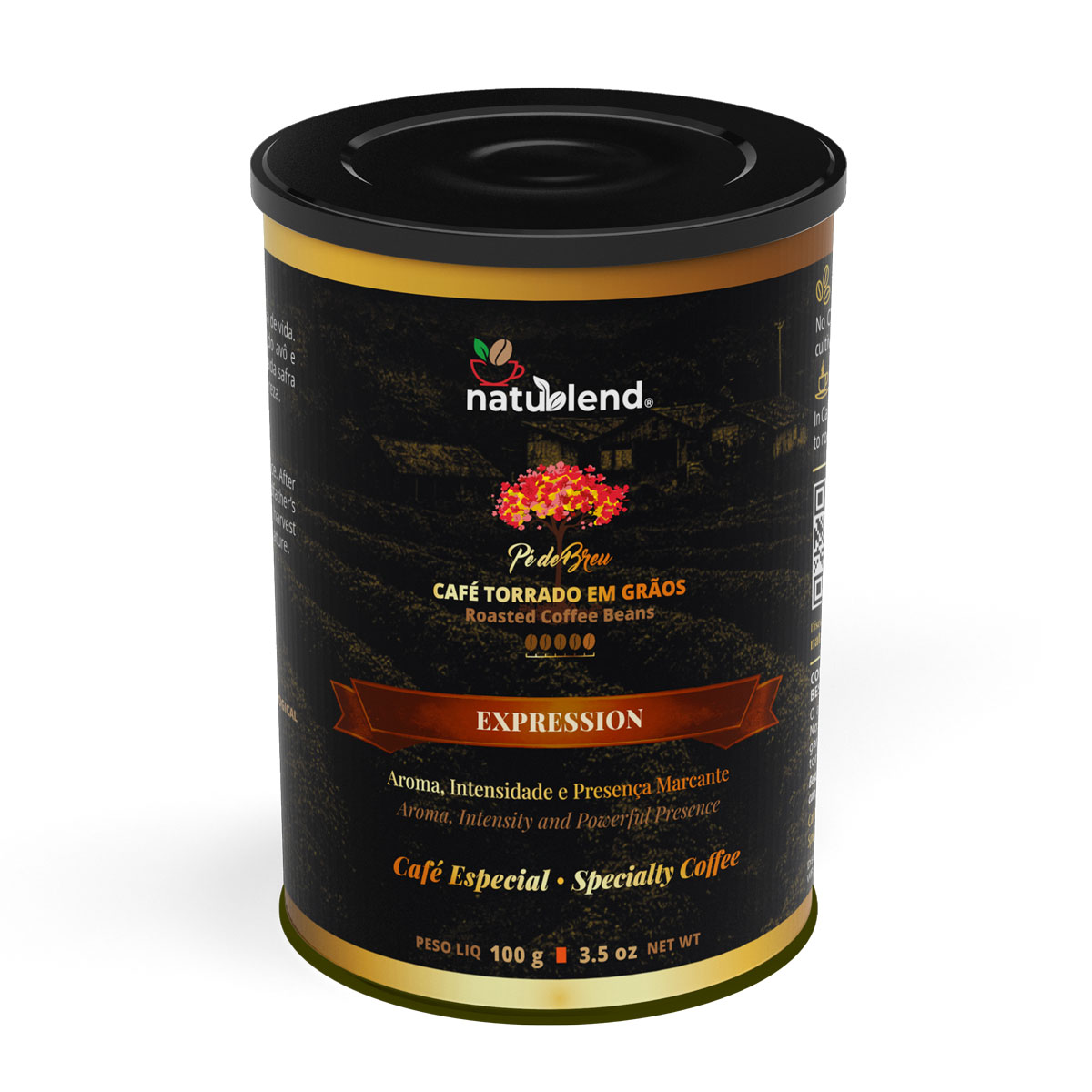
Cappuccinos and lattes call for a coffee that does not disappear into the milk, and it is for that cup, alongside straight espresso, that Natublend recommends Expression specialty coffee. On the brand’s sheet, it combines rich sweetness and a dense body under the motto printed on the tin, Aroma, Intensity and Powerful Presence, and the recommendation is to brew it under pressure, in an espresso machine or a moka pot.
The beans come from Sítio Pé de Breu, in Alto Caparaó, in the state of Minas Gerais, the same origin as Essence and Exaltation. The historical background of the mountains where this coffee is grown is covered in the history of coffee, from Ethiopia to Caparaó.
What to Expect in the Cup
On Natublend’s sensory sheet, which uses a five-point scale, Expression scores sweetness 4, body 4, bitterness 1, and acidity 4. It is the only one of the three Sítio Pé de Breu coffees in which sweetness and body both reach 4, and that pairing gives the cup a full, rounded feel, consistent with the powerful presence in its motto.
| Attribute | Score | What the Sheet Says |
|---|---|---|
| Acidity | 4 | Vibrant, plays off the aroma and sweetness |
| Bitterness | 1 | Almost imperceptible, even with the more developed roast |
| Body | 4 | Dense and pronounced, holds up in cappuccinos and lattes |
| Sweetness | 4 | Rich and present |
Rich sweetness is the trait that most sets Expression apart from the farm’s other two coffees, and the sheet credits it to the developed medium roast, which triggers caramelization without losing balance. The chemistry calls for a useful caveat: in brewed coffee, total sugar content drops sharply with roasting, from about 0.97 mg/ml in a light roast to 0.25 mg/ml in a medium one, yet the study’s authors note that perceived sweetness and sugar content are not strongly linked (Rune et al., 2023). The sweetness the palate registers therefore depends on more than the sugar that ends up dissolved in the cup.
Body, also at 4, is described as dense and pronounced. According to the sheet, it is what lets the coffee hold its own in cappuccinos and lattes and gives espresso a thick, consistent crema. Bitterness stays at 1, almost imperceptible even with the more developed roast, and acidity, at 4, comes through vibrant, playing off the aroma and sweetness.
Aroma, the first word of the motto, is not scored on the sheet, which rates only acidity, bitterness, body, and sweetness. It belongs to the brand’s positioning, and the most direct way to check it is to smell the grounds when you open the tin or right after grinding, and the cup before the first sip.
The Curation Behind Expression
The Chosen Origin
Expression comes from Sítio Pé de Breu, where the coffee grows between 1,000 and 1,400 meters, according to Natublend. The farm lies in Alto Caparaó, one of the 16 municipalities within the delimited area of the Caparaó Designation of Origin, recognized in 2021 by INPI, Brazil’s National Institute of Industrial Property (INPI, 2021). For a coffee positioned around aroma, altitude is a relevant factor: in the state of Espírito Santo, beans harvested at the highest elevations, up to 1,100 meters, produced a cup of superior sensory quality (Ferrão et al., 2009), and in the Serra da Canastra, in Minas Gerais, a study by the Federal University of Lavras (UFLA) with the participation of Embrapa Café reported improved acidity, aroma, and flavor above 1,300 meters (Embrapa Café, n.d.). These results come from other farms; they help put the origin in context without serving as a measure of this coffee.
Tasting Each Lot
According to Natublend, every lot is tasted and approved by the brand’s curators so that Expression keeps its profile from one harvest to the next. The sheet neither describes how this tasting is conducted nor gives a score. As a reference for what a professional taster looks at, the affective assessment of the Specialty Coffee Association (SCA), revised in 2024, splits the evaluation into eight attributes, each on a 9-point scale, and two of them deal with smell: fragrance and aroma (SCA, 2024). In a coffee whose motto starts with aroma, this is the attribute the tasting needs to find again in every lot.
The Roast Curve
The roast color, temperature, and time for Expression are left off Natublend’s sheet, which limits itself to stating the intent: a developed medium roast that triggers caramelization without losing balance and without pushing bitterness out of the almost imperceptible range.
The reactions involved are well documented. The Maillard reaction, between reducing sugars and amino acids, darkens the bean and creates much of its aroma: in a study of single-origin coffees, between 30% and 40% of the volatile compounds detected were formed mainly through this pathway. In parallel, caramelization acts on the sugars, and together the two reactions produce furan derivatives and compounds with caramel notes, such as furaneol and maltol (Zakidou et al., 2021). The limit is also known: when caramelization goes too far, the sugars burn, perceived sweetness drops, and bitter, burnt notes appear (Sucafina, n.d.). Developing the roast without crossing that point is the balance the sheet describes for Expression.
Small-Batch Roasting and Packaging
According to Natublend, Expression is roasted in small batches and packed in an airtight 100 g tin, which the brand describes as a barrier against light, moisture, and oxygen. Since this is a coffee designed for espresso, the timing of the grind matters: in a study published in the Journal of Agricultural and Food Chemistry, grinding released up to 75% of the gas trapped in the bean within seconds or a few minutes, whereas whole beans give off that proportion over weeks (Smrke et al., 2018).
Heat counts too. According to the SCA review on the staling of roasted coffee, degassing in ground coffee is about twice as sensitive to temperature as in whole beans (Sage, 2012). For anyone with an espresso machine at home, that argues against storing the opened tin on top of it, where heat builds up.
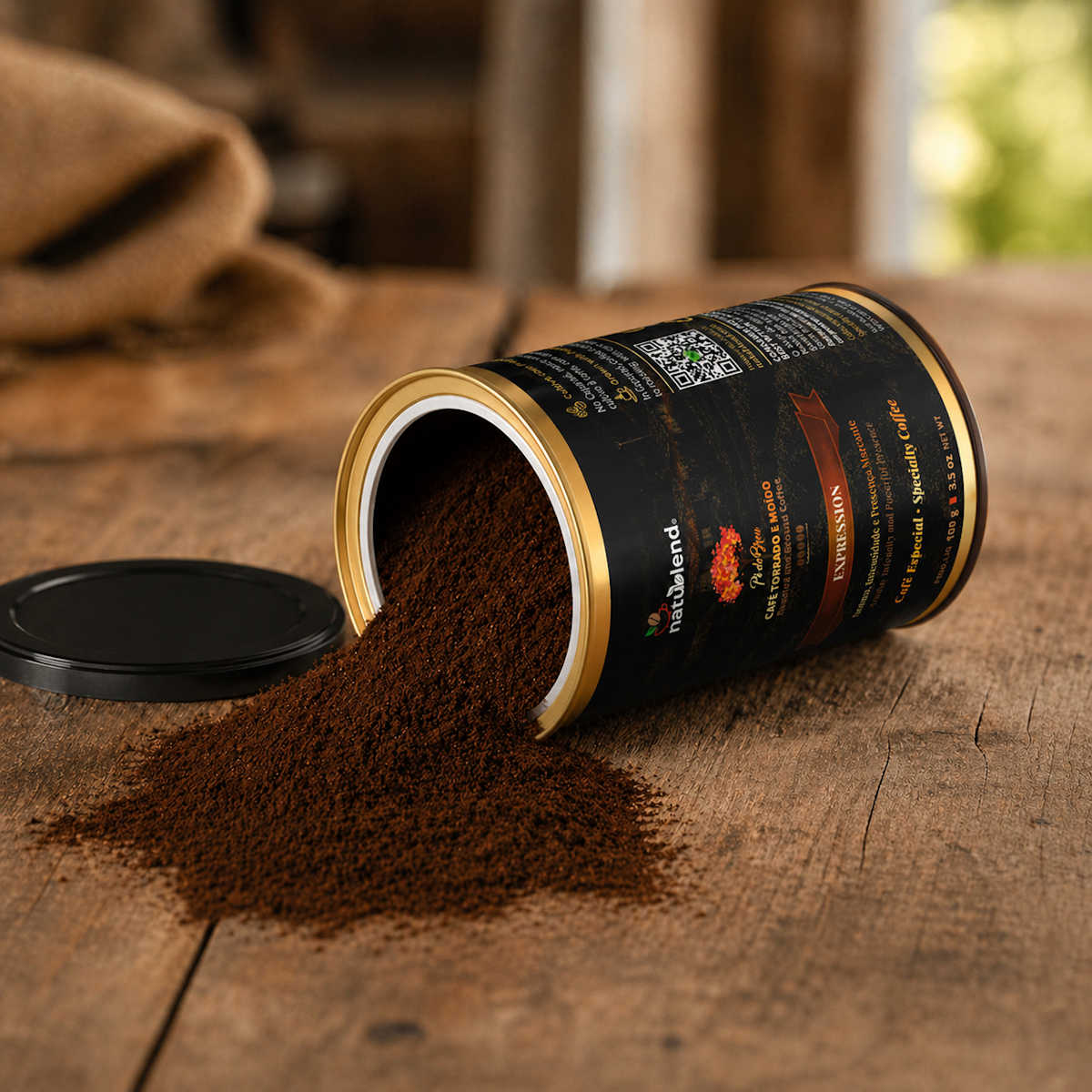
Anyone with an adjustable grinder at home may prefer the whole beans and grind them fresh, to the very fine setting the espresso recipe calls for. The motto and the text the brand uses to present Expression are on the Natublend specialty coffees page.
How to Brew Expression
The three methods on the Expression sheet rely on pressure or immersion, and the order below follows Natublend’s recommendation, with espresso first. In pressure extraction, the grind decides much of the result: in a study by the Zurich University of Applied Sciences (ZHAW) of 43 coffee capsules, the factor that most influenced extraction time was the proportion of fine particles below 100 micrometers, more than the average particle size (ZHAW, n.d.).
Espresso
| Parameter | Natublend Product Sheet |
|---|---|
| Grind | Very fine |
| Ratio | 18 g of coffee to 36 g of beverage |
| Temperature | 93 to 95 °C |
| Time | 25 to 30 seconds |
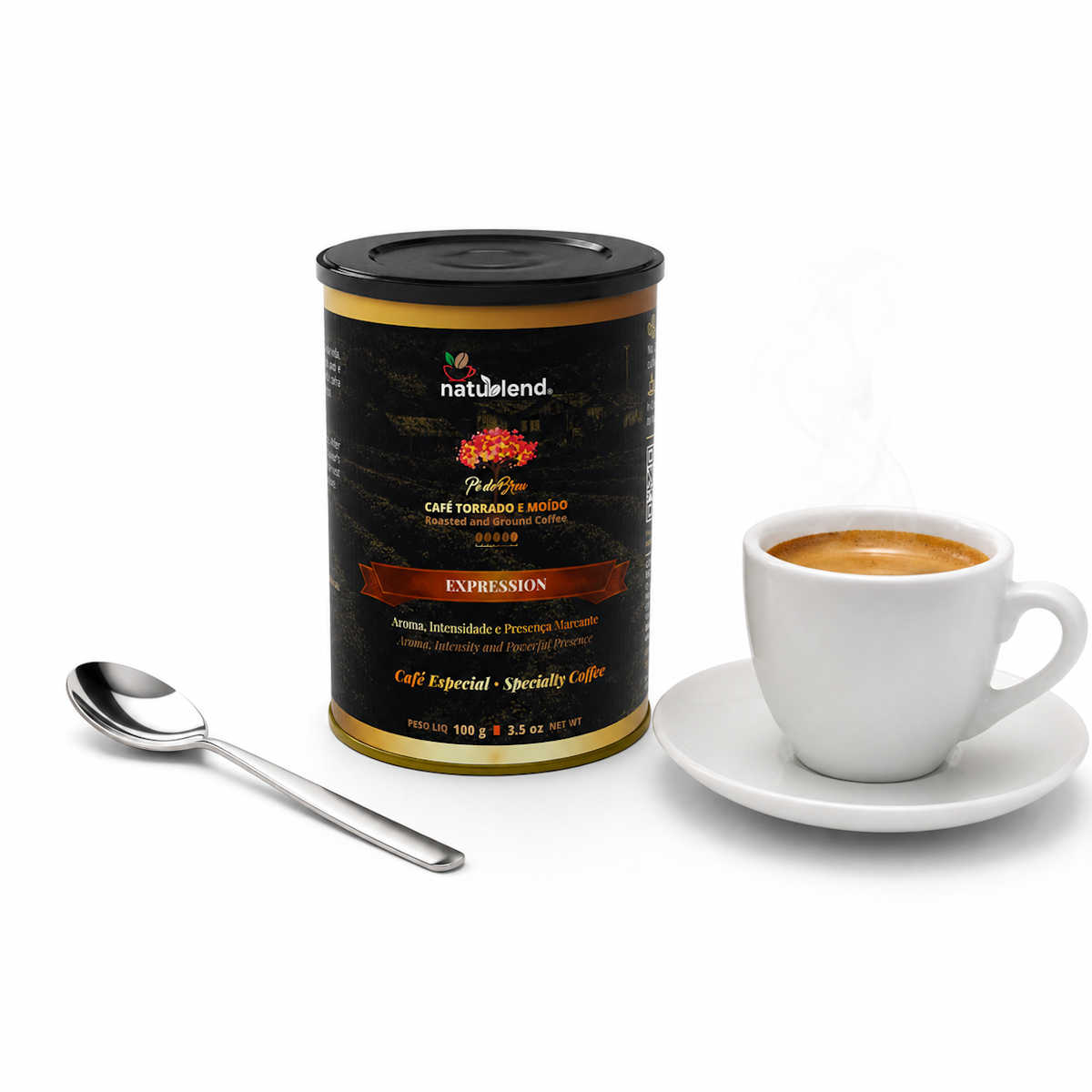
This is Natublend’s ideal method, and the note on the sheet explains why: 9 bar of pressure extracts the dense body of Expression. The recipe, 18 g of grounds for 36 g of beverage in 25 to 30 seconds, follows the 1:2 ratio the specialty coffee industry has adopted as a convention, with water between 90 and 96 °C and pressure of around 9 bar (Sage Appliances, n.d.). If the shot runs fast and the cup comes out sour and short, it is underextracted, and grinding slightly finer usually fixes it; if it runs slowly and turns bitter, extraction has gone too far (Coffee Hunter, n.d.). Once it is dialed in, an Expression espresso forms the thick, consistent crema the sheet describes.
Moka Pot
| Parameter | Natublend Product Sheet |
|---|---|
| Grind | Medium-fine |
| Ratio | Full filter basket |
| Temperature | Medium heat |
| Time | 4 to 5 minutes |
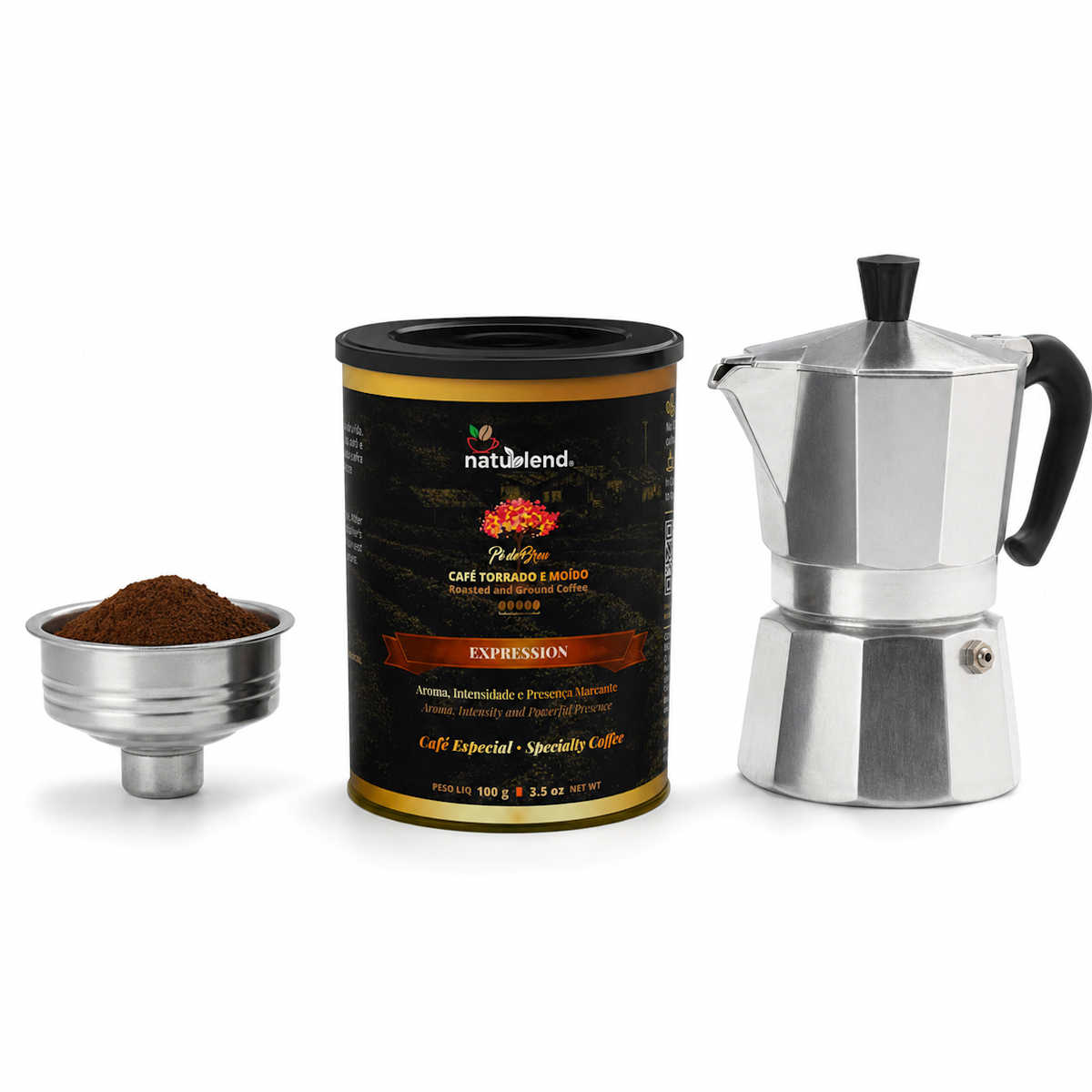
The moka pot, the Italian stovetop coffee maker, uses steam pressure and, according to Natublend, delivers a profile close to espresso for those without a machine. The recipe calls for a full filter basket of medium-fine Expression, medium heat, and 4 to 5 minutes. The brand’s tip is to pour already hot water into the base, which shortens the time the pot spends on the stove before the water rises through the grounds and makes it easier to control contact time, one of the five drivers of extraction according to ZHAW researchers (Wellinger, n.d.).
French Press
| Parameter | Natublend Product Sheet |
|---|---|
| Grind | Coarse |
| Ratio | 30 g of coffee to 500 ml of water |
| Temperature | 94 to 96 °C |
| Time | Exactly 4:00 minutes |
In the French press, the coffee steeps in the water and the filter is metal, which according to the sheet preserves the oils and delivers a full-bodied cup, consistent with the body score of 4 for Expression. A coarse grind reduces the contact area with the water and, without compensation, would tend toward underextraction (Coffee Circle, n.d.); in the press, the compensation comes from the immersion time, which the brand sets at exactly 4 minutes. At 30 g to 500 ml, it is the most practical method on the sheet for serving more than one person.
Essence, Exaltation, or Expression?
On Natublend’s sheet, the three Sítio Pé de Breu coffees have the same acidity (4) and the same bitterness (1). The difference lies in sweetness and body, and Expression is the only one that takes both to 4 at once, a profile the brand associates with espresso, the moka pot, and milk drinks. Essence sits at 3 on both attributes and was designed for paper-filter pour-overs such as the V60 and the Chemex, where lightness is the point. Exaltation pairs sweetness at 3 with body at 5, the top of the scale, and calls for slow methods to show its layers. For the morning espresso or the afternoon cappuccino, Expression is the way to go in this line; for an unhurried filtered cup, the other two are a better fit.
Frequently Asked Questions
Does Expression Work in Cappuccinos and Lattes?
Yes. Natublend’s sheet describes the body of Expression as dense and pronounced, scored at 4, able to hold up in cappuccinos and lattes, and its rich sweetness, also at 4, rounds out the profile the brand recommends for milk drinks.
Do I Need an Espresso Machine to Enjoy Expression?
No. The sheet offers two alternatives: the moka pot, with a full filter basket, a medium-fine grind, medium heat, and 4 to 5 minutes, which delivers a profile close to espresso, and the French press, with 30 g to 500 ml, a coarse grind, water between 94 and 96 °C, and exactly 4 minutes of immersion.
Does the More Developed Roast Make Expression Bitter?
According to Natublend’s sheet, no: the bitterness of Expression is scored at 1, almost imperceptible, even with the developed medium roast that triggers caramelization. In espresso, strong bitterness usually signals overextraction, which can be corrected by grinding slightly coarser (Coffee Hunter, n.d.).
Natublend’s Specialty Coffees
Expression shares the Natublend lineup with three other specialty coffees: Essence and Exaltation, also from Sítio Pé de Breu, and Golden Reserve.
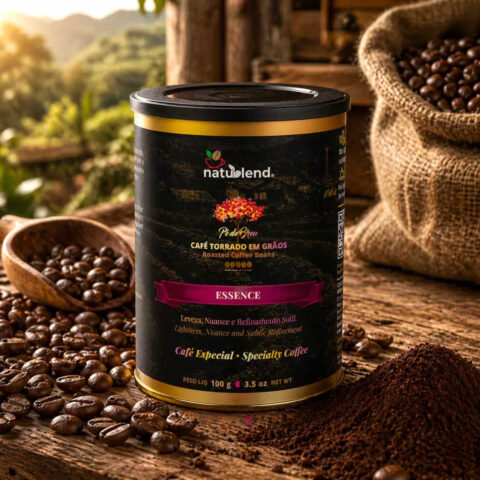
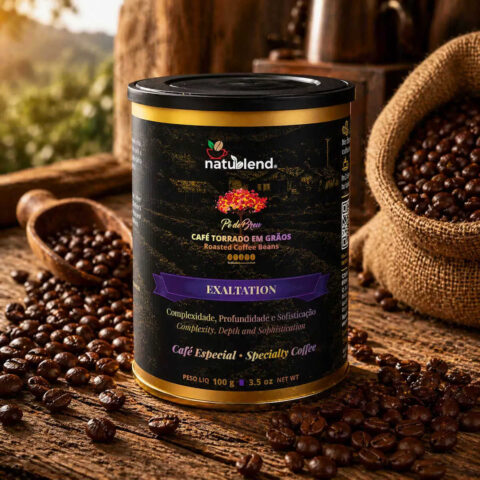
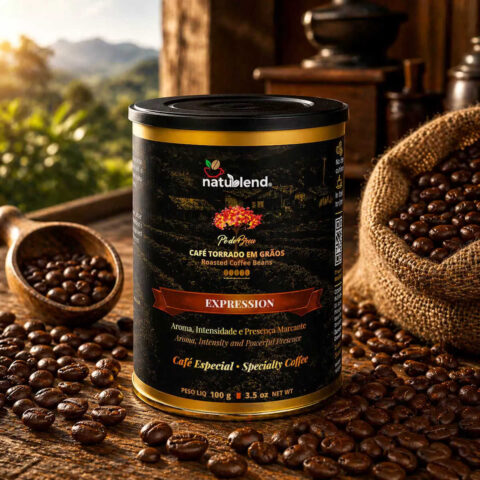
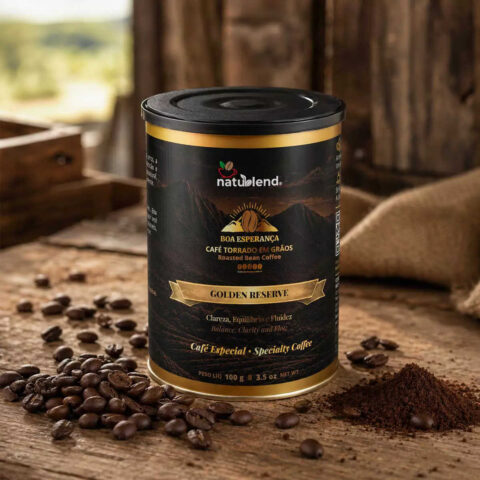
All four come in 100 g tins and can be compared side by side on the Natublend specialty coffees page.
References
View All 14 Cited References
Peer-Reviewed Scientific Studies (4)
- DOI2023 RUNE et al. Acids in brewed coffees: chemical composition and sensory threshold. Current Research in Food Science, v. 6, 100485, 2023. Available at: doi.org.
- PMC2021 ZAKIDOU, P. et al. Single Origin Coffee Aroma: From Optimized Flavor Protocols and Coffee Customization to Instrumental Volatile Characterization and Chemometrics. Molecules, v. 26, n. 15, 4609, 2021. Available at: pmc.ncbi.nlm.nih.gov.
- DOI2018 SMRKE, S. et al. Time-Resolved Gravimetric Method To Assess Degassing of Roasted Coffee. Journal of Agricultural and Food Chemistry, v. 66, n. 21, 2018. Available at: doi.org.
- PEER SAGE APPLIANCES. What is the best coffee water temperature? n.d. Available at: sageappliances.com.
Institutional Sources (3)
- GOV2021 INSTITUTO NACIONAL DA PROPRIEDADE INDUSTRIAL (INPI). Certificado de Registro de Indicação Geográfica nº BR412019000005-0: Caparaó, com Caderno de Especificações Técnicas. Rio de Janeiro, 2021. Available at: gov.br.
- GOV2009 FERRÃO, M. A. G. et al. Qualidade do café arábica em diferentes altitudes no Espírito Santo. In: VI Simpósio de Pesquisa dos Cafés do Brasil, Vitória, 2009. Available at: alice.cnptia.embrapa.br.
- GOV EMBRAPA CAFÉ; UNIVERSIDADE FEDERAL DE LAVRAS (UFLA). Influência da altitude em cafés. n.d. Available at: alice.cnptia.embrapa.br.
Supplementary Readings (7)
- 2024 SPECIALTY COFFEE ASSOCIATION (SCA). SCA Standard 104-2024: Coffee Value Assessment, Affective Assessment. 2024. Available at: sca.coffee.
- SUCAFINA. Chemical Reactions in Roasting. Sucafina Instant, n.d. Available at: instant.sucafina.com.
- 2012 SAGE, Emma. What is the Shelf Life of Roasted Coffee? A Literature Review on Coffee Staling. Specialty Coffee Association, 2012. Available at: sca.coffee.
- ZHAW DIGITAL COLLECTION. Study by Smrke et al. on the role of fine particles in espresso extraction. Zurich University of Applied Sciences, n.d. Available at: digitalcollection.zhaw.ch.
- COFFEE HUNTER. Understanding over, under and ideal extraction. n.d. Available at: coffeehunter.com.
- WELLINGER, Marco. The Five Drivers of Extraction. World of Coffee Europe, n.d. Available at: europe.worldofcoffee.org.
- COFFEE CIRCLE. Coffee Grind Size. n.d. Available at: coffeecircle.com.