
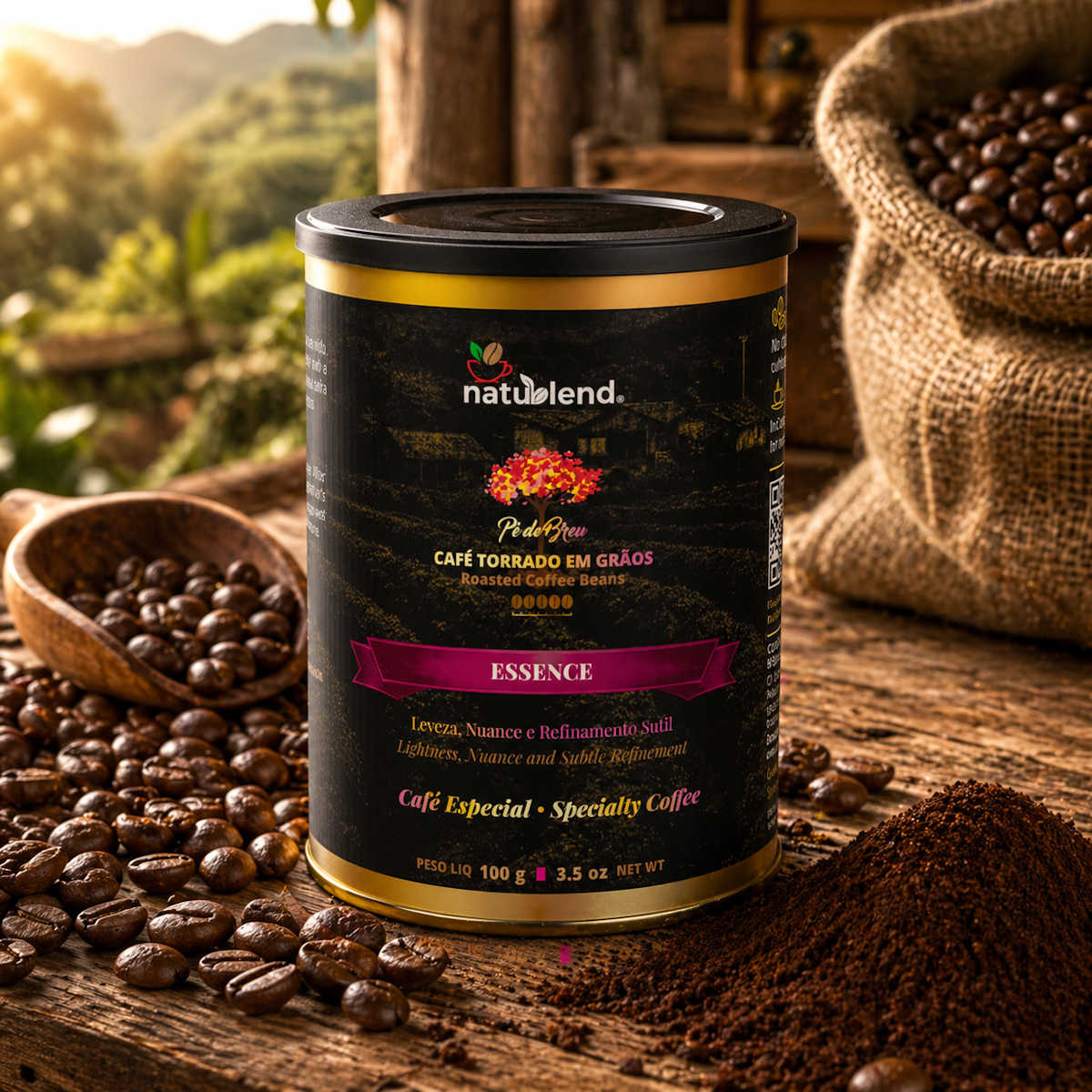
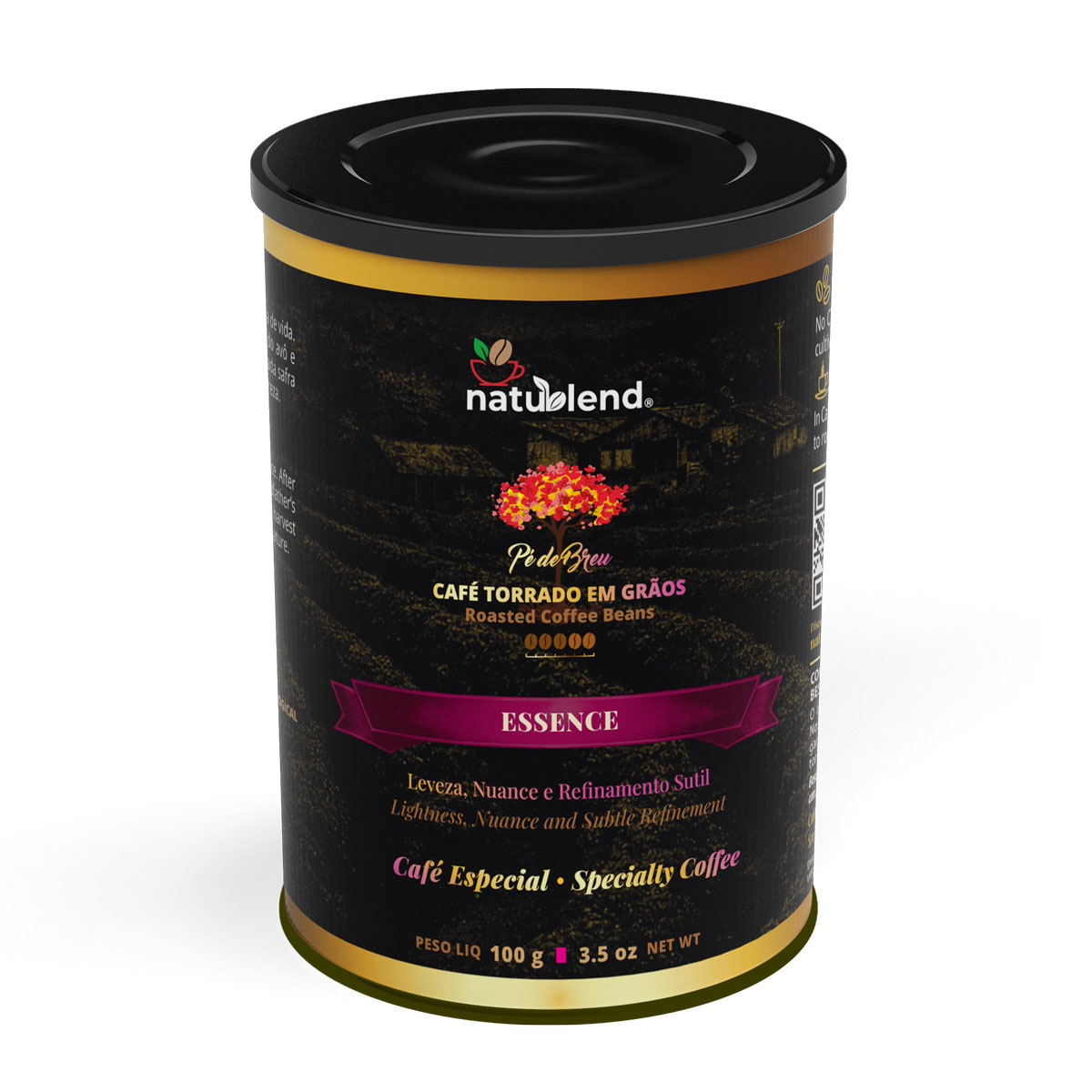
As Natublend describes it, Essence specialty coffee is the profile in the Pé de Breu line designed for light cups in which the notes unfold gradually: a medium, fluid body, natural sweetness without excess, and a bright citrus acidity that carries each sip. The brand sums up the idea in the motto printed on the tin, Lightness, Nuance and Subtle Refinement, and recommends the coffee above all for paper-filter pour-overs such as the V60 and the Chemex.
It comes from Sítio Pé de Breu, in Alto Caparaó, in the state of Minas Gerais, and, judging by the profile the brand describes, it suits people who already drink their coffee without sugar or who want to learn to recognize acidity as a mark of quality. To understand how these mountains made it onto the specialty coffee map, it is worth reading the history of coffee, from Ethiopia to Caparaó.
What to Expect in the Cup
Natublend’s sensory sheet rates Essence on a five-point scale: sweetness 3, body 3, bitterness 1, and acidity 4. With sweetness and body in the middle of the scale and bitterness almost absent, acidity takes the lead without masking everything else, a reading that fits the subtle refinement promised in the motto.
| Attribute | Score | What the Sheet Says |
|---|---|---|
| Acidity | 4 | Bright and vibrant, with a delicate citrus presence |
| Bitterness | 1 | Almost imperceptible |
| Body | 3 | Medium and fluid, supports each sip without taking over |
| Sweetness | 3 | Natural and present, without dominating |
On Essence’s own sheet, acidity is the highest-scoring attribute, and the brand describes it as bright and vibrant, with a delicate citrus presence. The chemistry of brewed coffee helps explain that wording: acids such as citric and malic acid are more concentrated in lighter roasts and decrease as the roast gets darker (Rune et al., 2023). The same researchers point out that perceived acidity is a broader concept than pH or the sum of the acids, because each acid has its own sensory threshold and flavor.
Sweetness sits at 3, present without dominating. Natublend attributes this natural sweetness to two factors: altitude, which according to the sheet concentrates sugars in the mucilage, and the medium roast, which preserves balance. Science partly supports the first point: in a study of arabica from southwestern Ethiopia, the sucrose content of green beans rose with altitude, but the effect was significant only in wet-processed beans (Worku et al., 2018). According to Natublend, Sítio Pé de Breu uses wet processing after the harvest, separating the bean from the pulp and mucilage, though the brand does not say which specific wet process it follows. Since the study looked at Ethiopian farms, the link works as background rather than as proof about this coffee.
Body, also at 3, is described as medium and fluid: it supports each sip without crowding the palate and leaves acidity and sweetness in plain view. Bitterness, scored at 1, is almost imperceptible, which suits anyone who drinks coffee black and does not want to mask bitterness with sugar.
The Curation Behind Essence
The Chosen Origin
Essence comes from Sítio Pé de Breu, where the coffee grows between 1,000 and 1,400 meters above sea level, according to Natublend. The farm lies in Alto Caparaó, one of the 16 municipalities within the delimited area of the Caparaó Designation of Origin, recognized in 2021 by INPI, Brazil’s National Institute of Industrial Property (INPI, 2021). It is this altitude range that the Essence sheet draws on to explain the natural sweetness that balances the citrus acidity in the cup.
Tasting Each Lot
According to Natublend, every lot is tasted and approved by the brand’s curators so that Essence keeps the same profile from one harvest to the next. The brand’s sheet does not give a cupping score, and it is worth knowing that the Specialty Coffee Association (SCA) itself no longer defines specialty coffee by a minimum score: under its 2024 standard, specialty coffee is coffee recognized for distinctive attributes that give it extra value in the market (SCA, 2024), whereas the old 100-point protocol used a cutoff of 80 (Royal Coffee, n.d.).
Natublend does not describe how this tasting is conducted, but if the criterion is consistency of profile, the sheet itself shows what should reappear with every harvest: in Essence, a delicate citrus acidity over a fluid body, without the sweetness growing heavy enough to mask the nuance the brand placed in the coffee’s motto.
The Roast Curve
Natublend’s sheet does not list the color reading, temperature, or time of the Essence roast. What it does state is the goal: a medium roast, managed to preserve the balance between natural sweetness and bright acidity.
Sensory research shows why this care matters in a coffee with a citrus profile. In a study published by the SCA, the lightest roast tested was perceived as having more acidity and dried fruit notes, while progressively darker roasts reduced acidity and fruitiness and increased bitterness, harshness, and roasted character (Alstrup, n.d.). Taking the roast too far would erase precisely the attributes that the Essence sheet puts up front.
Small-Batch Roasting and Packaging
Natublend says it roasts Essence in small batches and packs it in an airtight 100 g tin, which according to the brand protects the coffee from light, moisture, and oxygen. Of these factors, oxygen is the one the literature identifies as most important in the loss of freshness in roasted coffee, and oxidation of the bean’s fats proceeds faster in ground coffee, which exposes far more surface to the air than whole beans do (Sage, 2012).
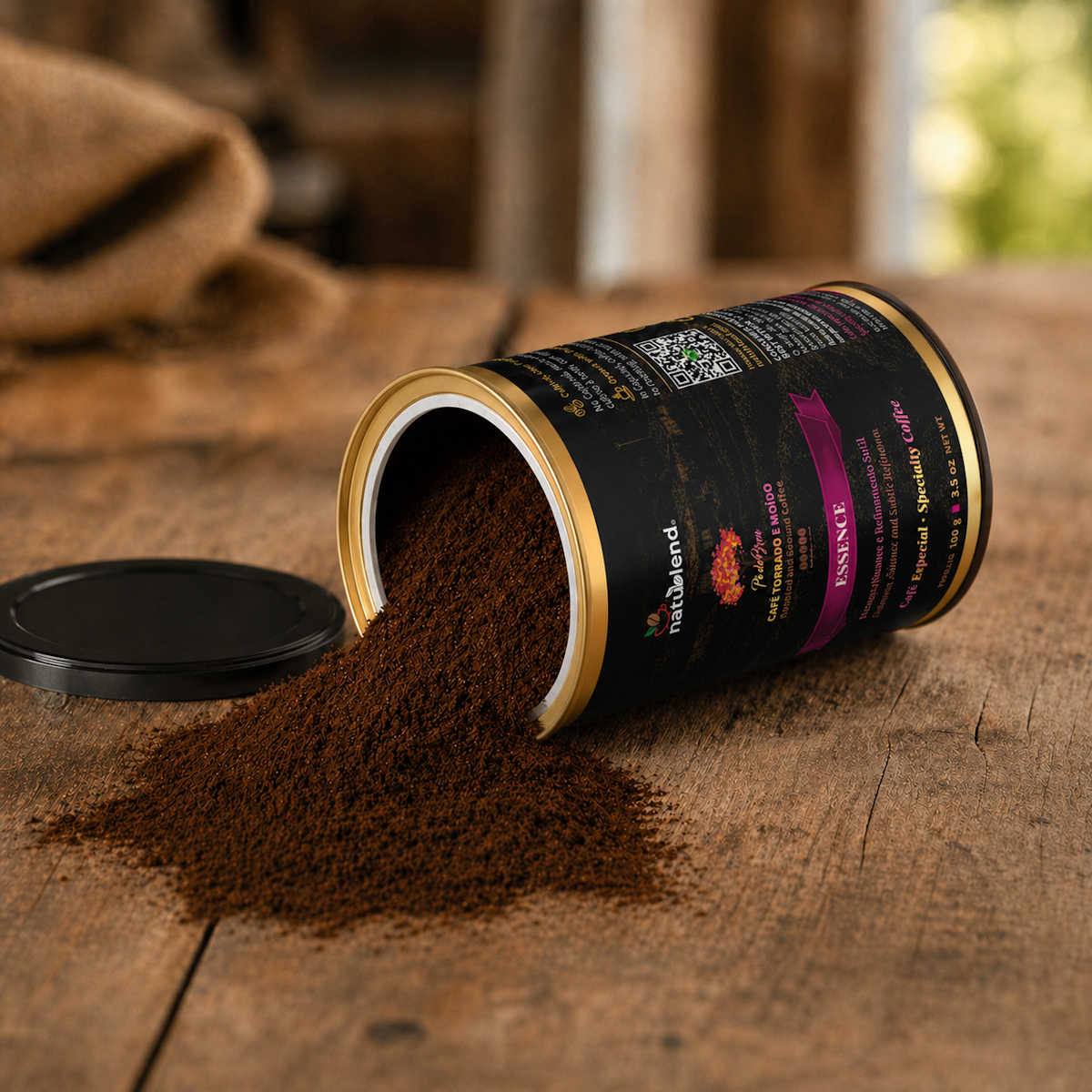
For Essence, which calls for a medium-fine grind in the V60 and a medium grind in the Chemex, the practical takeaway is straightforward: buying whole beans and grinding just before brewing keeps the freshness the cup’s nuances depend on for longer, while the ground version offers convenience, as long as the tin is closed tightly right after each use.
To place this choice within the full range, the Natublend specialty coffees page presents Essence alongside the other three coffees and summarizes the brewing methods, from pour-over to espresso.
How to Brew Essence
Natublend recommends Essence above all for paper-filter pour-overs, where the brand describes a transparent cup in the V60 and an even cleaner one in the Chemex. The parameters below come from the sheet, in the brand’s order of recommendation, and are meant as a starting point. Researchers at the Coffee Excellence Center of the Zurich University of Applied Sciences (ZHAW) sum up extraction in five drivers: coffee bed height, the concentration difference between water and coffee, grind size, temperature, and time (Wellinger, n.d.). Adjusting one at a time makes it easier to understand what changed in the cup.
V60
| Parameter | Natublend Product Sheet |
|---|---|
| Grind | Medium-fine |
| Ratio | 15 g of coffee to 250 ml of water |
| Temperature | 92 to 94 °C |
| Time | 2:30 to 3:00 minutes |
This is the method Natublend considers ideal for Essence because, according to the brand, extraction in an open cone reveals that transparent cup. The 15 g to 250 ml dose works out to 60 g per liter, within the 10% margin around the 55 g per liter of the SCA’s brewing reference for filter coffee, and the 92 to 94 °C range fits inside the 90.6 to 96.1 °C window of that same reference (Gear Patrol, 2018). If the cup comes out thin and sour, with a short finish, that points to underextraction, and the simplest fix is to grind a little finer; if it comes out bitter and astringent, extraction has gone too far (Coffee Hunter, n.d.).
Chemex
| Parameter | Natublend Product Sheet |
|---|---|
| Grind | Medium |
| Ratio | 30 g of coffee to 500 ml of water |
| Temperature | 93 to 95 °C |
| Time | 4:00 to 5:00 minutes |
In the Chemex, the ratio of 60 g per liter repeats at twice the volume, and the thicker paper filter, according to Natublend, holds back fine particles and oils and leaves the cup exceptionally clean, the version the brand recommends for tasting. The medium grind, slightly coarser than the V60’s, suits the slower filter: larger particles offer less contact surface and let the water pass through more quickly (Coffee Circle, n.d.).
Traditional Pour-Over
| Parameter | Natublend Product Sheet |
|---|---|
| Grind | Medium |
| Ratio | 7 to 8 g of coffee per 100 ml of water |
| Temperature | 92 to 94 °C |
| Time | 3:00 to 4:00 minutes |
This is the everyday method, the most accessible on the list, and it works with the drip cone you already have in the kitchen. The dose of 7 to 8 g per 100 ml is more generous than the V60’s 6 g per 100 ml and produces a more concentrated cup. It is worth sticking to the 92 to 94 °C range, because water that is too cool is among the classic causes of underextraction, which in Essence would show up as a sour acidity instead of a citrus one (Coffee Hunter, n.d.).
Essence, Exaltation, or Expression?
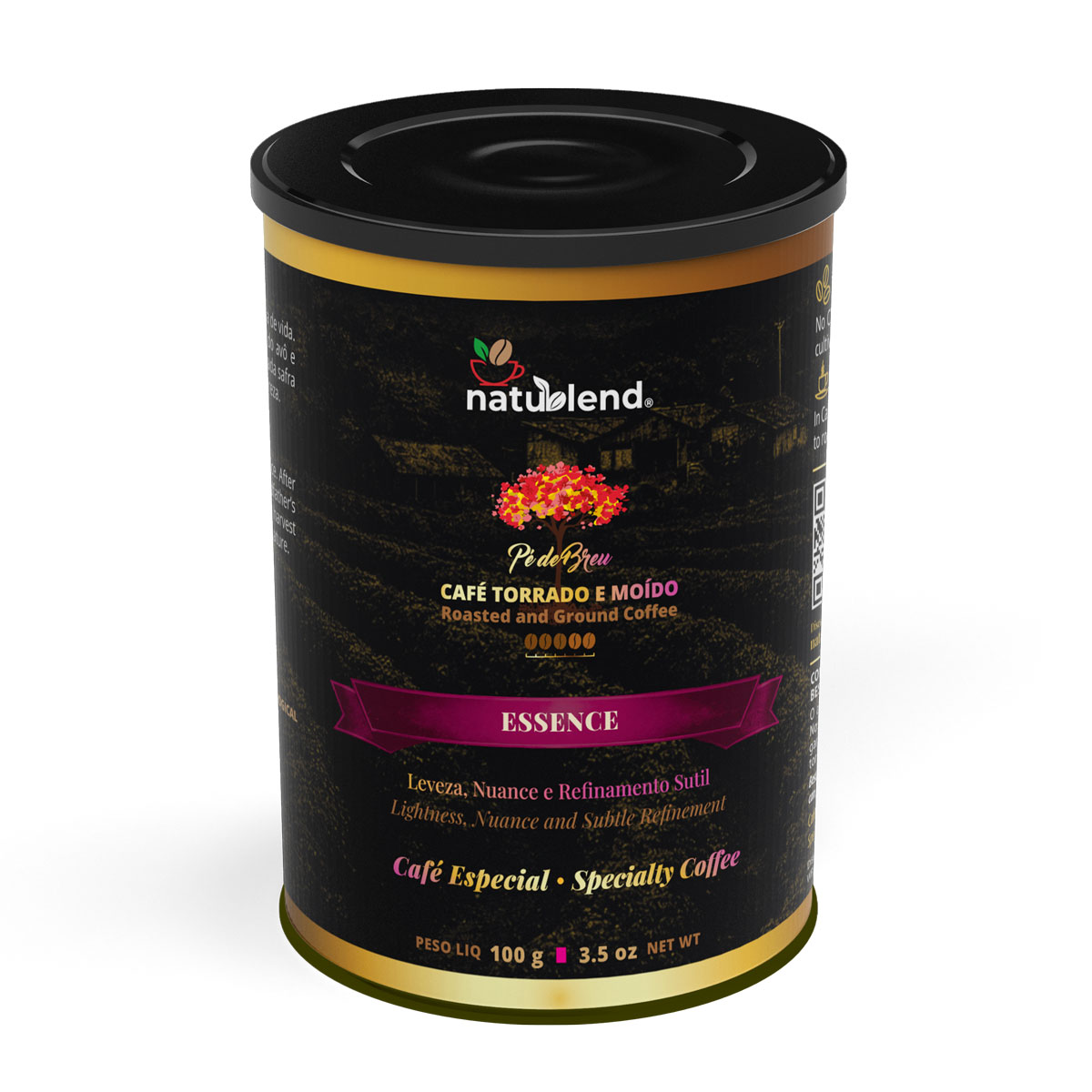
On Natublend’s sheet, the three Sítio Pé de Breu coffees share the same acidity (4) and the same bitterness (1); what sets them apart is sweetness, body, and, with them, the ideal brewing method. Essence sits on the light side of that comparison, with sweetness at 3 and body at 3, and was designed for the V60 and the Chemex. Expression takes sweetness and body to 4 and gains density for espresso, the moka pot, and milk drinks. Exaltation keeps the sweetness of Essence at 3 but raises body to 5, the top of the scale, and calls for slow brewing to show its layers. Anyone who wants to pick out each note clearly is well served by Essence; anyone looking for a velvety texture through the same paper filter will find the other end of the line in Exaltation.
Frequently Asked Questions
Is Essence a Good Choice for Specialty Coffee Beginners?
Going by Natublend’s sheet, it is a good entry point for people who already drink coffee without sugar: bitterness is almost imperceptible, scored at 1 on the sheet, the body is medium, and the sweetness is natural. The thing to watch is the citrus acidity, scored at 4, which may surprise those used to dark-roast coffees. Natublend’s V60 recipe is a good place to start.
Can You Brew Essence with a Regular Drip Cone at Home?
Yes. Natublend’s sheet includes a traditional pour-over recipe, with 7 to 8 g of coffee for every 100 ml of water, a medium grind, water between 92 and 94 °C, and 3 to 4 minutes of brewing. The cup comes out more concentrated than the V60’s, which uses 6 g per 100 ml.
How Do the V60 and the Chemex Differ for Essence?
The V60 is the method the brand considers ideal: with 15 g to 250 ml, a medium-fine grind, and 2:30 to 3:00 minutes, the open cone reveals a transparent cup. The Chemex uses 30 g to 500 ml, a medium grind, and 4 to 5 minutes, and its thicker filter holds back fine particles and oils, leaving an exceptionally clean cup recommended for tasting.
Natublend’s Specialty Coffees
Besides Essence, Natublend offers three other specialty coffees: the two sister profiles from Sítio Pé de Breu, Exaltation and Expression, and Golden Reserve.
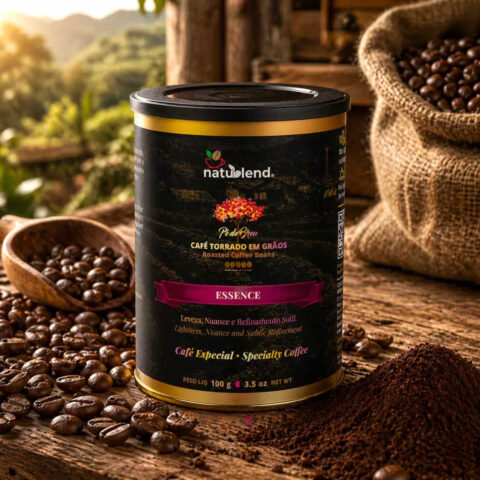
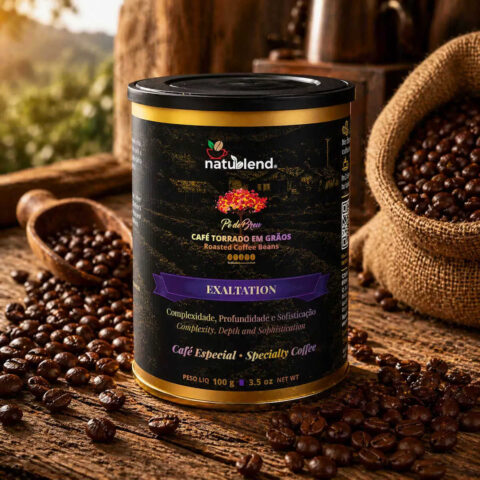
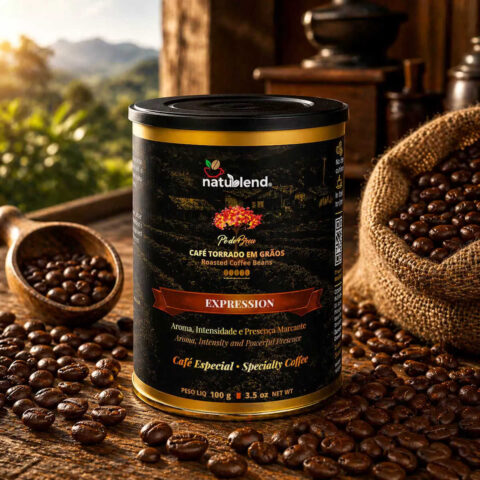
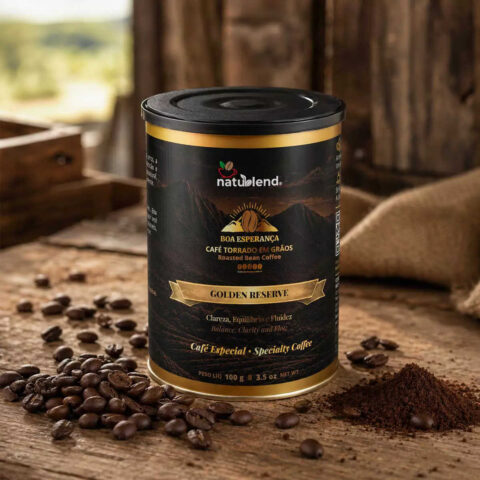
All four come in 100 g tins and can be compared side by side on the Natublend specialty coffees page.
References
View All 11 Cited References
Peer-Reviewed Scientific Studies (2)
- DOI2023 RUNE et al. Acids in brewed coffees: chemical composition and sensory threshold. Current Research in Food Science, v. 6, 100485, 2023. Available at: doi.org.
- DOI2018 WORKU, M. et al. Effect of altitude on biochemical composition and quality of green arabica coffee beans can be affected by shade and postharvest processing method. Food Research International, v. 105, 2018. Available at: doi.org.
Institutional Sources (1)
- GOV2021 INSTITUTO NACIONAL DA PROPRIEDADE INDUSTRIAL (INPI). Certificado de Registro de Indicação Geográfica nº BR412019000005-0: Caparaó, com Caderno de Especificações Técnicas. Rio de Janeiro, 2021. Available at: gov.br.
Supplementary Readings (8)
- 2024 SPECIALTY COFFEE ASSOCIATION (SCA). SCA Standard 104-2024: Coffee Value Assessment, Affective Assessment. 2024. Available at: sca.coffee.
- ROYAL COFFEE. Scoring Specialty Coffee: What Do the Numbers Mean? n.d. Available at: royalcoffee.com.
- ALSTRUP, Jesper. Modulating Perception. 25 Magazine, n. 5. Specialty Coffee Association, n.d. Available at: sca.coffee.
- 2012 SAGE, Emma. What is the Shelf Life of Roasted Coffee? A Literature Review on Coffee Staling. Specialty Coffee Association, 2012. Available at: sca.coffee.
- WELLINGER, Marco. The Five Drivers of Extraction. World of Coffee Europe, n.d. Available at: europe.worldofcoffee.org.
- 2018 GEAR PATROL. Best Coffee Makers According to SCA. 2018. Available at: gearpatrol.com.
- COFFEE HUNTER. Understanding over, under and ideal extraction. n.d. Available at: coffeehunter.com.
- COFFEE CIRCLE. Coffee Grind Size. n.d. Available at: coffeecircle.com.